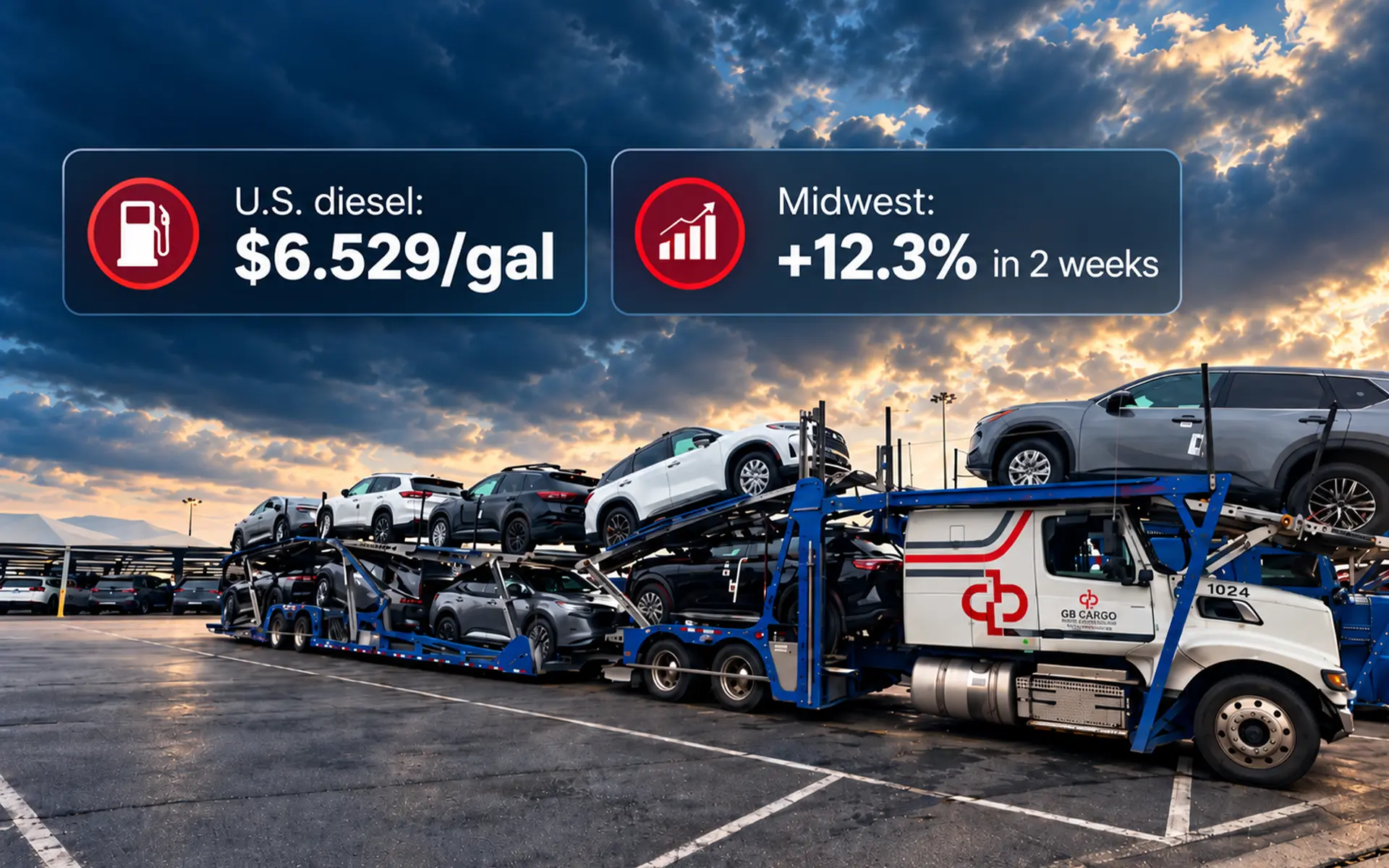
$100K per Year: The Hidden Floorplan Cost of Slow Vehicle Transportation
Slow inbound car transportation silently drains dealer floorplan budgets. See the per-vehicle math, the $100K annual gap, and what carrier performance actually controls.

Your floorplan interest started accruing before that truck left the rail yard. That is not a billing error. It is standard industry practice. The moment your OEM’s captive finance arm wires funds to the manufacturer — typically at or near the time a vehicle ships from the factory — the interest clock begins ticking on your revolving credit line. Not when the vehicle rolls off the carrier at your lot. Not when your team completes the PDI (Pre-Delivery Inspection). When the lender disburses.
For most dealership operations directors and GMs, carrier selection lives in the freight budget. You compare per-unit bids, pick the lowest reasonable option, and move on. Meanwhile, a slower carrier is silently burning through your floorplan credit window on vehicles you cannot display, photograph, list online, or sell. A 7-day difference in transit performance across 150 vehicles per month translates to roughly $100,000 per year in avoidable floorplan cost — and most dealers have never isolated that number because it doesn’t appear on a single line item.
This article breaks down exactly how inbound car transportation timelines affect your floorplan math, where the real money leaks, and why the cheapest carrier bid is often the most expensive decision on your P&L.
The mechanics of floorplan financing are straightforward: a revolving line of credit lets your dealership purchase inventory without paying cash upfront. The lender — whether an OEM captive like Ford Credit or GM Financial, or an independent provider like NextGear Capital — advances funds directly to the seller. You carry the debt per unit, and when the vehicle sells, you remit principal plus accrued interest. The credit line reopens.
What is less straightforward is when that interest starts. In the prevailing U.S. model, the clock begins at the moment of fund disbursement — which occurs when the OEM’s system generates an invoice and requests payment from the lender. For most manufacturers, that happens when the vehicle is built and released to transport. GM, for example, invoices dealers right after production, while the vehicle is going onto the carrier. The result: a vehicle that takes 14 days to travel from factory to your lot has already accumulated 14 days of interest before you can even park it on the frontline.
At current rates, most floorplan lines price at SOFR (Secured Overnight Financing Rate — the benchmark that replaced LIBOR) plus 200–400 basis points, translating to effective annual rates of roughly 5.5–8% depending on dealer creditworthiness. Using a mid-range blended rate of 6.5% on a $45,000 pickup truck:
That $8.01 figure aligns closely with vAuto’s industry benchmark of $7.90 per vehicle per day for new vehicles in Q1 2025 — a number that reflects weighted averages across the full inventory mix, from compact sedans to full-size trucks.
A persistent myth in dealership operations is that new-vehicle floorplans come with an interest-free window of roughly six months. This conflates two distinct mechanisms. OEM floorplan credits — direct payments from manufacturers to dealers — are designed to offset interest expense, not eliminate it. The interest accrues in full from day one. The credit reimburses part or all of it, up to a cap.
When the credit runs out, you bear the full unsubsidized cost. And every transit day eats into that credit budget before the vehicle generates a single dollar of revenue.
The math that builds to $100,000 is straightforward, and every input is verifiable against public industry data.
Consider a franchised dealership receiving 150 new vehicles per month — a reasonable volume for a high-performing single-point store or a mid-tier group location. Average invoice price: $45,000. Floorplan rate: 6.5%.
The formula: 150 vehicles × $8.01/day × transit days. The 7-day gap between a 10-day and 17-day average carrier produces $100,932 in additional annual floorplan cost — attributable entirely to the difference in carrier performance. This calculation assumes no OEM floorplan credit offset, which means the gross exposure is real even if credits partially mitigate the net impact.
Where does the 10-day vs. 17-day range come from? Industry transit benchmarks for domestic factory-to-dealer delivery range from 7 to 21 days, with 10–14 days as a common baseline for moderate-distance routes. Cross-country deliveries or peak-season congestion routinely push into the upper range. The spread between a well-managed carrier relationship and a lowest-bid alternative is frequently 5–7 days — which is exactly the gap that produces six-figure annual cost differences.
Most dealers facing rising floorplan pressure respond by cutting advertising spend, repricing aggressively, or pushing for larger OEM incentives. These are reactive measures that address symptoms. The transit-time lever is different: it is controllable, it is upstream, and it directly reduces the number of days each vehicle sits on a floorplan with zero revenue potential.
The damage compounds when OEM floorplan credits are structured as fixed amounts rather than per-day reimbursements — a structural shift that several major OEMs have made in recent years, moving from days-based interest reimbursement to flat percentage-of-MSRP credits.
Here is what that looks like in practice. On a $45,000 MSRP vehicle with a flat 1.25% credit, the dealer receives approximately $562.50 in floorplan assistance. At $8.01 per day in carrying cost, that credit covers roughly 70 days of interest. Now consider: a 14-day transit consumes 20% of that credit budget before the vehicle reaches the lot. A 21-day transit consumes 30%.
If the vehicle then takes 45 days to sell — a reasonable expectation at current days’-supply levels of 75–83 days across the industry — the dealer’s total interest exposure is roughly 66 days ($528.66), nearly exhausting the entire credit. Shaving transit from 21 to 10 days leaves $88 more credit headroom and ensures the vehicle spends more of its floorplan budget in retail-ready, saleable condition.
Curtailment timing amplifies this further. Curtailments are mandatory principal reduction payments triggered when a vehicle reaches a specific age on your floorplan — typically at 60–90 days for the first principal reduction. If 14 of those days are consumed in transit, the dealer effectively has 76 days of lot time before the curtailment trigger, not 90. For slower-moving models — luxury trims, specific configurations with limited buyer pools — that compression can be the difference between selling within the initial term at full margin and being forced into a curtailment payment, aggressive repricing, or wholesale disposal.
Transit time is only one component of the total dead-time window — the days during which the floorplan clock runs but the vehicle generates zero revenue opportunity. The full equation:
Transit days + lot-prep days = total pre-revenue floorplan exposure
After a vehicle arrives at the dealership, it must clear PDI, get photographed for online listings, have any accessories or protection packages installed, and be physically staged on the frontline. Industry guidance from vAuto recommends a target of under 48 hours from arrival to frontline-ready status — a target that implies many dealerships currently exceed it.
If transit consumes 14 days and lot prep adds another 3–5 days, the dealer is 17–19 days into a floorplan term before the first buyer can see the vehicle. On a 90-day initial term, that leaves barely 70 days of actual selling time. Every additional transit day compresses selling time, accelerates curtailment pressure, and reduces the financial return per unit of floorplan capital deployed.
The net floorplan expense per new vehicle at franchised dealerships reached $487 per unit in Q1 2025 — up 35% year over year. If transit days account for 10–15 of a vehicle’s average days’ supply, transit-period interest represents roughly 12–20% of total floorplan exposure per vehicle. For a 150-unit-per-month dealer, that is $8,700–$14,550 per month in transit-driven carrying cost. It is a meaningful line item that is fully controllable through carrier selection.
Here is the uncomfortable truth that the industry’s procurement culture systematically avoids: the lowest per-unit transport bid almost never produces the lowest total cost of inbound inventory.
The conventional approach is intuitive. You receive three bids for your inbound car transportation. You pick the lowest per-unit price, perhaps $50–$75 cheaper per vehicle. The freight budget looks good. But that savings is visible, and the cost it creates is invisible — buried across floorplan interest accruals, compressed credit windows, missed curtailment timelines, and extended days-to-frontline metrics that nobody traces back to the carrier.
Run the math on a concrete scenario. A faster, more reliable carrier costs $75 more per vehicle but delivers an average of 5 fewer transit days. At $8.01 per day, those 5 days represent $40.05 in floorplan savings. The net premium is $34.95 per vehicle. But that analysis captures only the direct interest delta. It does not capture the indirect benefits: fresher inventory with less depreciation exposure, better pricing power, fewer curtailment events, stronger credit line utilization, and the ability to list vehicles online sooner in a market where digital-first shoppers are making shortlists before they visit a lot.
The correct optimization framework is not per-unit freight cost. It is total floorplan exposure per unit, which includes transit days, lot-prep days, days to first retail contact, and days to sale. The carrier controls the first variable directly and influences the second through documentation and predictable scheduling.
A counterintuitive finding from the research: a carrier with a slightly longer average transit time but tighter variance is more financially manageable than one with a lower average but wide swings. A carrier that delivers in 12–14 days every time lets you plan curtailment calendars, pre-schedule PDI crews, and coordinate online listings. A carrier that averages 11 days but occasionally delivers in 22 creates staffing chaos, lot-prep backlogs, and unpredictable floorplan exposure that you cannot budget around.
When evaluating carriers, ask for variance data, not just average transit time. The standard deviation of delivery windows tells you more about your floorplan exposure than the mean.
Every hour a vehicle sits at a rail yard or plant lot with the floorplan clock running and no transit progress is a cost with zero return. This dwell time is one of the most common — and most controllable — sources of transit delay.
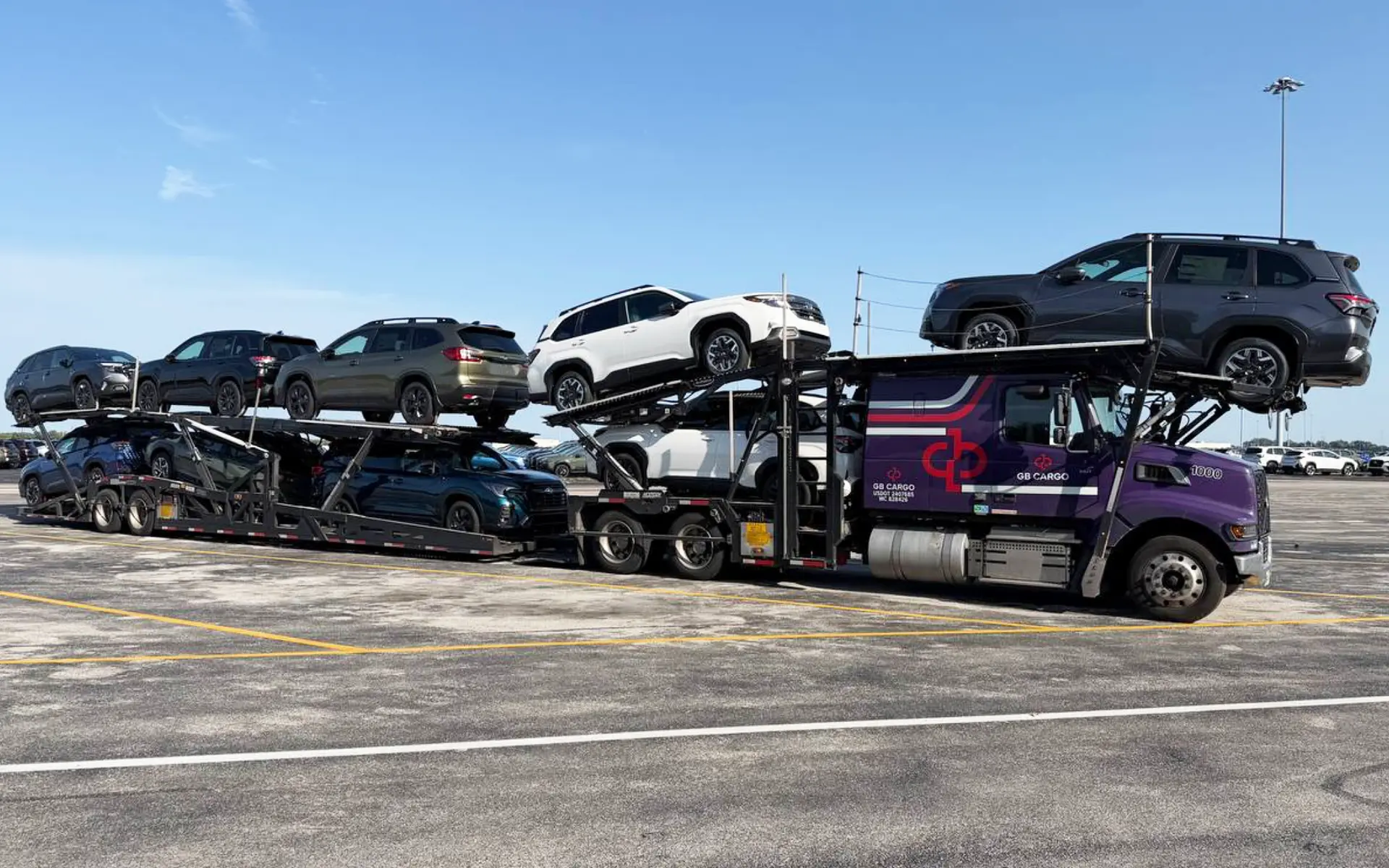
Pickup reliability is not just about showing up on the right day. It is about the operational window. Loading a 9-car hauler is a precise operation that involves sequencing vehicles by size, weight, and destination to maximize trailer utilization. At GB Cargo, we target a 3-hour pickup window for a 9-car car hauler — from arrival at the yard to departure with a full load. That discipline eliminates the multi-day scheduling gaps that plague carriers operating with looser standards, where vehicles can sit for 48–72 hours after becoming available simply because the carrier’s dispatch could not coordinate a tighter window.
GB Cargo regularly picks up directly from rail yards for dealership deliveries — the exact bottleneck segment that the research identifies as the most variable and controllable piece of the inbound journey. The final truck leg from rail yard to dealership is where carrier performance has the most direct impact on your floorplan exposure, because it is the one segment that is not constrained by rail schedules or port processing.
When you know exactly when a vehicle will arrive — not a 3-day window, but a specific ETA updated in real time — you can pre-schedule PDI, photography, and online listing. That compresses the lot-prep gap from the industry-typical 3–5 days down toward vAuto’s 48-hour target.
We use a real-time tracking system paired with a TMS app that generates timestamped photos of every vehicle at pickup and delivery. This is not a tracking dot on a map. It is a documented chain of custody: condition at origin, condition at destination, with photos stored and shared with all parties. For dealers, this speeds lot acceptance because you are not relying on a paper BOL (Bill of Lading) and a visual walk-around to determine whether a vehicle arrived clean. The photo record resolves disputes before they start and eliminates the administrative delays that add days to the pre-frontline window.
National transit benchmarks are useful for context, but what matters for your dealership is performance on your specific lanes. On our Midwest-to-South Florida corridor — one of the highest-volume routes in the industry — GB Cargo delivers in approximately 4 days. Compare that to the industry’s 10–14-day baseline for moderate-distance routes, and the floorplan math becomes immediately tangible: at $8.01 per vehicle per day, a 4-day transit versus a 12-day transit saves $64 per vehicle. Across 150 vehicles per month, that is $9,600 monthly — over $115,000 annually on a single corridor.
GB Cargo is an asset-based auto transportation carrier headquartered in West Lafayette, Indiana. We own and operate more than 20 trucks — we are not a broker, and we do not subcontract your vehicles to carriers we cannot vet or control.
• 4-day transit on Midwest-to-South Florida corridors
• 3-hour pickup window target for 9-car haulers
• TMS with timestamped photo documentation at every pickup and delivery
• Dedicated account management for dealership clients
• New, modern car carriers for safer, more reliable transport
Does floorplan interest really start before my vehicle arrives at the lot?
In the prevailing U.S. model, yes. Most OEM captive lenders disburse funds at or near the time of vehicle shipment from the factory, and interest accrues from that disbursement date. There are manufacturer-specific variations — some OEMs invoice only upon dealer receipt — but the dominant practice starts the clock before the vehicle is in transit. Check your specific floorplan agreement for the exact trigger.
How much does one extra transit day actually cost per vehicle?
At a 6.5% annual floorplan rate on a $45,000 vehicle, one transit day costs approximately $8.01 in interest. That figure scales linearly: 5 extra days across 150 monthly units equals $6,008 per month, or over $72,000 annually. The vAuto industry benchmark of $7.90 per vehicle per day confirms this range.
Should I pay more for a faster carrier if floorplan savings offset the premium?
The math generally supports it. A $75 per-vehicle carrier premium that saves 5 transit days yields $40.05 in direct floorplan savings per vehicle — a net premium of about $35. That does not account for fresher inventory, fewer curtailment events, faster online listing, and better credit line utilization. Evaluate carrier cost against total floorplan exposure, not freight budget alone.
Inbound car transportation is not a logistics detail. It is a floorplan cost lever that directly affects dealer margins in proportion to transit days consumed. The $100,000 gap between a 10-day and 17-day carrier is not hypothetical — it is arithmetic built on publicly benchmarked holding costs and standard floorplan rates. In a market where net floorplan expense per vehicle is up 35% year over year and rising, every controllable variable matters. Transit time is the one variable most dealers have never optimized because the cost is real but invisible.
Calculate your own per-vehicle daily floorplan cost: take your current floorplan rate, multiply by your average invoice price, and divide by 365. Then ask your carrier — or your broker’s carrier — for average transit time and variance data on your highest-volume lanes. Compare the transit cost against the per-unit freight rate. If the transit cost exceeds the freight savings, you are optimizing the wrong number.
If you want to see what a 4-day corridor and a 3-hour pickup window look like on your specific lanes, request a quote from GB Cargo and we will walk through the math with you.
Stay informed on the latest news and insights from GB Cargo.