How Vehicle Transportation Works in the B2B Auto Auction Ecosystem
Discover how auction transport really works — title timing, condition documentation, dispatch logistics, and what to verify before you book a carrier.
Winning the bid is the straightforward part.
The costs that accumulate after the gavel falls are where margin quietly disappears. Storage fees start accruing within days of the sale. Arbitration windows — the period during which buyers can flag condition issues — run on a fixed clock whether the vehicle is moving or sitting in a queue. And if a carrier dispatches before the title is cleared, the truck arrives at a yard where nothing can legally move.
Most buyers don't calculate transport into their true out-the-door cost until something goes wrong. According to industry data, missed add-on costs — including transport and logistics fees — can swing the final financial outcome on a single unit by 8 to 15 percent. At volume, that number is not an abstraction. It is the difference between a profitable auction strategy and one that consistently underperforms on paper.
This article breaks down how vehicle transportation actually works inside the B2B auction ecosystem: where the logistics pressure points are, what operational discipline looks like from a carrier's perspective, and what to verify before you book a move.
The old model was efficient by design. A carrier would pull into a Manheim yard, load ten units, and deliver them along a single regional corridor. Origins were centralized, routes were predictable, and load-building was straightforward. That model no longer describes how most B2B auction volume moves.
Digital platforms — ACV Auctions, OPENLANE, Manheim Express — have dispersed origin points across thousands of individual dealership service lanes and independent lot locations. A dealer in the Midwest can now win a vehicle listed from a franchise lot in the Southeast, a repossession sitting in a suburban credit union impound, and a rental defleeted unit from a regional airport facility — all in the same session. Each of those vehicles requires a separate pickup, at a different origin, with a different free-storage clock running.
This geographic fragmentation is the defining logistics challenge of the current auction environment. Carriers that built their networks around centralized physical auction yards often struggle with dispersed dealer-to-dealer volume. The unit economics of picking up a single vehicle from a suburban dealership forty miles off a major corridor are fundamentally different from loading ten units at a Manheim gate.
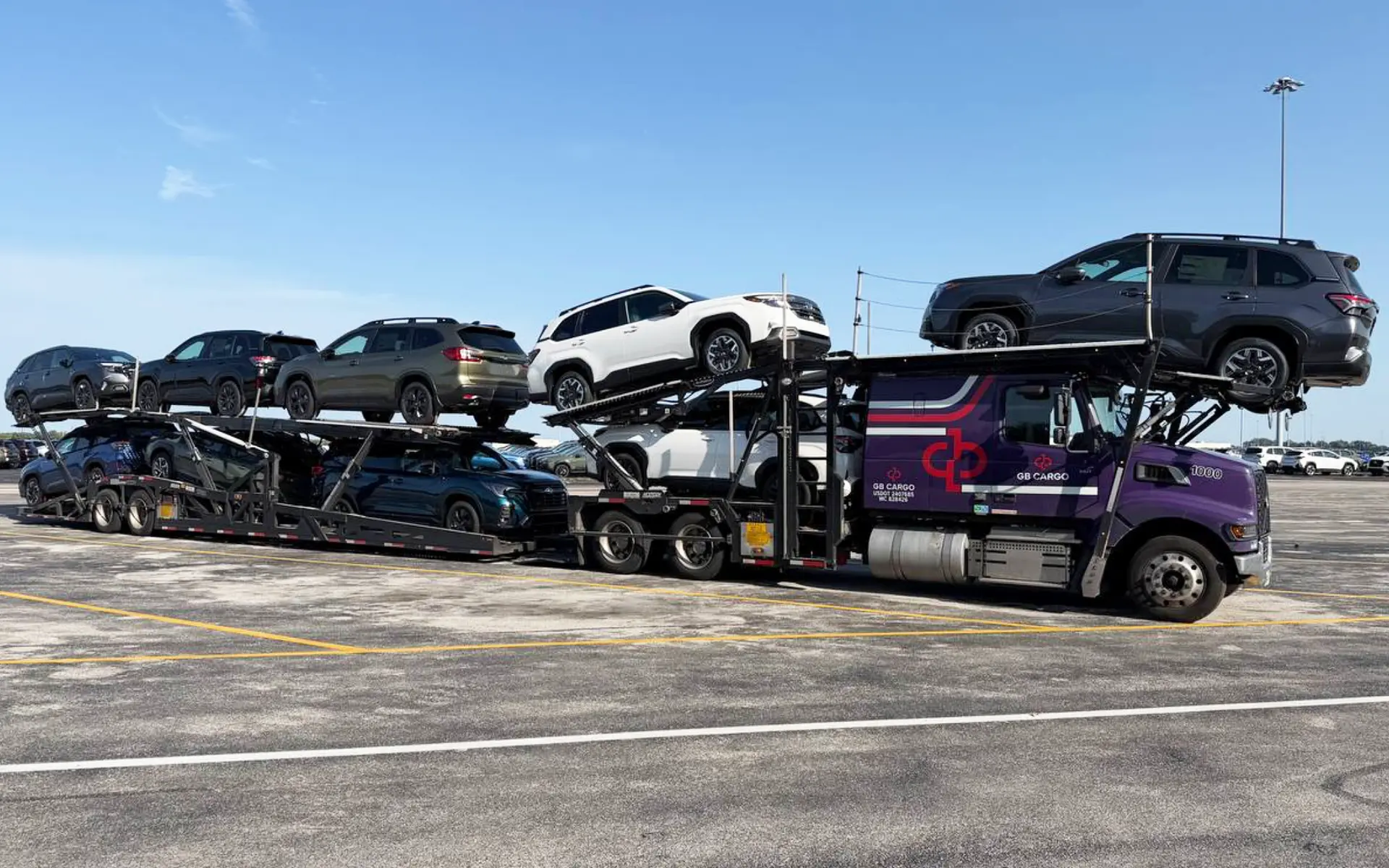
For auction buyers, this means the carrier question has become more important, not less. A carrier that can move vehicles from any origin point — physical auction yards, individual dealership lots, fleet staging areas — using the same documentation process regardless of where the vehicle sits, is a different operational asset than one built for the hub-and-spoke world. At GB Cargo, we handle pickups from auction yards and dealership lots using the same dispatch protocol and TMS documentation chain for every move, regardless of origin type.
The U.S. wholesale vehicle auction market — valued at approximately $3.47 billion and responsible for facilitating the movement of over 14.26 million units in 2024 — enters 2026 under structural pressure on multiple fronts. Understanding that pressure is directly relevant to transport planning, because supply dynamics determine volume timing, inventory concentration, and the urgency profile of most auction moves.
The market is anchored by a small number of dominant platforms. Manheim (Cox Automotive) remains the largest, offering approximately eight million vehicles annually through a combination of 111 physical locations and over 650 digital lanes. OPENLANE operates as a digital-first marketplace with particular strength in off-lease inventory from captive finance companies — the off-lease vehicles from Ford Credit, GM Financial, Toyota Financial Services, and more than 40 other commercial lenders flow through OPENLANE before reaching any open auction channel. ACV Auctions drives the dealer-to-dealer digital segment, having sold over 829,000 units in 2025 generating $10.4 billion in gross merchandise value. In the salvage and total-loss segment, Copart and IAA (RB Global) operate as a functional duopoly.
The supply picture entering 2026 is shaped by three overlapping dynamics. First, off-lease volume remains structurally compressed — the collapse in new-vehicle lease originations during the 2021-2022 supply chain crisis created a shortage of returning lease units that franchise dealers are still absorbing. Second, rental companies are aggressively defleeting. Commercial sales of two-year-old units surged nearly 32 percent year-over-year at physical auctions in late 2025, as major rental operators cycled out inventory — including a significant volume of electric vehicles whose repair economics and residual values failed to meet initial projections. Third, elevated auto loan default rates through 2024 and into 2025 have sustained repossession volumes, adding a steady stream of units requiring significant reconditioning and title processing.
The combined effect is a market with high buyer demand, dispersed inventory sources, and a meaningful proportion of first-time or infrequent auction buyers entering the channel to compensate for tight off-lease supply. That last point matters for logistics: experienced high-volume auction buyers have internalized the transport discipline the market requires. Buyers new to the channel often haven't — and they discover the gap when fees arrive.
The hammer price is the cost buyers plan for. The costs that follow — before the vehicle moves a mile — are the ones that erode it.
Auction yards do not hold vehicles indefinitely without charge. Copart, for example, begins billing storage at $15 to $30 per day after a very short grace period. Physical Manheim locations operate under similar schedules. For a buyer running high volume across multiple platforms, uncoordinated dispatch — carrier booked separately, title status unknown, pickup scheduled without confirming the free-storage deadline — routinely generates fees that were never part of the margin calculation.
The fix is not complicated, but it requires coordination before dispatch, not after. Confirming the yard's specific free-storage window and aligning pickup timing around it is a basic step that experienced carriers build into the scheduling conversation. Carriers who treat pickup timing as purely a capacity question — when do we have a truck available — often deliver the vehicle and the invoice simultaneously.
Most B2B auction platforms give buyers a defined window — typically 10 to 14 days — to flag condition discrepancies and initiate arbitration. ACV Auctions enforces a strict 10-day window. OPENLANE offers a 14-day guarantee on qualifying transactions. That clock starts running at the point of sale, not the point of delivery.
A carrier with no condition documentation standard — no timestamped pickup photos, no damage report signed at origin — leaves the buyer without the evidence needed to support an arbitration claim if a condition dispute arises post-delivery. By the time the vehicle reaches the retail lot and someone notices a problem, the question of when and where the damage occurred becomes difficult to answer without a documented paper trail.
At GB Cargo, every pickup and delivery is processed through a dedicated TMS (Transportation Management System — the software platform used to manage, track, and document vehicle moves) for auto transport logistics. Both the sender and receiver receive timestamped photos and a damage report at pickup and at delivery. That documentation is available to all parties in real time through our real-time tracking system — not produced after the fact if a dispute arises, but generated as a standard part of every move.
A vehicle cannot legally be transported across state lines until the physical or electronic title is cleared. In the wholesale market, sellers have up to 21 days in some cases to produce proof of ownership. If a carrier dispatches before that documentation is confirmed, the truck arrives at a yard where nothing can move — and the vehicle continues accumulating storage fees while the carrier's schedule shifts around an unresolvable hold.
This is a point where speed works against buyers, not for them. A carrier willing to dispatch on an uncleared title is not offering faster service. It is transferring the scheduling risk to the buyer while creating conditions for additional fees on both ends.
Our protocol is direct: we do not dispatch until title and documentation are confirmed clear for every VIN on the load. For buyers new to the auction channel who haven't yet built this into their workflow, we walk through the sequencing before the first move — not because it slows things down, but because it is the only approach that reliably avoids the fees that experienced buyers have learned the hard way to prevent.
Auction vehicles have already changed hands at least once before a carrier touches them. The seller consigned to the platform, the platform ran the transaction, and the buyer won the vehicle — often without having seen it in person. By the time a carrier picks up the unit, the condition report that supported the sale is already in the past. What happens from pickup to delivery is the carrier's record.
Thin carrier documentation creates a specific problem in auction transactions: it leaves a gap in the chain of custody that no party can independently fill. If a vehicle arrives with damage that wasn't on the auction CR (Condition Report — the standardized inspection document generated at consignment, typically grading a vehicle on a 1.0 to 5.0 scale across frame, mechanical, cosmetic, and tire condition), and the carrier has no pickup photos or damage report, the buyer has no way to establish whether the damage occurred at the yard, in transit, or after delivery. Every party in the chain has plausible deniability — and the buyer absorbs the loss.
The documentation standard that actually protects buyers is not complicated. It requires timestamped photos at pickup showing the vehicle's condition at the moment of loading, a damage report signed at origin, corresponding documentation at delivery showing condition at drop-off, and a system that makes all of that accessible to both sender and receiver without requiring a phone call to retrieve it.
That is what our TMS generates on every move. Both the party releasing the vehicle and the party receiving it get the full photo set and damage report for their unit, timestamped, at both ends of the move. For B2B clients managing volume, our dedicated account management means there is a named point of contact — not a call center rotation — available to resolve any issue that the TMS data alone doesn't close. When a condition question comes up post-delivery, the documentation is already there. The conversation starts with evidence, not with disagreement about who saw what.
One operational priority that shapes every move we make: we pick up and deliver every vehicle in the same condition we received it. The documentation system exists to prove that standard, not just claim it.
Auction buys don't arrive on a predictable schedule. A dealer or fleet buyer might win three units on a Tuesday afternoon and need all of them moved before the weekend free-storage window expires. How a carrier responds to that situation depends entirely on what they actually control.
When a short-notice request comes in, two conditions have to be satisfied before anything else — regardless of relationship, volume, or rate history. First, we need confirmed available equipment at or near the origin location. Second, we need to know the specific free-storage deadline for each vehicle, because that determines whether the move is feasible on the buyer's preferred timeline or whether the scheduling math doesn't work. Those aren't negotiating points. They're operational prerequisites.
For established contracted partners, pricing is already set, which means those are the only two variables in play. The conversation is short: do we have a truck in the right place, and does the free-storage window give us enough time to execute? For new clients, pricing that reflects the urgency of a short-notice move is part of the upfront discussion. That isn't a premium for its own sake — it is what makes it possible to reallocate capacity to prioritize the move ahead of other loads already in the schedule.
There is a broader point here about platform-integrated logistics that buyers should understand. Services like Ready Logistics (the transportation arm embedded in the Manheim platform) and ACV Transportation (ACV Auctions' baked-in transport option) offer genuine convenience — pricing is surfaced at checkout, and the coordination is handled within the same interface as the bid. But both of these services operate broker-model networks. The carrier that ultimately shows up to pick up the vehicle is a third party the platform has dispatched, not an employee or owned asset of the platform itself.
An asset-based carrier owns its equipment and makes dispatch decisions internally. When capacity is available, it is confirmed — not contingent on a third-party carrier accepting the load in a specific market. GB Cargo's new equipment fleet operates on this model. There is no intermediary between the dispatch decision and the truck. That distinction matters most when timing is tight and the cost of a missed pickup window is measured in daily storage fees.
The carrier evaluation for auction transport is different from standard fleet transport in one important way: the margin on the underlying transaction is already set. The buyer won at a specific hammer price, and every cost between that price and the vehicle reaching the lot comes directly out of the return. Carrier selection isn't just a logistics decision — it's a margin decision.
Four factors consistently separate carriers that protect auction margins from those that quietly erode them.
Asset-based versus broker model. A broker can book the move, but the carrier that arrives was selected from an open network. The broker cannot guarantee that carrier's documentation standards, equipment condition, or response protocol if something goes wrong mid-move. An asset-based carrier controls all of those variables directly.
Title clearance protocol. Ask directly: does the carrier dispatch before or after title is confirmed clear? The answer tells you whether the carrier's scheduling process is built around protecting the buyer or around moving trucks. There is no ambiguous middle position on this question.
Documentation standard. What does the pickup condition report look like? Who receives it, and when? If the answer is that documentation is generated if there's a claim, the carrier's process doesn't support the arbitration timeline the auction platform requires.
Account management access. For high-volume buyers managing multiple simultaneous auction purchases, a dedicated contact who knows the account — not a dispatch queue — is the difference between a resolved issue and a delayed one. The car dealerships and fleet operators who run consistent auction volume understand this. Escalation paths matter when arbitration clocks are running.
Why Auction Buyers Work With GB Cargo
Can you pick up directly from auction yards, or only from dealerships?
We handle pickups from any origin — physical auction yards, individual dealership lots, fleet staging areas, and repossession facilities. The documentation process and dispatch protocol are the same regardless of where the vehicle is located.
What happens if the title isn't ready when we need the vehicle moved?
We don't dispatch until title and documentation are confirmed clear for the specific VIN. If a title is delayed, we hold dispatch and work with the client to monitor clearance status. For buyers new to the auction channel, we walk through the sequencing before the first move so there are no surprises on either side.
How do you document vehicle condition at pickup and delivery?
Every move is processed through our TMS. At pickup, the sender receives timestamped photos and a damage report for the vehicle. At delivery, the receiver receives the same. All documentation is accessible to both parties through our real-time tracking system — not produced retroactively if a dispute arises, but generated as a standard part of the move.
What's the lead time for auction transport on established routes?
Lead time on any move depends on equipment availability at the origin and the free-storage deadline at the auction yard. For contracted partners, pricing is pre-negotiated and those are the only two variables in the scheduling conversation. For new clients with urgent timelines, we discuss pricing that reflects the urgency upfront — that transparency is what makes realistic scheduling possible.
The auction transaction takes seconds. The logistics window that follows — title clearance, dispatch timing, storage deadline management, carrier documentation — takes days, and it is where the margin on most wholesale moves is actually determined.
Buyers who treat transport as an afterthought, coordinated separately from title clearance and booked without confirming storage deadlines, consistently absorb costs that weren't in their original calculation. The carriers and processes that protect margin aren't always the most convenient option at checkout. They're the ones that treat title clearance, dispatch, condition documentation, and delivery as a single integrated sequence — because that's what the arbitration window and storage fee structure of the auction ecosystem actually require.
Speed matters in auction transport, but sequence matters more. Getting the order right is what keeps a clean buy from becoming an expensive one.
Before your next auction buy, confirm three things with your carrier: whether they dispatch before or after title clearance is confirmed, what their condition documentation looks like at pickup and delivery, and whether you'll have a direct contact if something needs to be resolved while the vehicle is in transit.
If you're evaluating GB Cargo for auction transport, reach out to our team — we'll walk through your lanes, volume profile, and any specific platform requirements before the first load moves.
Stay informed on the latest news and insights from GB Cargo.