OEM procurement still treats dedicated outbound transportation as a freight line item. The framing breaks the moment a contracted carrier misses a dealer window — the cost lands outside the transport budget, on dealer activations and yard congestion at the origin plant. In 2026, dedicated invoices may exceed spot rates and still cost less in total.
This article is for OEM (Original Equipment Manufacturer — the vehicle maker) logistics teams that are signing, renewing, or reconsidering dedicated outbound contracts in a freight market that has tightened faster than most procurement models account for. We work with B2B customers across the United States as an asset-based carrier moving finished vehicles, and the gap between how dedicated capacity is priced and how it actually performs is wider in 2026 than at any point we have seen in recent years.
Finished-vehicle outbound is a different logistics problem
Most coverage of dedicated trucking in automotive focuses on inbound parts logistics — Just-in-Time (JIT — the inventory strategy that requires materials to arrive exactly when production needs them) sequencing, dock-window precision, and the catastrophic cost of a line stop. That coverage is accurate, but it doesn't describe the failure profile that OEM outbound carriers actually face.
Outbound finished-vehicle logistics has a different failure mode: missed dealer commitments. Dealers schedule sales floor inventory, customer pickup commitments, and floor-plan financing around expected delivery dates. When a carrier misses by 48 hours, the OEM doesn't lose a minute of production — but it inherits a cascade of dealer-side commitments that have to be renegotiated, often during a launch or seasonal allocation cycle where the stakes are highest.
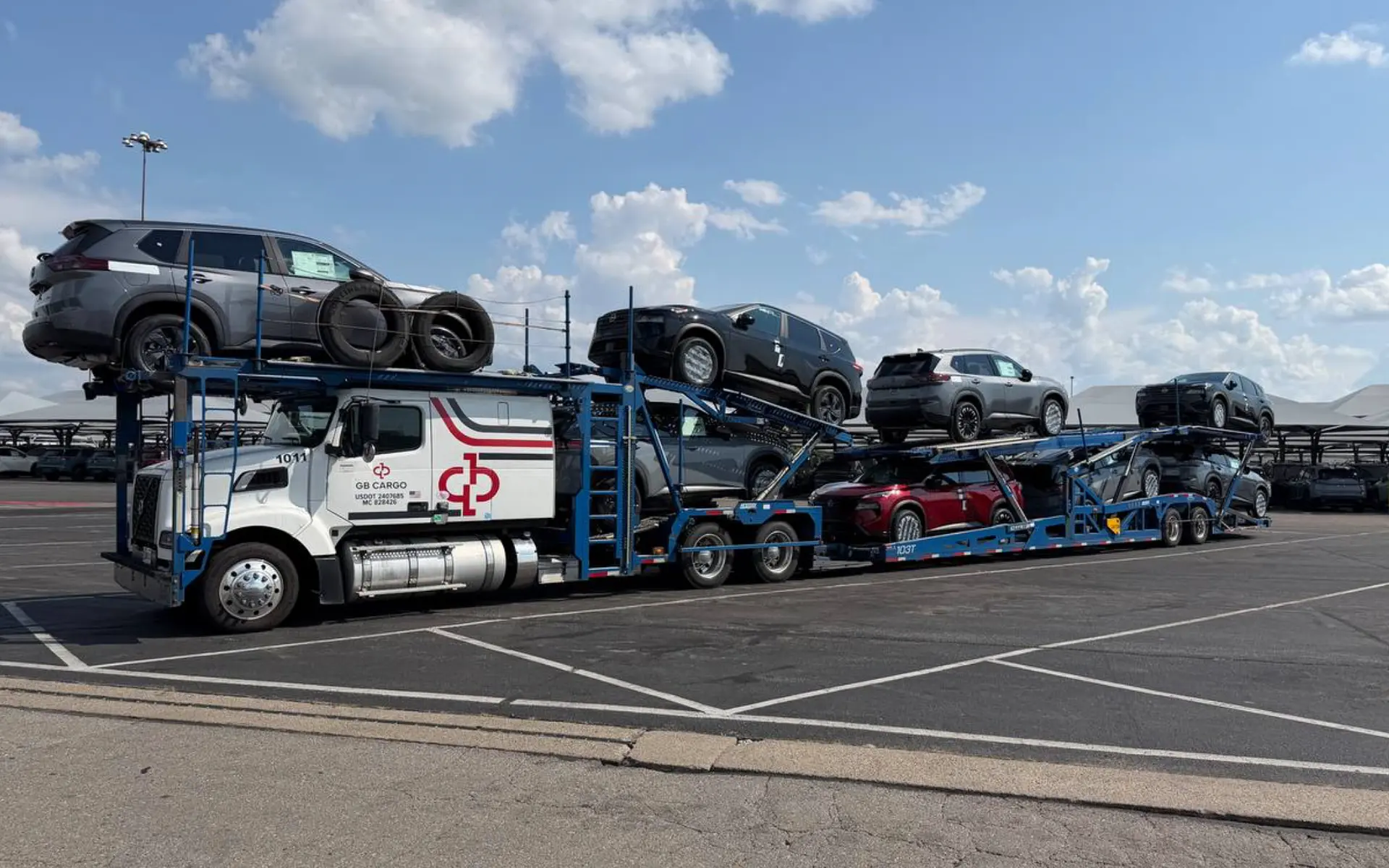
The equipment side of the problem isn't substitutable either. Finished-vehicle outbound runs on 9-car haulers, with up to 10-car stinger configurations on certain lanes. Electric vehicle (EV) loads drop to 7 or 8 units for standard EVs and 5 or 6 for larger units like the Tesla Cybertruck. Drive-on handling, damaged-but-drivable units, and forklift-loaded non-runners each require different operational protocols. An OEM that needs reliable outbound capacity is not shopping in the same market as a shipper looking for a 53-foot trailer of consumer goods.
Dedicated, broker, and spot: the structural comparison that matters
The three transportation models available for OEM outbound differ on more than rate. They differ on capacity guarantee — and that's the dimension that determines whether a load actually moves on the day it's tendered.
In a dedicated arrangement, the carrier commits a defined fleet to a shipper's program. Equipment, drivers, and scheduling are assigned to that program, and the carrier's obligation runs to one shipper rather than to whichever load offers the best rate that morning.
In broker-mediated freight, the broker tenders loads to a rotating pool of for-hire carriers. The OEM doesn't know which carrier shows up, which drivers are loading, or what condition the equipment is in. That model works well in soft freight markets when capacity is abundant. It works less well when capacity tightens.
In the spot market, capacity is procured load-by-load at prevailing rates with no advance commitment from either side. There is no relationship structure, no service-level commitment, and no driver familiarity with the lane or the loading protocol.
The 2026 freight market is exposing where these models diverge. The FreightWaves SONAR Outbound Tender Rejection Index reached 14.2% in March 2026, up from 8.5% a year earlier — meaning carriers are increasingly rejecting contracted loads in favor of better-paying alternatives. National linehaul spot rates ran 27% above year-prior levels as of early May. When the freight market tightens, broker-tendered loads are the first to be rejected, and the rejection rate is a leading indicator of whose freight gets moved and whose doesn't.
The asset-based difference is structural, not rhetorical. We own and operate our equipment. Drivers are ours. Scheduling, equipment maintenance, and compliance sit inside one operational system. That structure determines whether a load tendered on Tuesday actually rolls on Tuesday — independent of what the broader market is doing.
The insurance framing: why per-vehicle cost is the wrong optimization variable
The argument we hold, and that we think most OEM outbound procurement should reckon with: dedicated capacity is not a freight cost. It's insurance against tail-risk failures whose cost lands outside the transportation budget.
The actuarial logic isn't complicated. The expected cost of a dealer-commitment failure, multiplied by the probability that broker or spot freight fails to deliver against that commitment, equals the real cost of “cheaper” capacity. The failure probability isn't constant — it rises sharply when the freight market tightens, which it has, sharply, in 2026.
Procurement models that score outbound carriers on per-vehicle rate are evaluating one variable in a two-variable equation. The other variable — the cost of failure — sits in a different P&L line and gets attributed to operations, dealer relations, or finance when it eventually shows up. The transportation team optimizes its own number; the cost surfaces elsewhere; the procurement decision keeps getting credit for “savings” that the company is paying for through other channels.
This produces a cyclical mistake. In soft freight markets, dedicated looks expensive compared to spot, so OEMs reduce dedicated commitments. In tight markets, dedicated capacity is unavailable to add back at any price, because the carriers who would have committed have already allocated capacity to shippers who valued the relationship. The decision to size dedicated capacity should be a function of long-term dealer-commitment risk — not the freight market's current cycle.
What we'd suggest looking at instead: model the cost of a 48-hour dealer-delivery miss during an allocation cycle. Multiply by the realistic probability of that miss on broker freight at March 2026 tender-rejection rates. Compare the result to the rate spread between dedicated and broker capacity on the same lane. The math typically doesn't favor the line-item optimization.
Operationally, our position rests on documentation and accountability. Our transportation management system (TMS — the software that tracks loads, equipment, and exceptions in real time) generates timestamped photo documentation at both pickup and delivery, shared with all parties on every load, and feeds the real-time tracking our customers see from pickup through delivery. Damage-free delivery sits above 99%. We assign a named account manager to every B2B program through our dedicated account management model, so there is a single point of contact when a question or exception emerges — not a queue.
How fuel surcharges work, and why 2026 is stressing the math
The fuel surcharge (FSC — the floating fuel-cost component layered onto a base freight rate) is the most consequential and least understood line item in a dedicated outbound contract. In 2026, it's also the most volatile.
What the FSC actually is
The FSC exists to decouple diesel price risk from the base linehaul rate. No carrier can predict diesel prices across a three- to five-year contract, and no shipper wants the carrier to embed a fuel-price guess into a fixed rate. The FSC solves both problems: the base rate covers everything except fuel, and the FSC floats based on a published benchmark.
The industry-standard benchmark is the U.S. Energy Information Administration (EIA — the federal agency that publishes weekly U.S. on-highway retail diesel prices) Monday reading. The per-mile FSC formula most carriers use is straightforward: subtract a contractually agreed baseline diesel price from the current EIA price, then divide by the carrier's assumed fleet fuel economy.
What changed in 2026
Diesel rose from $3.53 per gallon at the start of February 2026 to $5.64 by early May, driven by geopolitical disruption to Strait of Hormuz oil flows. Industry sources reported FSC levels reaching 40 to 44% of total freight cost by late March, up from 28 to 29% at the start of the year — a near-doubling of the fuel component in roughly three months.
The baseline anchoring problem
Contracts written in 2023 or 2024 with baselines around $3.00 per gallon are now producing FSC invoices that are mechanically correct but commercially uncomfortable for both sides. The mechanism is doing exactly what it was designed to do. The magnitude is exposing assumptions that need revisiting — particularly fleet-MPG assumptions in older FSC tables that no longer reflect actual fleet efficiency.
Why this matters for OEM dedicated outbound
The base rate stability is the value the FSC preserves. In a dedicated arrangement, fuel volatility is absorbed in the floating component instead of repriced into the linehaul rate. Spot-market carriers don't get that protection: they have to price current fuel into every load bid, which means spot all-in rates move faster and less predictably than dedicated totals during fuel spikes.
That produces the counterintuitive 2026 dynamic. The dedicated contract — sometimes perceived as expensive — is producing more predictable total cost than spot alternatives on the same lane, because rising diesel is being managed through an indexed formula rather than embedded in a fully volatile all-in rate.
We work with transparent pricing. All costs and surcharges, including FSC mechanics, are discussed before contracts are signed. That's not a contractual concession; it's the only way the math works for either side over a multi-year horizon.
Capacity and drivers in a tightening 2026 market
The 2026 capacity picture is tighter than most outbound procurement models account for. The American Trucking Associations (ATA — the industry's main trade association) Truck Tonnage Index reached 117.9 in April 2026, the highest since fall 2022. Contract rates hit two-year highs in March. The Logistics Managers' Index measure of available truck capacity dropped to 41.0 in February — the most constrained since the pandemic peak.
Underlying the capacity squeeze is a driver shortage that has re-emerged after several years of post-pandemic correction. The ATA projects a current shortfall of approximately 82,000 drivers in 2026. A federal CDL (Commercial Driver's License — the federally regulated license required to operate a commercial vehicle) rule that took effect in March 2026 limited eligibility for certain categories of foreign-born drivers, and a separate Department of State pause on commercial-driver employment visas has narrowed the pool further. These regulatory changes are affecting smaller carriers and broker-dependent capacity disproportionately, because that segment depends more heavily on a continually replenished driver pool.
We are aware of these dynamics across the industry. They haven't directly affected our operations to date. Our driver pipeline — including mandatory pre-hire EV driver training with fleet manager escalation support — is structured for the specialized work car-haul represents, which insulates us somewhat from the general driver-pool pressures.
The point worth surfacing for OEM logistics teams: tightening capacity is concentrated where broker-dependent freight lives. Dedicated programs with stable lanes, planned routing, and direct employment relationships are structurally more attractive to drivers — which protects program continuity in a market where continuity is harder to find.
Contract structure: 2026 demands sharper calculations and better-negotiated terms
We work on multi-year dedicated arrangements with OEM-style customers. That structural preference hasn't changed in 2026, but the environment around it has changed significantly — and both sides need to model the terms more carefully than they did in 2023.
A standard dedicated outbound contract includes a 2-to-5-year term, a minimum volume commitment, defined lane configurations, key performance indicators (on-time delivery, damage-free rate, communication SLAs), and a base linehaul rate with FSC pass-through. Those elements haven't changed. What's changed is the volatility surrounding them.
Tariff policy — including Section 232 duties on imported vehicles, parts, and heavy trucks — is reshaping which OEM plants produce which models on what timelines. That uncertainty propagates into outbound lane geography. A lane running at predictable volume today may run differently in 18 months. Carriers need long terms to justify equipment and driver investment. OEMs need flexibility to accommodate network changes. Both sides are negotiating into uncertainty that neither can fully model.
The response isn't to abandon multi-year structure — it's to negotiate the mechanics inside that structure more carefully. Realistic FSC baselines and table-MPG assumptions, lane-flex provisions for OEM network changes, transparent minimum-volume mechanics, clearly defined KPI thresholds, and named escalation contacts on both sides. None of this is exotic. It's the contract conversation that, in our experience, gets shortened in soft markets and gets paid for in tight ones.
Where this typically falls apart: the contract is signed against assumptions that were reasonable in 2024 and aren't reasonable now. The FSC baseline is too low, the table MPG is too generous, the minimum volume is set to a level the OEM no longer expects to ship. The mechanism still works mechanically, but neither party is happy with what it produces. The cleaner approach is to revisit those parameters explicitly at signing — or to build in scheduled reviews that allow recalibration without renegotiating the entire agreement.
About GB Cargo
Asset-based finished-vehicle carrier headquartered in West Lafayette, Indiana, with Chicago terminal operations.
Owned and operated fleet of 9-car haulers, with up to 10-car stinger configurations on certain lanes. EV loads configured at 7 to 8 units for standard EVs and 5 to 6 for larger units like the Cybertruck.
Above 99% damage-free delivery rate across primary corridors radiating from the Chicago and Illinois hub to South Florida, Texas, California, and New York.
TMS-generated timestamped photo documentation at pickup and delivery, shared with all parties on every load.
Dedicated account management for B2B programs; customer portal with real-time tracking from pickup through delivery.
Transparent pricing: all costs and surcharges discussed before contracts are signed.
Frequently asked questions
What's the structural difference between dedicated outbound transport and using a broker?
A dedicated carrier commits a defined fleet — equipment and drivers — to a shipper's program. The carrier's obligation runs to one shipper, and capacity is available when the program needs it. A broker tenders loads to a rotating pool of for-hire carriers; the OEM doesn't know which carrier shows up or whether the load will be accepted at all. In tight freight markets, the difference becomes operational: dedicated capacity moves on schedule; broker-tendered freight rejection rises sharply.
How does the fuel surcharge work in a dedicated outbound contract?
The FSC is a floating fuel-cost component layered onto the base linehaul rate. It is indexed to the EIA's weekly on-highway diesel price, with a contract-agreed baseline and a fleet-MPG assumption that together produce a per-mile surcharge. The mechanism is designed to absorb diesel volatility without repricing the base rate — though FSC table parameters set in older contracts may need updating in the current fuel environment.
Is dedicated capacity worth the commitment if our outbound volume is variable?
The honest answer depends on lane criticality, volume predictability, and the cost of dealer-commitment failures on that lane. Multi-year dedicated terms work best on stable, high-volume lanes where dealer-commitment failures carry real downstream cost. For lower-volume or highly variable lanes, lane-flex provisions inside a dedicated agreement — or a hybrid structure that uses dedicated for primary lanes and contracted capacity for the rest — typically produces a better result than committing the entire program one way or the other.
Conclusion
Dedicated outbound capacity is insurance against failures whose cost lands outside the transportation budget. The 2026 freight market — diesel volatility, tightening capacity, driver-pool pressures, tariff-driven network uncertainty — is exposing the procurement frame that has historically treated it as a line item. The OEMs renegotiating dedicated terms with sharper contract mechanics aren't retreating from dedicated capacity. They're sizing it more deliberately, against a clearer view of what failure actually costs.
Next steps
If your OEM outbound program is approaching a contract renewal — or you are evaluating whether your current dedicated coverage matches your dealer-commitment risk — the conversation worth having starts with a lane-by-lane review. Current volume, failure-cost exposure, FSC baseline assumptions, lane-flex requirements. We're happy to walk through what that looks like.