2,403 Spaces, 14 Projects, None Open Yet. What It Means for Car Hauling
USDOT funded 2,403 truck-parking spaces, but none are open yet. When they may open, which lanes they touch, and why car haulers need more than a stall.
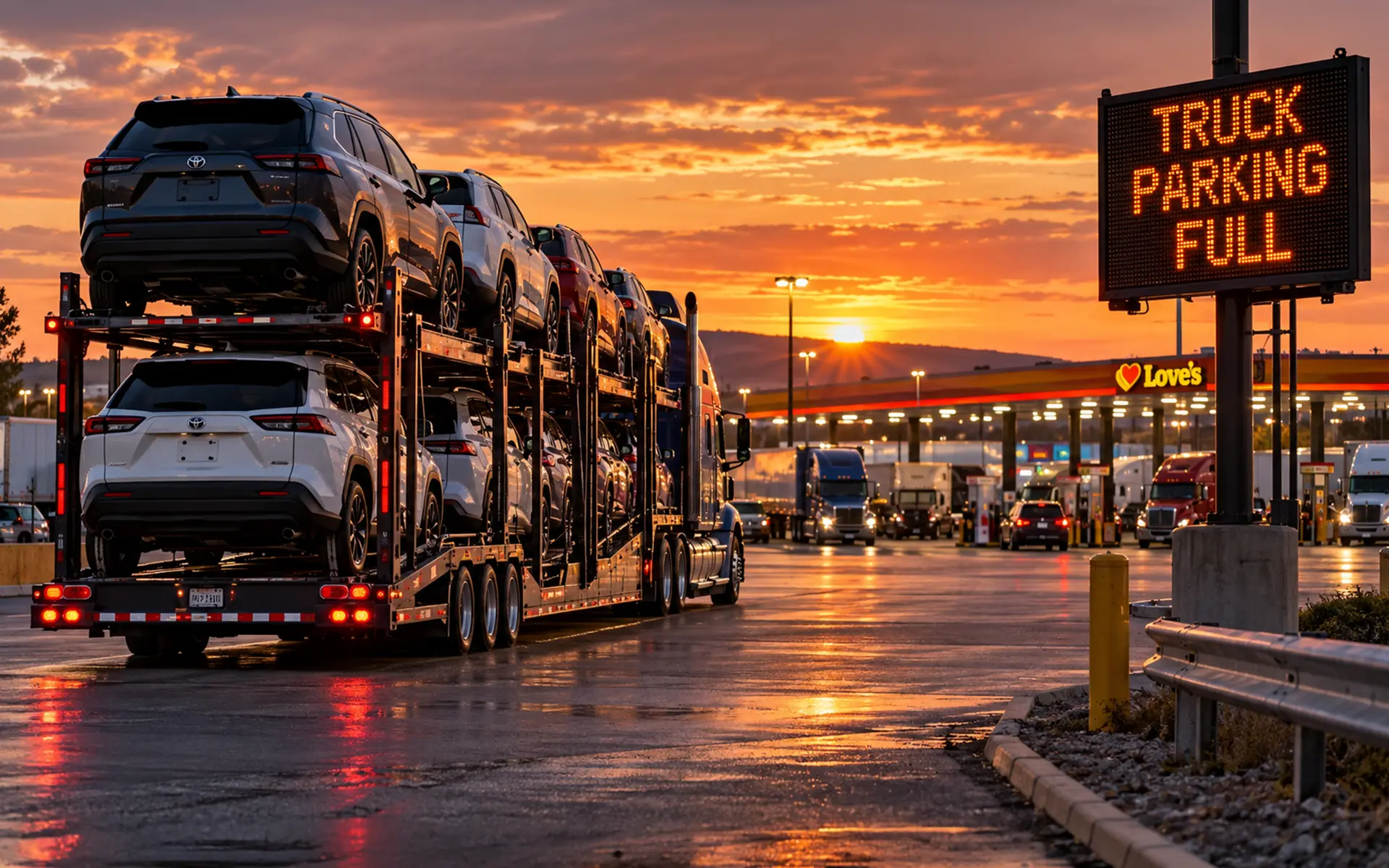
Washington just funded 2,403 new truck-parking spaces. None of them are open. Until they are, a car carrier that can’t find a safe place to stop still stops early, and in our experience that costs about an hour of drive time a day.
That hour comes out of your delivery window. And for vehicle shippers, the biggest gap in the new funding isn’t how many spaces it buys. It’s whether those spaces are lit and watched. A box trailer hides its cargo. Ours carries up to nine vehicles in plain view.
On October 14, the U.S. Department of Transportation (USDOT) announced $200 million in awards for 14 truck-parking projects across 12 states. Several land on lanes we run every week. The headline number will get repeated as if 2,403 spaces are waiting at the next exit. They aren’t, and the number that matters for your vehicles is smaller still.
The money is real, but it funds a pipeline, not a parking lot. Congress set aside the $200 million in the Consolidated Appropriations Act, 2026, signed on February 3. USDOT then ran a dedicated competition through INFRA (the Nationally Significant Multimodal Freight and Highway Projects program, the federal grant program for major freight infrastructure), with applications due July 15.
Three stages still sit between the announcement and a driver pulling in. First, each recipient signs a grant agreement after federal prerequisites are met. USDOT calls this obligation, and it is separate from being selected. Then comes design, environmental review, land purchase, or permitting where needed. Construction comes last.
Several projects are near the start of that line. Arkansas’s award still includes final design. The City of Needles, California, has to acquire its site first. The Savannah project includes engineering, environmental studies, and permitting. Minnesota’s replacement rest area near Fergus Falls carried an FY2032 construction date in state planning documents, and we found nothing showing that date has moved.
The 2,403 figure also needs two footnotes. USDOT’s own award fact sheet calls the space counts estimates that may change. And not every listed space is net new. Nebraska’s project shows 120 spaces, but because it replaces existing rest areas, the net gain is about 92.
Two conditions attached to the money matter for drivers. Congress barred grant recipients from charging truck drivers to park in spaces this funding builds or improves. Every project also has to sit within reasonable reach of an Interstate or a major freight route, so these lots will be free, public, and close to the highways carriers already use.
Iowa is the opposite case. Some I-80 rest-area work is visibly underway: the westbound Victor site reopened in February with 19 truck spaces. But that work started before this award, so it isn’t evidence the federal money has delivered anything yet. For 2026 and 2027 planning, treat all of these spaces as future capacity. Most award sheets list no opening date at all.
You never see parking on an invoice, but you feel it in transit time. Hours-of-Service rules from the FMCSA (Federal Motor Carrier Safety Administration, the federal agency that regulates commercial trucking) cap most drivers at 11 hours of driving after 10 consecutive hours off duty. Those 11 hours must fit inside a 14-hour on-duty window, with a 30-minute break after eight hours of driving.
When the clock runs out, the driver has to be parked, legally and safely. That is where the hour goes. If a driver knows the good stops ahead will likely be full by evening, the sensible move is to stop early and take the spot that is open now.
Research from ATRI (the American Transportation Research Institute, the trucking industry’s research organization) found drivers in its study gave up an average of 56 minutes of driving per day this way. Our experience matches: about an hour a day. On a multi-day lane, those hours compound, because a stop moved earlier on night one changes where the truck is on day two.
The timing makes it worse. FHWA’s Jason’s Law survey found shortages are sharpest from late afternoon through early morning, exactly when most drivers need to shut down. ATRI estimated the lost time added up to roughly 9,300 revenue miles a year per driver in its sample.
Many quotes in this industry are still built as if the truck drives straight from pickup to delivery, stopping only when the regulations force it. That math looks clean on paper. It breaks the first night the planned stop is full, and the driver must choose between pushing toward the end of the clock or settling for a lot nobody would pick for a load of new vehicles.
We plan for it instead. Parking availability on the route is one of the factors we build into the buffered delivery windows we quote, rather than promising exact times. The goal is a window we can beat, not one that only works if every stop goes perfectly.
When a plan does change, the update moves from the driver to dispatch to your dedicated account manager. That way you hear about it before it affects your dealership inventory schedule or your fleet’s in-service date.
Most analysis of truck parking for car carriers starts with length, and it is an easy assumption to make. Federal rules let a stinger-steered auto transporter (a car carrier whose hitch sits behind the tractor’s rear axle, allowing a longer, lower load) run at least 80 feet. Vehicles can also overhang up to four feet in front and six feet behind. On paper, that looks like a truck that won’t fit a standard stall.
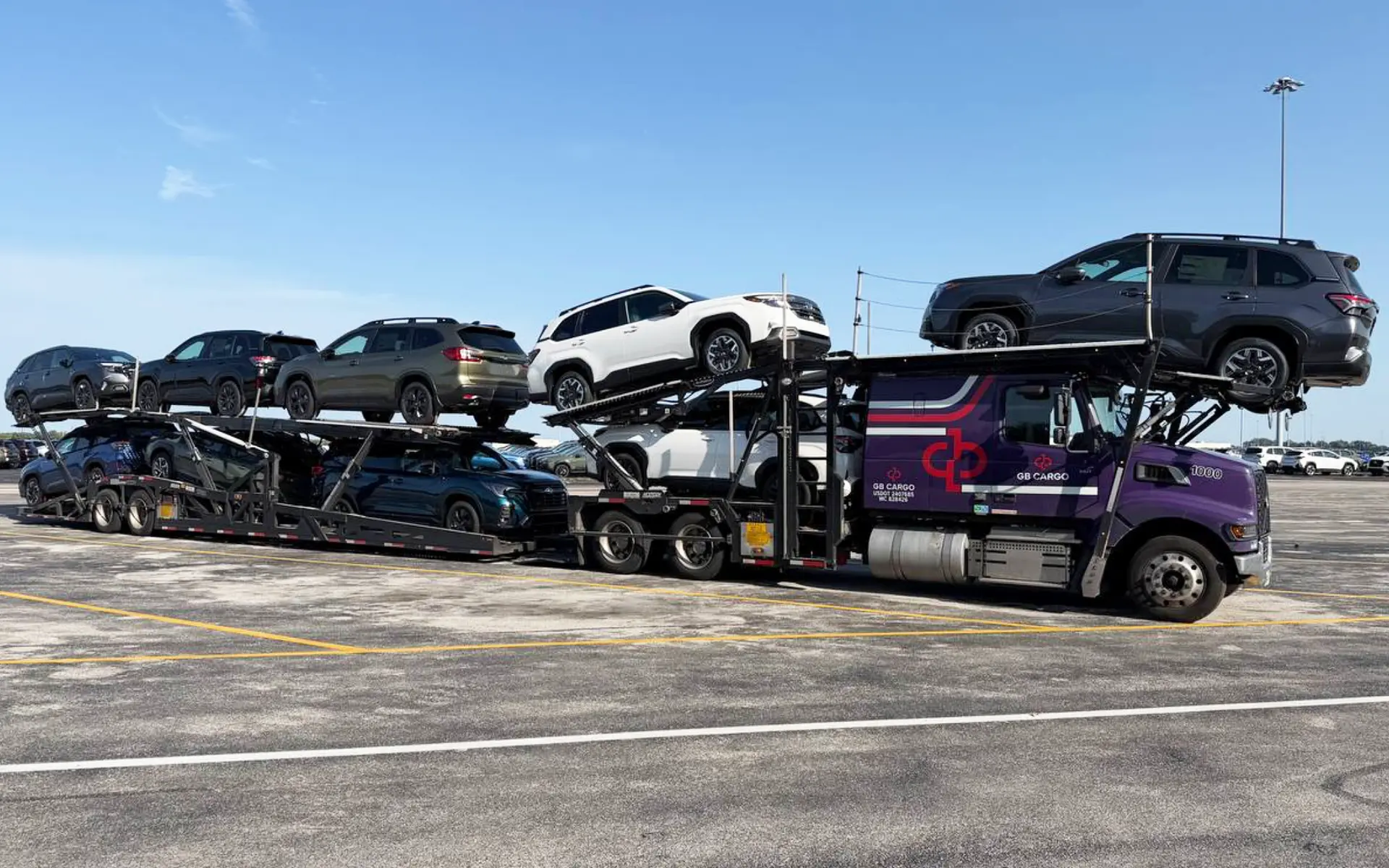
In practice, length is not the constraint. Our stingers park in the same spaces as any other tractor-trailer. If a standard semi with a trailer fits, our trucks fit too.
The real difference is what sits on the trailer. A dry van hides its cargo behind walls and a locked door. A car carrier displays its vehicles on an open deck, often new and sometimes high-value. To someone looking to steal a vehicle or damage one, a parked car carrier announces exactly what is on board and that it will sit there until morning.
So our drivers don’t just look for an open space. Most of the time, they look for well-lit truck stops and rest areas, and they avoid dark lots, even when a dark lot is the only opening nearby. That choice protects the vehicles you hand us, but it also narrows the list of usable stops every night.
This changes how to read the 2,403 number. A space in a dark, unwatched lot is technically a truck space. For a loaded car carrier, it often isn’t a usable one. The question for vehicle shippers isn’t how many spaces were funded. It’s how many lit, monitored spaces now sit on their lanes.
Small additions can matter. Public rest areas start small: a 2025 ATRI study found the average one has just 19 truck stalls, so it fills early. Several new projects explicitly include security features: lighting at Arkansas’s I-49 rest area, security and ITS (intelligent transportation systems, electronic monitoring and information tools) at Needles, and lighting, CCTV, and fencing at Fort Worth. Wisconsin’s I-41 sites add lighting, CCTV, and sensors, and Savannah adds gates, fencing, lighting, and cameras. For the other projects, the federal summaries don’t describe lighting or security, which means unknown, not unsafe.
Seven of the 14 projects sit on corridors we run regularly, and an eighth sits on a lane we run occasionally. Three land on a single lane: Chicago to South Florida. The rest of the list is real freight infrastructure, but it matters less to the vehicles moving through our network.
Effingham County, Illinois (I-57). Illinois DOT received $12.6 million to rebuild and expand two southbound I-57 rest areas, Green Creek and Post Oak, adding 38 spaces. The award also funds a truck-parking information system at additional sites, which shows drivers how many spaces are open ahead. Knowing a lit lot is full before arriving lets a driver decide where to stop before the clock decides for them.
Tennessee (I-24 and I-40). The Greater Nashville Regional Council received $24 million for 500 spaces at five existing Pilot Travel Centers near Nashville and Knoxville. It is the largest block of spaces in the round, and USDOT says the parking will be free and open 24/7. One site is in Rutherford County, home to Nissan’s Smyrna assembly plant, which gives this project a direct link to finished-vehicle traffic. Because these are expansions of operating truck stops, they avoid the land purchases that greenfield projects still face, though the award lists no opening date.
Monroe County, Georgia (I-75). Georgia DOT received $13.5 million to expand a southbound weigh station and rest area, adding 109 spaces on the stretch that carries southbound freight toward Florida. The award summary does not detail lighting or security.
The City of Fort Worth received $5.1 million for 100 spaces at a Pilot Travel Center near SH 170 and I-35W. The scope includes heavy-duty pavement, lighting, CCTV, fencing, and occupancy detection. Alliance is one of the busiest rail and truck logistics areas in Texas, with automotive-handling infrastructure nearby. Of all 14 projects, this one most closely matches what our drivers look for: lit, fenced, and monitored.
Iowa DOT received $24.5 million to expand and modernize six I-80 rest areas, adding 150 spaces plus real-time parking monitoring. Nebraska received $7.5 million to rebuild paired I-80 rest areas in Dawson County, for a net gain of about 92 spaces. In Connecticut, $13.5 million funds up to 260 spaces at a new facility on I-91 in Enfield, north of Hartford. These are long-haul relief points rather than projects tied to a specific vehicle hub.
Needles received $6.4 million for about 100 stalls near I-40, closing what USDOT describes as a roughly 160-mile parking gap. The 45-degree drive-through layout lets a truck pull in and out without backing, and security is part of the scope. We run California only occasionally, and this site still has to acquire its land before construction can start.
Two awards carry port names, and they are easy to misread. Savannah’s 275-space lot is designed for container trucks queuing near the terminal, while Georgia’s vehicle traffic moves through Brunswick, which handled 779,000 autos in 2025 according to the Georgia Ports Authority. Wilmington, North Carolina, is similarly geared toward general port staging. A “port” project is not automatically a vehicle-port project.
The table below summarizes the eight projects on our lanes.
New York, New Jersey, and Pennsylvania were among the states drivers named most often in the Jason’s Law truck-parking survey from the FHWA (Federal Highway Administration). None of the three received a project in this round. The closest award is Enfield, Connecticut, which helps New England traffic but sits well north of where the squeeze is worst.
Our experience matches the survey. NY, NJ, and PA have always been among the hardest places to park a truck, and they still are. FHWA has also noted that major urban freight origins and destinations hold a disproportionately small share of truck parking, which describes the dense dealer markets of the Northeast well.
We plan these runs with that in mind, and the delivery windows we quote for the Northeast reflect it. On the origin side, our Chicago terminal gives us a place to stage loads, which reduces how much we depend on open truck parking before a run starts. For shippers with Northeast dealerships, the honest expectation is that the region’s parking picture in 2027 will look much like it does today.
Expect targeted relief on specific corridors, not a national fix. The 2,403 estimated spaces equal less than 1% of the roughly 313,000 spaces FHWA counted nationwide in 2019. A 2025 ATRI study put the ratio at about one truck-parking space for every 11 truck drivers.
At individual bottlenecks, though, the new capacity can matter. Five hundred free, 24/7 spaces around Nashville, or a lit lot that closes a 160-mile gap on I-40, will change where drivers can stop on those stretches once they open.
Information may matter as much as pavement. Iowa and Illinois both pair new spaces with systems that show drivers how many spots are open ahead. For a car-carrier driver choosing between a known, lit lot farther down the road and a closer stop of unknown quality, knowing which one is full can be worth more than a handful of new stalls.
Don’t expect lower rates or faster transit because of this round. No source we reviewed ties these grants to shipping prices or delivery times, and anyone forecasting either is guessing. Any benefit to delivery reliability depends on when sites open, how fully they get used, and whether new spaces are ones a loaded car carrier will actually choose.
What you can do now is ask your carrier three questions:
A carrier with clear answers is managing the parking problem today. That matters more than any federal space count for at least the next several years.
We are an asset-based carrier: we own our trucks and employ our drivers, so we control how overnight stops are planned on every load. Our fleet of modern car carriers runs core lanes from the Midwest to South Florida, Texas, and New York, plus I-80 west, with California on an occasional basis.
We quote buffered delivery windows that account for parking on the route, and our Chicago terminal reduces origin-side staging pressure. You can follow each load, with its VINs and pickup and delivery photos, through real-time tracking, and a named account manager keeps you informed when plans change.
There is no common opening date. Most award sheets list none, and several projects still need design, land acquisition, or permitting. Minnesota’s project had an FY2032 construction baseline before the award. Expect openings on project-by-project schedules over the next several years.
No source we reviewed ties these grants to transport rates. The likely benefit is less time lost searching for parking on specific corridors. If that shows up anywhere, it will show up first in schedule reliability, and only after the sites open.
Because the cargo is exposed. A car carrier displays its vehicles on an open trailer, so drivers typically choose well-lit truck stops and rest areas and avoid dark lots to reduce the risk of theft or damage. A space that works fine for a closed trailer may not be a safe place to leave a load of vehicles overnight.
No. New York, New Jersey, and Pennsylvania received no projects in this round, even though drivers ranked them among the hardest states to find parking. The nearest award is in Enfield, Connecticut, on I-91 north of Hartford.
The October awards are a real down payment on a real problem, but they fund a pipeline, not open spaces. The spaces that will matter most for vehicle shipments are the lit, watched ones on specific corridors, and the award sheets say little about which ones those will be. For the next several years, how reliably your vehicles arrive will depend less on federal space counts and more on whether your carrier plans each night’s stop before the truck leaves.
The next time you review a quote on a multi-day lane, ask the carrier where its drivers plan to park overnight and how that is built into your delivery window. If you’d like that answer for your own lanes, talk to our team about your routes.
Stay informed on the latest news and insights from GB Cargo.