66,000 Hybrids, 40,000 Units of Headroom. The Math Behind Hyundai's Alabama Tucson Plan
Hyundai is moving Tucson Hybrid production to Alabama, but no start date is set. What the capacity math and lane shifts mean for Hyundai dealership operations.
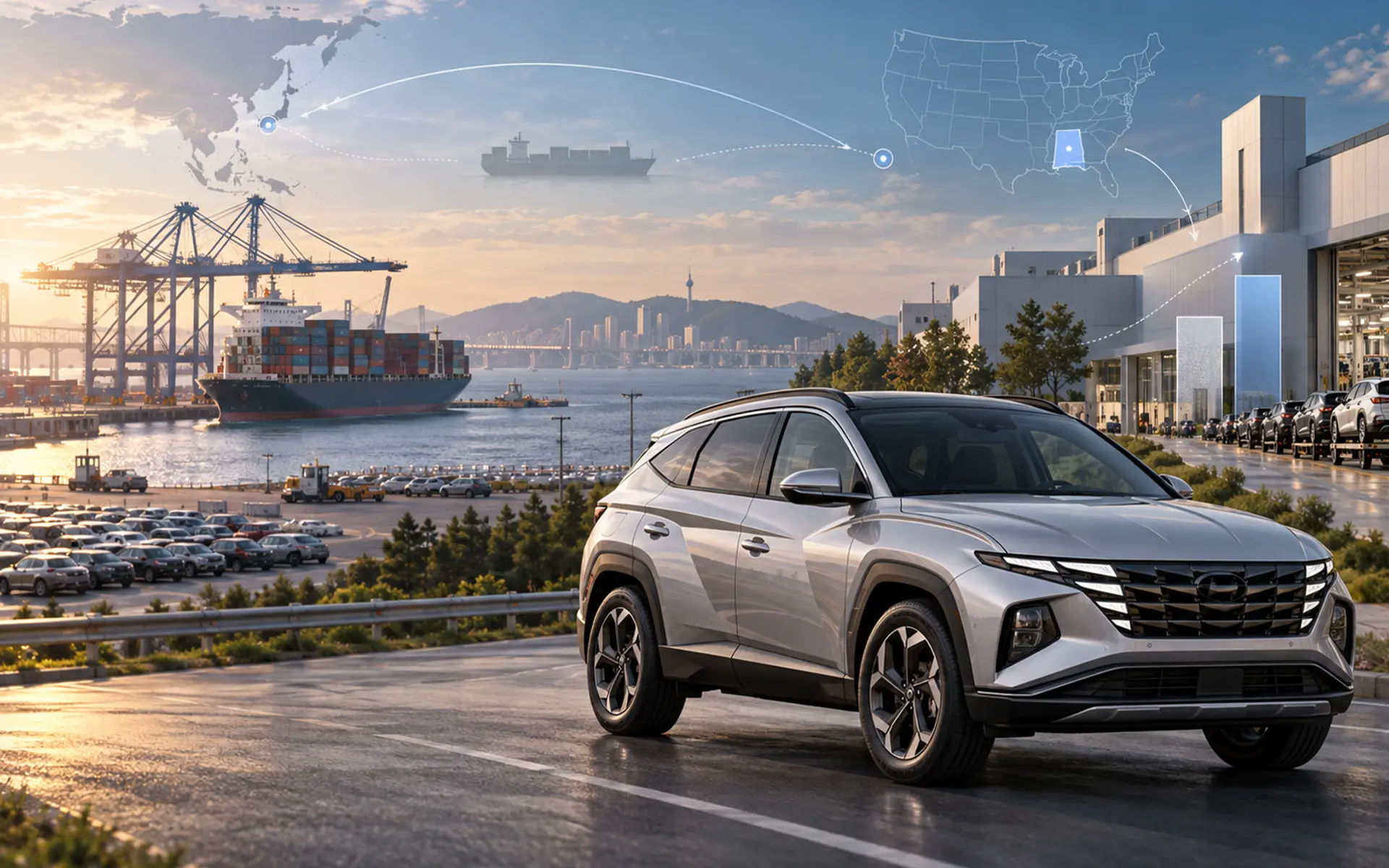
Hyundai says the Tucson Hybrid is moving to Alabama. It hasn't said when, and that gap is where dealer planning goes wrong. Hyundai's own numbers show its Montgomery plant has about 40,000 units of spare room for a hybrid selling at roughly 66,000 a year.
For a dealership operations team, “Alabama-built” sounds like good news: a shorter, steadier pipeline for one of the busiest units on the lot. It's tempting to start adjusting customer promises and inventory expectations now. But the math says the shift will likely be gradual, possibly partial, and uneven by region.
Below, we break down what Hyundai actually confirmed, why your 2026 inbound freight isn't changing yet, and which signals will tell you when it does.
Hyundai confirmed the destination but not the timeline. On September 29, 2026, Hyundai Motor Company President and CEO José Muñoz told the Automotive News Congress in Detroit that Hyundai will invest “about half a billion dollars” in its Alabama operations. The plan moves U.S.-market Tucson Hybrid production from Ulsan, South Korea, to Hyundai Motor Manufacturing Alabama (HMMA) in Montgomery, with the Santa Fe to follow.
A Hyundai spokesperson said the spending also supports new engines and an EREV (extended-range electric vehicle — an EV with a gas engine that recharges the battery) powertrain. Some pieces were already public. Hyundai's August 26 investor presentation confirmed the Santa Fe EREV will be built at HMMA and arrive in the first half of 2027.
That same presentation said the all-new Tucson and Tucson Hybrid would launch in initial markets in the fourth quarter of 2026. That is a product launch window, not a statement about when Alabama production begins. Here is what Hyundai has not disclosed:
The business case itself is clear. Korean-built vehicles have faced a 15% U.S. tariff since November 2025, and Hyundai attributed a 30.8% year-over-year drop in first-quarter 2026 operating profit primarily to U.S. tariffs. HMMA already builds the gas-powered Tucson. The direction isn't in doubt. The timing and volume are.
The project also sits inside Hyundai Motor Group's broader $26 billion U.S. commitment for 2025 through 2028, which covers vehicles, steel, and robotics. Hyundai's 2030 roadmap targets more than 80% North American parts sourcing and a 50% hybrid sales mix in the region. The Tucson Hybrid is the first high-volume hybrid to fit that strategy, and it likely won't be the last.
The announcement changes Hyundai's plan, not this year's freight. With one quarter left in 2026 and no Alabama start date disclosed, the Tucson Hybrids reaching your lot through year-end will almost certainly be Korean-built units moving through the same import network they use today.
Headlines like this one read as finished events. “Hyundai moves Tucson Hybrid production to Alabama” sounds like something that already happened. Teams react accordingly: they tell customers delivery will get faster, expect steadier allocation, or assume port-related delays are about to disappear.
The instinct makes sense, but a hybrid launch at an existing plant takes time. Tooling, supplier validation for hybrid components, pilot builds, and quality signoff all come before the first saleable unit ships. Meanwhile, imported 2026 and early 2027 model-year inventory keeps moving through the ports.
Hyundai's own recent history shows why announced plans deserve some caution. In July 2026, Korean media reported that Hyundai planned to move roughly 30,000 annual Genesis-related units from Alabama back to Ulsan while shifting Palisade hybrid volume toward the U.S. That plan followed labor opposition that shrank and delayed an earlier transfer concept of about 200,000 units.
Hyundai's 2026 roadmap also lists 200,000 units of Georgia plant expansion as announced but not yet installed. The pattern isn't unique to Hyundai. Ford, GM, and Rivian have all delayed or paused announced production in recent years as demand and economics shifted.
None of this means the Tucson Hybrid move won't happen. HMMA already builds the conventional Tucson, the Santa Fe Hybrid, and engines on site, so this extends a working production system rather than starting from scratch. The better reading is that September 29 started a network redesign. Plan around the supply chain you have today, and change plans when the evidence changes.
Hyundai's published numbers suggest Montgomery can't absorb full U.S. Tucson Hybrid demand without changing something else. The arithmetic is simple, though each input carries caveats.
On the supply side, HMMA's published rated capacity is 399,500 vehicles a year, and the plant normally builds about 360,000. On the demand side, Hyundai sold 158,523 Tucsons in the U.S. through August 2026. Korean reporting citing Hyundai data put the hybrid share at 27.8% for that period, which works out to about 44,000 Tucson Hybrids in eight months, or roughly 66,000 at an annual pace.
A full one-for-one transfer would exceed simple headroom by roughly 25,000 to 27,000 units, before any Santa Fe EREV volume is added. And nominal headroom overstates usable room. Paint shop limits, model mix, engine output, and launch downtime all eat into it.
The Santa Fe EREV compounds the squeeze. It is scheduled to arrive from the same plant in the first half of 2027, likely while the Tucson Hybrid is still ramping. Two powertrain launches competing for line time at a plant already running near its normal output is a strong reason to expect a gradual handoff rather than a clean switch.
Hyundai has several ways to close that gap. It could add capacity with the new investment, raise line rates or overtime, move another model's volume elsewhere, ramp slowly, or keep importing some Tucson Hybrids from Korea. It hasn't said which.
For dealers, the practical takeaway is to expect a stretch where the same nameplate arrives from two origins. Korean-built and Alabama-built Tucson Hybrids may sit in the pipeline at the same time, on different routes, with different transit profiles. For perspective, 44,000 units is roughly 7% of Hyundai's 620,025 U.S. sales through August, so Hyundai's import network stays busy with other models regardless.
When Alabama production starts, the vehicle's first U.S. stop shifts from a coastal port to the plant itself. That single change reshapes transit differently depending on where your store sits.
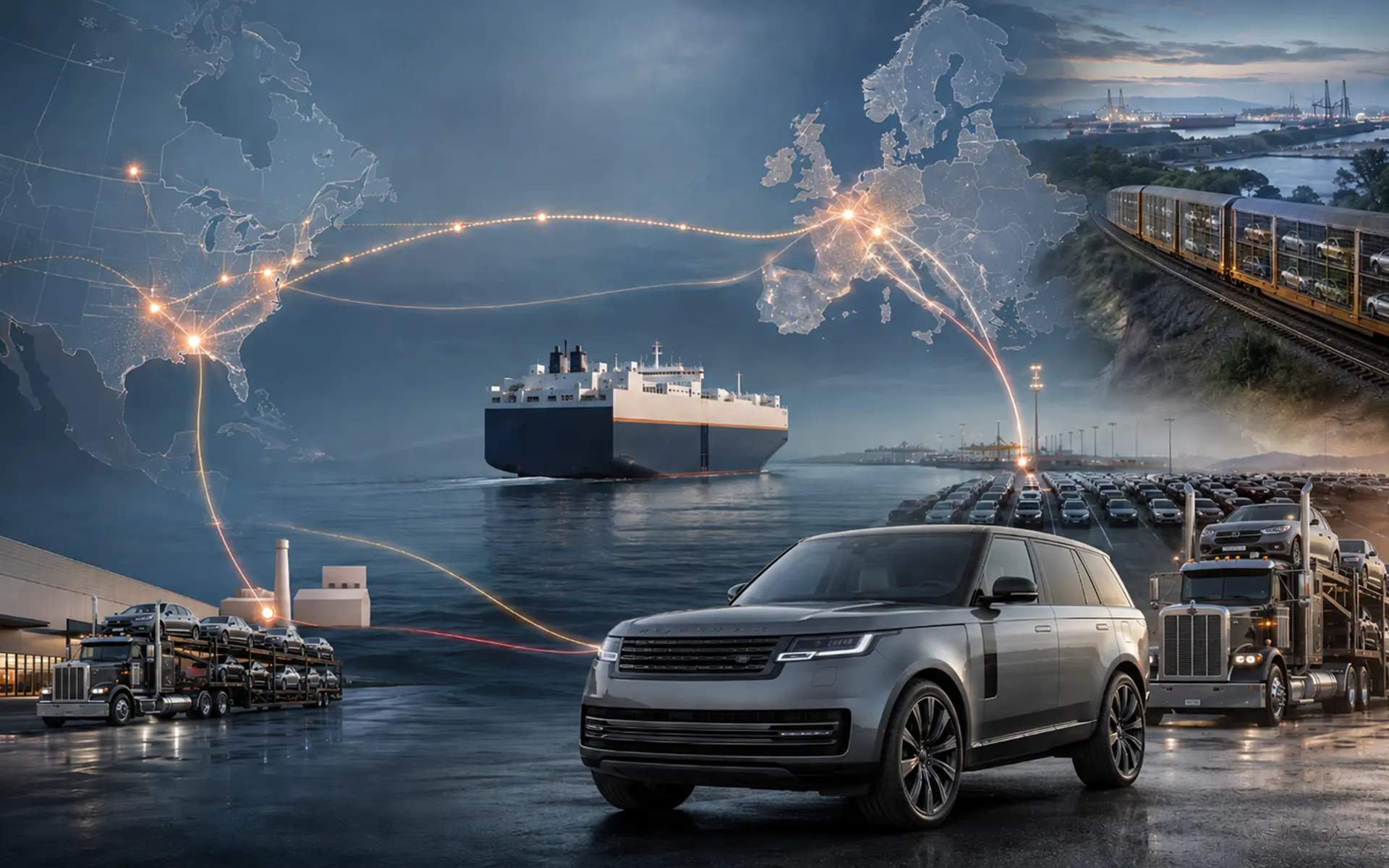
Today, Korean-built units ship from Korean ports to a multi-port Hyundai/GLOVIS network that includes Philadelphia, Brunswick (Georgia), and Port Hueneme (California). There they pass through a VPC (vehicle processing center — where new vehicles are inspected, prepared, and labeled before shipment). From the VPC, they move by truck to dealers, or by rail to a destination ramp followed by a final-mile truck. Hyundai doesn't publish which ports handle the Tucson Hybrid.
After localization, Alabama-built units go from the assembly line to the GLOVIS-operated VPC at HMMA, then out by truck or rail. CSX already serves the plant. For those units, the ocean voyage and port dwell time disappear.
The release pattern changes too. In our plant-origin OEM (Original Equipment Manufacturer — the vehicle maker) work, finished vehicles typically release in steady daily volumes, while port flows tend to arrive in vessel-sized batches that then work through processing. Steady releases make carrier capacity easier to plan and, in our experience, delivery windows more predictable. That benefit comes at steady state, though, not during launch.
Southeast dealers likely see the clearest gain. Stores in Alabama, Georgia, Tennessee, Mississippi, the Carolinas, and Florida sit within truck range of Montgomery. A unit that once entered through a port and then trucked inland could instead start its trip at a plant a few hundred miles away.
Florida is worth watching closely. It has one of Hyundai's largest dealer networks, and today some of its imported inventory likely flows through Southeast ports such as Brunswick. Alabama-built units could move south directly from the plant instead, though Hyundai's allocation system ultimately decides which origin serves which store.
For Texas and Midwest dealers, the bigger change may be how the vehicle travels, not how far. Public material documents rail service out of Montgomery and GLOVIS processing sites in Texas. Longer plant-origin hauls typically move by rail to a destination ramp, then by truck to the dealer, so your delivery window depends on the ramp handoff as much as on the plant.
A Korean-built Tucson Hybrid bound for California currently travels mostly by ocean and has a relatively short domestic leg from the port. An Alabama-built unit for the same dealer skips the ocean voyage but takes on a long inland haul. “Built in America” shortens the trip for some dealers and lengthens the domestic portion for others.
The Northeast may land somewhere in between. In 2020, PhilaPort documented daily Norfolk Southern rail service carrying Montgomery-built Hyundais to South Philadelphia, which shows domestic units can still route through a port-area processing site. Any plan built on a single nationwide assumption will miss these regional differences.
Dealers don't choose how Hyundai ships new inventory — Hyundai and GLOVIS manage that — but you can spot the switch at your own receiving dock before anyone announces it. Watch these signals:
During any two-origin period, track ETAs by origin, not just by model. Two Tucson Hybrids ordered the same week could start on different continents. Customer promises should follow the actual unit's origin and status.
Expect customers to ask about it, too. Some hybrid buyers will have seen the headline and want an Alabama-built unit, or assume every Tucson Hybrid on the lot already is one. The window sticker answers that question in seconds, and a sales team that knows where to look avoids an awkward correction after the sale.
The moves you book yourself are where your team has direct control: dealer trades, wholesale and auction purchases, and transfers between rooftops. If allocation runs uneven during a phased launch, those moves matter more. Look for carriers that track each load by VIN with pickup and delivery photos, and that quote delivery windows with a realistic buffer rather than optimistic exact times.
Why GB Cargo
We're an asset-based carrier headquartered in West Lafayette, Indiana. We own our equipment rather than brokering loads to carriers we can't vet. To be clear, we don't currently haul Hyundai freight. We wrote this because origin shifts like this one reshape the lanes we work alongside.
Our plant-to-dealer OEM work out of a Midwest assembly complex gives us a direct view of how plant-origin freight behaves. Montgomery fits our existing routing, and we adjust routes as demand moves. We track every load with its VINs listed and photos at pickup and delivery, and every client works with a named account manager.
If you'd like to talk through your inbound lanes, our team is glad to compare notes.
When will Alabama-built Tucson Hybrids reach dealers?
Hyundai hasn't disclosed a start-of-production date. The fourth-quarter 2026 launch it referenced applies to initial markets, not specifically to Alabama production. The clearest signals will be a change in the VIN's first character and the final assembly point on the window sticker, or an HMMA launch announcement.
Will Korean-built Tucson Hybrids stop arriving?
Hyundai hasn't announced an end to imports. Given the gap between Montgomery's headroom and current demand, continued imports alongside Alabama production for some period are plausible.
Does this change anything for the gas-powered Tucson?
HMMA already builds the conventional Tucson, and Hyundai hasn't announced changes to it. The open question is line time: if Montgomery runs short of capacity, Hyundai may shift some model's volume, but it hasn't said which one.
Will Alabama production mean faster delivery for every Hyundai dealer?
No. Southeast dealers will likely see shorter transit. Dealers far from Alabama, especially on the West Coast, may see a longer domestic leg even though the ocean voyage disappears. For more on how transport choices affect your store, see our page on transport for car dealerships.
The September 29 announcement tells you where Hyundai wants the Tucson Hybrid built, not when the freight changes. The capacity math points to a gradual, possibly partial shift, and the regional effects run in opposite directions depending on where your store sits. Dealers who plan around confirmed signals rather than headlines will avoid promising customers a supply chain that doesn't exist yet.
Add an origin check to inbound receiving for every Tucson Hybrid: note the VIN's first character and the final assembly point on the window sticker. It takes seconds per vehicle. It will tell your team the week Alabama production actually reaches your lot, so customer promises and inventory plans change on evidence instead of a press quote.
Stay informed on the latest news and insights from GB Cargo.