Rental Fleet Sales Fell 4%. Car-Haul Capacity Didn't Come Back.
Rental fleet sales fell about 4% in 2026, but car-haul capacity stayed tight. Here's why OEM planners shouldn't price 2027 lanes on rental-driven slack.

Rental fleet sales are falling, and car-haul capacity is still tight. Award your next lanes assuming softer rental volume frees up trucks, and you risk contracts carriers won't cover when volume returns. Until August, the published data showed rental purchases rising.
That reversal is worth understanding before anyone builds a 2027 budget around it. When Auto Rental News restated the year using only automakers that reported in both 2025 and 2026, a first-half gain became a decline. And one automaker says it cut its rental sales on purpose.
We run dedicated car-haul capacity for OEMs (Original Equipment Manufacturers — the vehicle makers) out of the Midwest and move rental fleet vehicles on separate lanes. That gives us a view of this question from both sides.
Our view is that the rental slowdown isn't freeing up car-haul capacity. The softness that could have created slack already hit carriers in earlier quarters, and it pushed trucks and drivers out of the market instead of parking them. We're a carrier, so we have a stake in that argument. Below, we lay out the evidence, including the signals that would prove us wrong.
The decline is real, but how big it looks depends on how the numbers are counted. Part of it also reflects decisions automakers made, not rental companies.
Auto Rental News compiles monthly fleet sales reports from automakers and publishes two versions of the result. The comparable figure includes only automakers that reported in both years. The reported figure includes every 2026 submission, even from automakers with no 2025 numbers to compare against.
Through July, comparable rental fleet sales fell 4.2%, from 763,313 to 731,288 vehicles. On the reported basis, rental sales rose 1.4% to 774,242. The gap between those two readings is bigger than the decline itself.
Earlier monthly releases told a different story. The July report showed rental fleet sales up 2.6% for the first half, and only the August restatement showed both quarters down. By the end of August, the comparable decline had reached 34,312 vehicles. The publisher also notes that these figures are not a complete count of U.S. rental purchases.
Timing adds another layer. Rental buyers pulled purchases forward into late 2025, helped by tax changes, which Cox Automotive flagged early this year as a reason 2026 comparisons would be tougher. Before treating any rental headline as a trend, it's worth asking which counting basis it uses and what it's being compared against.
Ford reported a 69% drop in daily rental sales in the second quarter of 2026, the same quarter its Escape and Lincoln Corsair phase-outs took hold. Ford estimated its quarter would have been up about 0.5% without those two factors.
In July, Ford's director of U.S. sales described a 96% decline in the company's daily rental business as intentional, part of a planned pullback from low-margin rental volume. Public data doesn't break out rental sales by automaker, so no one can say exactly how much of the national decline Ford accounts for. But the direction is clear: part of this decline is an automaker choosing to sell less, not rental companies choosing to buy less.
Unit counts are the wrong number for capacity planning. A car hauler's real limit is deck space, and the rental mix is moving toward vehicles that use more of it.
Through July, sales of passenger cars into rental fleets fell 18%, while truck and SUV sales rose 1.1%. Trucks and SUVs grew from 72.2% to 76.2% of comparable rental sales. The entire net decline came from cars, the vehicles that load most efficiently.
In our experience, a full load of SUVs drops a 9-car hauler to 7 or 8 vehicles, depending on the type of SUV. That's one or two fewer vehicles on every truck.
That makes the shape of the decline more important than its size. The vehicles that dropped out were the most deck-efficient in the rental mix, so the rental loads that remain are, on average, less dense than last year's. The same truckload budget now moves fewer rental vehicles.
Here's where unit-based planning goes wrong. A forecast built on units treats a 4% drop in vehicles as roughly 4% fewer loads. When the mix shifts toward larger vehicles at the same time, that math stops working.
In this example, an order that shrinks by 4% but shifts from sedans to SUVs needs 12 to 14 loads instead of 12. Real loads mix body styles, so actual results land in between. The direction holds, though: fewer units don't automatically mean fewer loads.
The broader fleet market points the same way. Through August, comparable commercial fleet sales rose by 35,225 vehicles, almost exactly offsetting rental's 34,312-vehicle decline. Commercial fleet vehicles go to different destinations than rental units, but they still ride on car haulers. In our own dedicated OEM volume, we haven't seen a rental-driven dip.
The fix is to plan in loads by body style and to confirm units per load with the carrier on each lane. Equipment configuration affects that answer, so it belongs in the capacity conversation from the start.
On paper, rental-bound freight looks like some of the easiest in the network. Airport rental lots concentrate large volumes at a few addresses, which suggests dense loads, few stops, and a low cost per vehicle.
In practice, many drivers try to avoid airport locations. Most sit in or near big cities, so a delivery means more time in traffic, and a delay that starts as a few hours can turn into lost days. That time is a real cost, even when the stop count looks efficient. It also carries forward: a truck held up in city traffic arrives late to its next pickup, and that schedule slips too.
To be fair, fewer airport deliveries do give some hours back to the network. But a smaller rental order book doesn't make the remaining airport loads any quicker or more attractive to drivers. Planners should model rental-bound lanes on truck time, not stop count, whatever the sales headline says.
We move vehicles for car rental companies on lanes separate from our dedicated OEM work, so we deal with this friction directly. It rarely shows up in fleet sales reporting, but it shapes what those lanes actually cost to cover. For planners with rental deliveries in their outbound mix, the hardest stops, not the average stop, usually decide what a lane costs.
The best public evidence shows car-haul capacity tightening in 2026, not loosening. The reason lies in what happened to carriers before rental sales turned down.
Proficient Auto Logistics (PAL) is the only publicly traded car-haul carrier, which makes its results a rare window into the market. In the second quarter of 2026, PAL's deliveries fell 8% to about 581,000 vehicles. The company said it couldn't find enough capacity, after several quarters of poor economics forced many haulers to close. Its CEO described the auto-haul industry as being at an inflection point, with regulation, rising operating costs, and the work of attracting and keeping drivers all tightening capacity.
On its first-quarter call, PAL's CEO explained why this surfaced now. When volume rebounded in March and April, supply losses that had been hard to see during the slow period became obvious. He tied those losses to low volumes, weak rates, tighter regulatory scrutiny, and drivers moving into other kinds of trucking as broader freight rates improved.
He also described contracts awarded below market rates over the previous six to 12 months that struggled to secure consistent capacity once seasonal volume returned. In several cases, that freight was redistributed at market-level pricing. That is the practical risk of pricing lanes around slack that doesn't exist.
Consolidation points the same way. PAL's agreement to acquire Hansen & Adkins combines existing fleets rather than parking them, and FreightWaves reported it would lift PAL's market share to roughly 25%. We examined that shift in our analysis of the Proficient–Hansen & Adkins deal.
Two federal changes have reduced the number of eligible drivers. Since June 25, 2025, inspectors have been able to place drivers out of service if they can't demonstrate English proficiency, under criteria from the CVSA (Commercial Vehicle Safety Alliance — the group that sets roadside inspection standards).
Then, on March 16, 2026, a final rule from the FMCSA (Federal Motor Carrier Safety Administration — the federal body that regulates commercial trucking) took effect. It limits non-domiciled CDLs (Commercial Driver's Licenses issued to drivers from other countries) to three employment-based visa categories. Work permits alone no longer count as proof of eligibility.
Across the industry, qualified car-haul drivers are harder to find than they used to be, and many drivers affected by the non-domiciled CDL rule are simply leaving trucking. It isn't a staffing problem for our own team. But every carrier recruits from the same, smaller pool.
We want to be precise about our own evidence. So far, we haven't seen carriers exit on our corridors, and our dedicated OEM volume hasn't shown a rental-driven dip. That's why the capacity case above rests on PAL's disclosures and federal rule changes rather than on our own lanes.
Our read is that rental sales aren't what's moving capacity. If anything, the relationship runs the other way: driver supply, operating costs, and regulation set how much capacity exists, and rental volume moves inside those limits.
Our rates are slightly up this year, and we'd overstate our case if we credited that to tight capacity alone. Fuel is a big part of it.
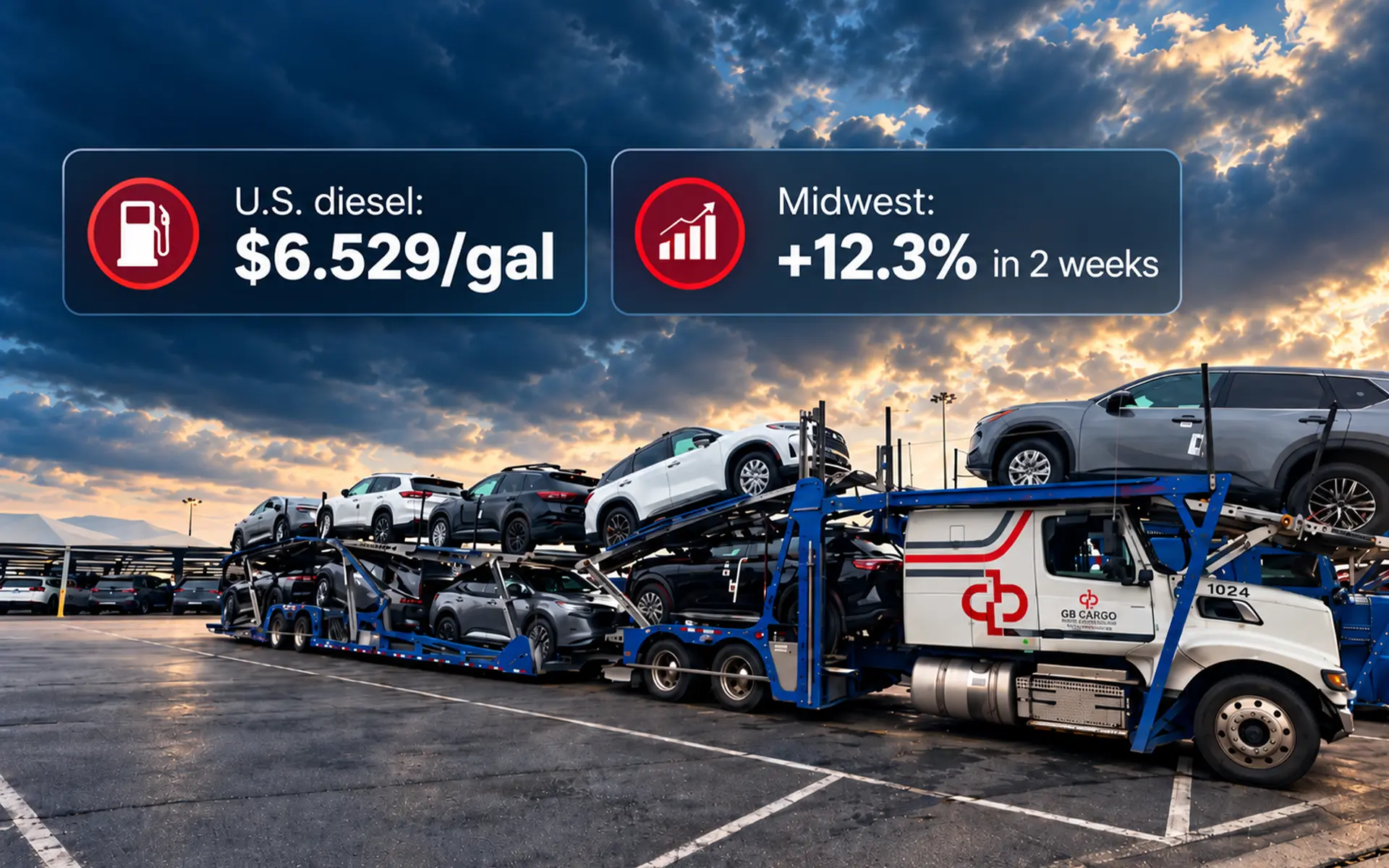
The EIA (U.S. Energy Information Administration — the federal agency that tracks fuel prices) put the national average on-highway diesel price at $5.97 per gallon for the week of September 7, 2026. That's up $2.20 from a year earlier, and it raises the cost of every loaded and empty mile.
Fuel surcharges usually reset on a schedule, so when diesel climbs quickly, carriers absorb the extra cost until the index catches up. PAL estimated that timing gap cost it about $1 million in the first quarter alone. It's also why a bid that looks higher than last year's can carry a flat base rate once fuel is backed out.
PAL's second quarter shows the same pattern at a larger scale. Higher fuel, equipment, and driver costs arrived before customer pricing caught up. As rate adjustments took effect, PAL's margins improved each month, reaching a 95.7% adjusted operating ratio in June (operating expenses as a share of revenue, where lower is better).
One limit applies to everyone making claims about car-haul rates, including us. There is no public, car-haul-specific rate index, so no one can prove from public data that rental volume moved rates in either direction. What the evidence does show is costs rising and capacity tightening at the same time.
We're a carrier, so we have a stake in the argument that capacity is tight. Weigh our view with that in mind, and watch for these signs that real slack is building:
If those signals show up together, the rental slowdown may finally be loosening the market. Today, the evidence points the other way. We'll keep watching for them, and we'll say so if they appear.
A common response to a soft sales headline is to rebid early and push for lower rates. That can work in a loose market. In a tight one, it tends to produce awards that look good on paper and struggle for coverage when volume returns, which is the pattern PAL described.
The more useful change is to plan capacity in loads, not units. These four checks help before an RFP (Request for Proposal — the formal bid process used to award transport lanes) or a contract renewal.
None of these checks depend on predicting where rental sales go next. They make a lane plan hold up whether the rental headline rises, falls, or gets restated again.
GB Cargo is an asset-based auto transport carrier headquartered in West Lafayette, Indiana. We own and operate 40+ trucks, including 9-car haulers and stinger configurations, and we hold multi-year dedicated OEM contracts for plant-to-dealer moves.
Because we own our equipment, we control scheduling and quality directly, and we invest in new equipment to support safety, reliability, and vehicle condition on delivery. Every client works with a named account manager and can follow shipments through real-time tracking from pickup to delivery.
Why are rental fleet sales down in 2026?
Through July, comparable rental fleet sales fell 4.2%, and the entire net decline came from passenger cars, while trucks and SUVs edged up. Pull-ahead buying in late 2025 made this year's comparisons tougher. Ford also cut rental sales sharply after ending Escape and Corsair production and deliberately pulling back from low-margin rental volume.
Does a drop in rental fleet sales lower car-haul rates?
Not so far: public carrier results and diesel prices point to firmer rates in 2026, because capacity had already tightened after earlier weak quarters. Larger rental vehicles can also require as many loads even when unit counts fall. Diesel alone was up $2.20 per gallon year over year in early September. No public car-haul rate index isolates rental's effect.
How many SUVs fit on a 9-car hauler?
In our experience, 7 or 8, depending on the type of SUV. That's one or two fewer vehicles per load than a full load of sedans, which is why load forecasts should follow body-style mix.
How do FMCSA's driver rules affect car-haul capacity?
English-proficiency out-of-service enforcement since June 2025 and the non-domiciled CDL final rule effective March 16, 2026 have both narrowed the pool of eligible drivers. Qualified car-haul drivers were already hard to find, so the smaller pool shows up directly in industry-wide hiring. Drivers holding existing non-domiciled licenses must meet the new standard when they renew.
The rental fleet sales decline measures what automakers chose to sell, which vehicles they sold, and how the numbers were counted. Car-haul capacity is set by something else entirely: the trucks and qualified drivers still on the road after several hard quarters, and how many vehicles each of those trucks can carry. In 2026, those two measures aren't moving together, and the evidence suggests capacity is the one that will set the terms. Planners who price lanes on the rental headline are planning for slack the market hasn't produced.
Before your next lane award or renewal, rebuild the capacity forecast in loads by body-style mix, with fuel separated from base rate. Start with your highest-volume lanes that end at airports or major metro areas, where mix shift and delivery time have the biggest effect. If a carrier's read on the load math would help for specific lanes, walk through your lane plan with our team.
Stay informed on the latest news and insights from GB Cargo.