What the JLR–Stellantis Agreement Would Actually Change in Finished Vehicle Logistics
A U.S. Defender program would likely add volume, not remove it. What the JLR–Stellantis record actually supports, and what finished-vehicle planners should hold.
Analysis current as of August 28, 2026, when no binding manufacturing agreement between the two companies has been publicly identified.
Three months of coverage, and still no agreement. Planners are being asked to model an import lane closing. But when BMW, Mercedes-Benz, and Volvo localized production here, their ports gained volume rather than losing it.
Since Jaguar Land Rover and Stellantis signed a memorandum in May 2026, the story has been reported as settled. Production moving to the United States. A finished-vehicle lane from Slovakia winding down. Network teams are being asked what it means for volume already on their books.
The record underneath is thinner than the coverage. What exists is a non-binding memorandum, a chief financial officer’s conditional remarks on an earnings call, and a target — not a commitment — to sign something binding around the end of 2026.
That target is what makes this a planning question now rather than later. The next piece of hard information arrives within months, and the base case a team carries into that window determines how much rework the announcement causes. This article separates what the record supports from what the coverage added, walks the current chain node by node, and argues that the most likely volume effect runs in a direction almost nobody is modeling.
Four dated events make up the entire public record, and none of them commits either company to anything.
On May 20, 2026, Stellantis and JLR announced a non-binding MOU (Memorandum of Understanding — a preliminary document recording intent to explore a deal, with no obligation to complete one). The release covered exploring collaboration on product and technology development in the United States. It also stated plainly that any resulting transaction would be subject to customary closing conditions, including execution of binding definitive agreements.
On June 17, JLR said it was increasing its North American focus and exploring new opportunities for the Defender brand alongside Stellantis. The same communication continued to identify Nitra, Slovakia as the Defender production location.
On August 13, JLR held its FY27 first-quarter investor call. CFO Richard Molyneux said the company sells roughly 30,000 Defenders a year in the United States, and that localizing existing vehicles would not be efficient at 30,000 units or even at 50,000. He described the opportunity as new vehicles in new segments under the Defender name, U.S. produced, and said a specific manufacturing agreement was targeted around the end of 2026.
On August 14, Stellantis raised its Belvidere, Illinois investment past $800 million for the next-generation Jeep Cherokee on its STLA One platform. That release names no JLR product and makes no Defender reference.
Then the coverage diverged from the source. A Yahoo Finance headline stated that JLR had handed U.S. Defender production to Stellantis. The investor-call language underneath that headline is exploratory throughout, and the CFO spent part of it explaining why localizing the current range does not work.
We are not raising this to score a point against a publication. We are raising it because the gap between the two framings is where planning error enters. A team that reads "handed production to Stellantis" builds a substitution scenario. A team that reads the transcript builds an addition scenario. Those produce different capacity commitments, and the year-end target means both teams find out which one was right inside the next few months.
The European leg of this lane is unusually well documented, and the U.S. leg is almost entirely dark. That asymmetry shapes what anyone can honestly claim about it.
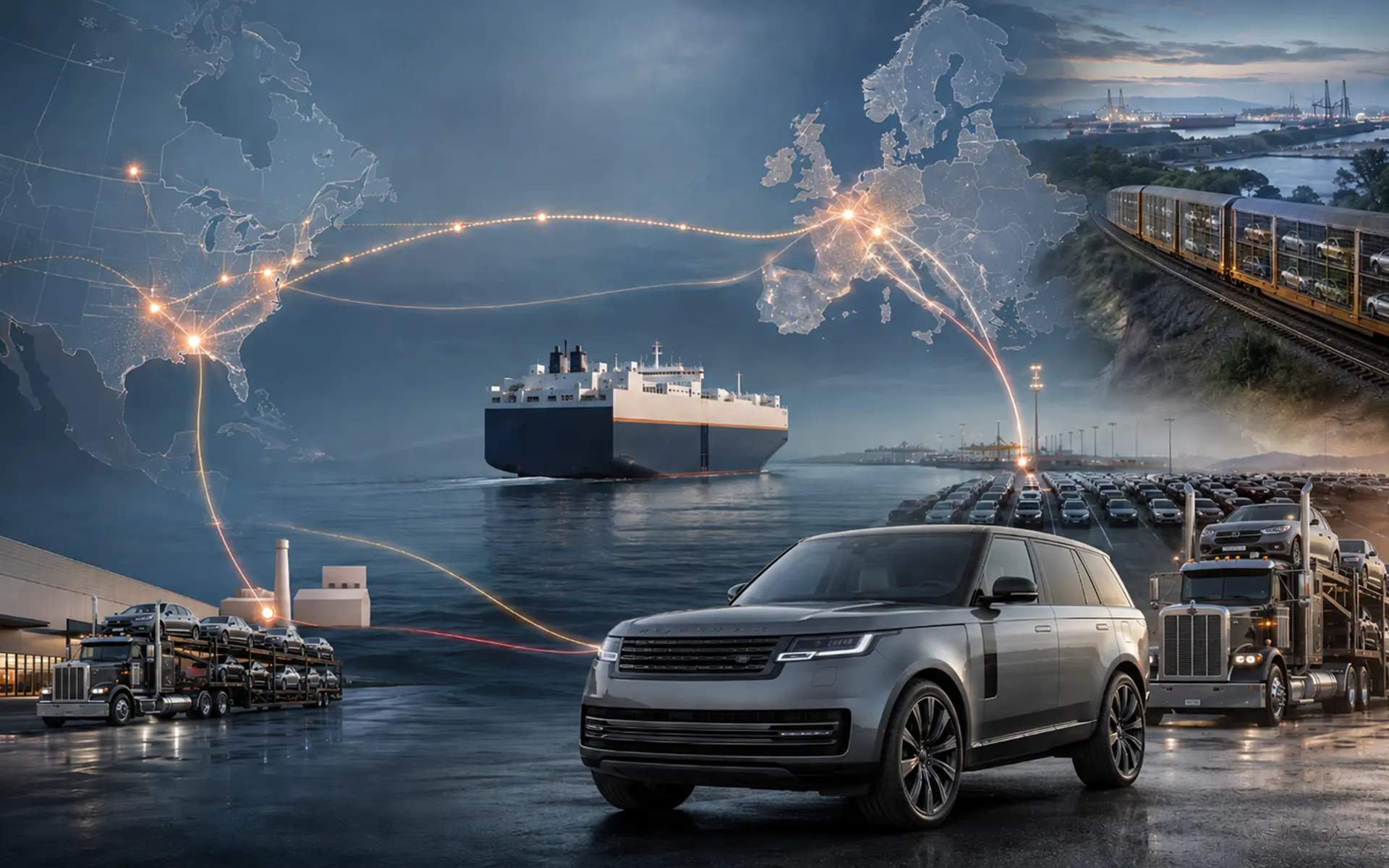
DB Cargo has published the physical loading pattern at Nitra rather than just announcing a contract. Eight block trains a week move Defender and Discovery output toward Belgian North Sea ports, carrying roughly 1,600 vehicles in total. A documented train runs 19 double-deck wagons at about 200 vehicles per train. The route covers roughly 1,300 kilometers through Slovakia, Austria, and Germany. Seven of the eight trains run direct to port. The eighth terminates at the Neuss trimodal terminal in Germany, where vehicles can be buffered and forwarded to port by road or barge.
That level of published operational detail is rare. You can read DB Cargo’s own description of the Nitra rail partnership and reconstruct the European movement with reasonable confidence. Antwerp and Zeebrugge appear in the contract reporting as the Belgian gateways.
On the U.S. side, three main entry points are identified in specialist logistics reporting: Brunswick, Georgia; Baltimore, Maryland; and Port Hueneme, California. Brunswick is the mature node. Ahead of the current Defender’s U.S. launch, JLR moved into a larger VPC (Vehicle Processing Center — the facility where imported vehicles are inspected, accessorized, updated, and released to dealers) operated there by Wallenius Wilhelmsen Solutions.
After that, the record stops. No public source establishes the ocean carrier, the vessel service string, the sailing frequency, or the transatlantic transit time for this specific lane. No source gives the volume split across the three ports. No source gives the rail-versus-truck split for dealer delivery, the secondary ramp map, or the average final haul distance.
This matters more than it looks. Any article that hands you a transit time or a modal split for JLR’s U.S. distribution has invented it, because the underlying contracts are commercially confidential and no operator publishes them at brand level. The honest planning move is to mark those fields unknown rather than populate them from generic industry ratios. We would rather tell an OEM planner that a number does not exist than supply a plausible one.
The published rail figure covers two nameplates — Defender and Discovery — moving toward seaports for every destination market, not just the United States. Nitra has a rated capacity of roughly 150,000 vehicles a year across both models.
Treating 1,600 a week as U.S. Defender throughput would overstate the lane by a wide margin. The only public figure for U.S. Defender scale remains management’s approximate 30,000 a year, and that number was given as a scale estimate on an earnings call, not as an audited retail count.
None of these cases predicts JLR. Their value is that they show which parts of a logistics network survive localization and which parts do not.
The intuitive base case is substitution. A plant opens here, the imported units stop arriving, and the port relationship winds down in proportion. It is a clean model and it is easy to defend in a planning meeting. It has also not happened in any of the four documented cases.
BMW committed to Spartanburg in 1992 and began production in 1994. Charleston recorded BMW imports around the launch period and exports beginning in March 1995. Imported BMW passenger cars and MINIs continued moving through Charleston while Spartanburg became the largest U.S. automotive exporter by value, sending roughly 200,000 to 225,000 vehicles a year abroad. The port did not lose BMW. It became a two-way node.
Mercedes-Benz announced Tuscaloosa in 1993 and started production in January 1997. Thirteen years later, in 2010, it opened a VPC at Brunswick expected to handle more than 40,000 imported vehicles a year — explicitly pairing those imports with Alabama-built exports that had used the same port since 1997. By 2013, trade reporting described Mercedes imports as split roughly 40% Baltimore, 30% Brunswick, and 30% Long Beach, while about 80% of Tuscaloosa exports moved through Brunswick.
Volvo went further and designed the hybrid deliberately. Ahead of its 2018 Ridgeville launch, the company said it would keep using Newark, Baltimore, and Brunswick for imports and route only some imported cars through the plant’s own VPC so they could be combined with locally built vehicles. Six months after start of production, it began exporting U.S.-built S60s to Europe.
Hyundai is the one case of steep import contraction. Combined Hyundai and Kia electric-vehicle exports from Korea to the United States fell from 59,705 units in January through May 2024 to 7,156 in the same period of 2025, an 88% decline, as Georgia production ramped. That is real substitution — at a plant with initial capacity of 300,000 units a year heading toward 500,000, roughly ten times the entire U.S. Defender baseline.
The pattern across all four is consistent. Local production changes the origin node first. It does not automatically erase the import network, and the degree of contraction tracks the scale of what gets localized. At Hyundai’s scale, imports collapse. At the scale JLR is discussing, the precedent points the other way.
Here is the position we will defend: a U.S. Defender program would most likely increase total finished-vehicle movement, and most of that increase would be export volume rather than domestic dealer volume.
The reasoning starts with JLR’s own arithmetic. Molyneux ruled out localizing the current range because 30,000 units, or even 50,000, cannot carry the fixed cost. That arithmetic does not improve because the vehicle is new. A new nameplate built for the U.S. market alone faces the same problem the existing one does, and building it inside another company’s plant reduces the capital burden without changing the volume math on the production line itself.
Now look at what every precedent plant did about that same problem. Each one was sized above pure domestic demand and carried an export mandate from the outset, because global-market absorption is what justifies the investment. BMW and Mercedes-Benz still export a majority of output decades in. Volvo was shipping to Europe within six months of start of production. Export capability was designed in, not added later when domestic demand disappointed.
Apply that to "new vehicles, new segments." The phrase describes products that do not exist yet, aimed at segments JLR has not defined publicly. If those products were intended only to replace 30,000 units of U.S. demand, the program would inherit the exact inefficiency the CFO used to rule out localization. A program sized for North America plus export markets does not.
The logistics consequence is specific, and it is not what the substitution narrative predicts. Under substitution, ocean volume falls and dealer distribution shifts to shorter domestic hauls. Under export-oriented addition, the Nitra lane continues largely as it is, a new domestic origin appears, and a second flow runs from that plant back toward a port. Total vehicles moved goes up. Part of the flow reverses direction.
That reversal is what changes the work. A plant with an export mandate generates concentrated rail-to-port movement plus regional truck distribution around the plant. A plant without one generates truck-heavy dispatch across the full national dealer map. Those are two different network shapes with different carrier requirements, and the variable that decides between them — market allocation — has not been announced.
We want to be clear about the evidentiary status here. No export mandate exists in any source. JLR has announced no market allocation for a program that has not been agreed to. This is inference from four documented precedents applied to a case that differs from all of them, and a reader who thinks the volume math will simply not clear the bar has a fair argument. What we would resist is the assumption that the only two outcomes are "nothing happens" and "the import lane closes."
Thirty thousand vehicles a year is about 82 vehicles per calendar day before seasonality. On nine-car haulers, that is roughly nine full loads a day spread across the entire United States.
Nine loads a day is a real business and a rounding error at the same time, depending on what you are comparing it to. Against a single dealership’s inbound needs it is substantial. Against the dispatch volume of a major assembly complex — where thousands of units a week leave the yard — it disappears into the existing pattern.
That number is the reason we expect a Defender line to ride its host plant’s outbound system rather than generate a dedicated one. Nine loads a day does not justify a dedicated rail ramp, a captive haulage pool, a separate carrier tender, or a purpose-built processing facility. It justifies adding VINs to dispatch runs that already exist.
This is consistent with what we see running OEM plant-to-dealer inbound moves out of a Midwest assembly complex. Incremental programs at this scale typically get absorbed into existing dispatch rather than tendered separately. The economics of a separate tender rarely work until a program can fill loads on consistent lanes, and a nationally dispersed nine loads a day does not do that in most weeks.
Two caveats on the arithmetic. It is illustrative rather than a forecast — real dispatch clusters around dealer density and production cadence, not calendar days. And it describes the current Defender baseline, not a new program whose volume nobody has disclosed. If the new segments are sized for export as we argue above, the load math changes materially, and it changes in the direction of concentrated port-bound movement rather than dispersed dealer delivery.
Whichever site is selected determines origin-to-dealer distances and therefore every modal threshold downstream of it. This is the single largest unresolved logistics variable, and it is genuinely unresolved — no plant has been named by either company.
A central U.S. origin raises the relevance of long-haul rail for distant markets and shortens truck hauls into the dense Midwest and Northeast dealer base. A Michigan or Ohio origin sits inside a mature automotive dispatch ecosystem with multiple competing East and Gulf Coast port options for any export flow. Those are different networks, and you cannot design either one until the site is known.
One assumption worth retiring: idle does not mean available. Belvidere was the obvious speculation target while it sat empty, but it now carries a next-generation Cherokee program with pilot production targeted for the first half of 2028 and series production for the second half of 2029. Brampton is idle, but it is in Canada, which works against the tariff rationale for the whole arrangement, and Stellantis notified Unifor in August that it was considering a sale. Toledo, Warren Truck, Detroit Assembly Complex, and Sterling Heights all carry announced programs of their own.
Available line capacity is not disclosed at the resolution this question needs. A plant can look underutilized in annual corporate data and still have no practical launch window on the right line, paint mix, or model-year cadence. Announced programs and launch calendars are the better public proxy.
On the leg where both the trade press and the research record go quiet — the final leg to dealer lots — one comparator is worth noting. Automotive Logistics reported that in 2025, 97% of Nissan vehicles leaving Brunswick moved by truck. Georgia Ports Authority separately reported that more than 90% of autos using rail at Colonel’s Island were U.S.-built exports.
Read together, those two figures describe a terminal where rail serves the export direction and imports leave predominantly by road. That matches what we typically see running port and VPC-origin hauls, and it is consistent with the equipment we run on those loads. It is not evidence about JLR specifically — no public source gives JLR’s modal split — but it does suggest that a planner assuming heavy rail participation on the import side is likely working from the wrong default.
Six events would each move this from scenario to plan. Everything else is commentary.
We would argue for trigger-based review over calendar-based review here. Rechecking weekly speculation before one of these six fires adds less information than watching the primary corporate record and the state economic-development filings that usually precede a plant announcement. A signed agreement or an incentive filing tells you something. A headline restating the May memorandum does not.
We are an asset-based carrier. We own and operate our equipment rather than brokering loads to third-party carriers we cannot fully vet, which gives us direct control over scheduling, condition, and compliance.
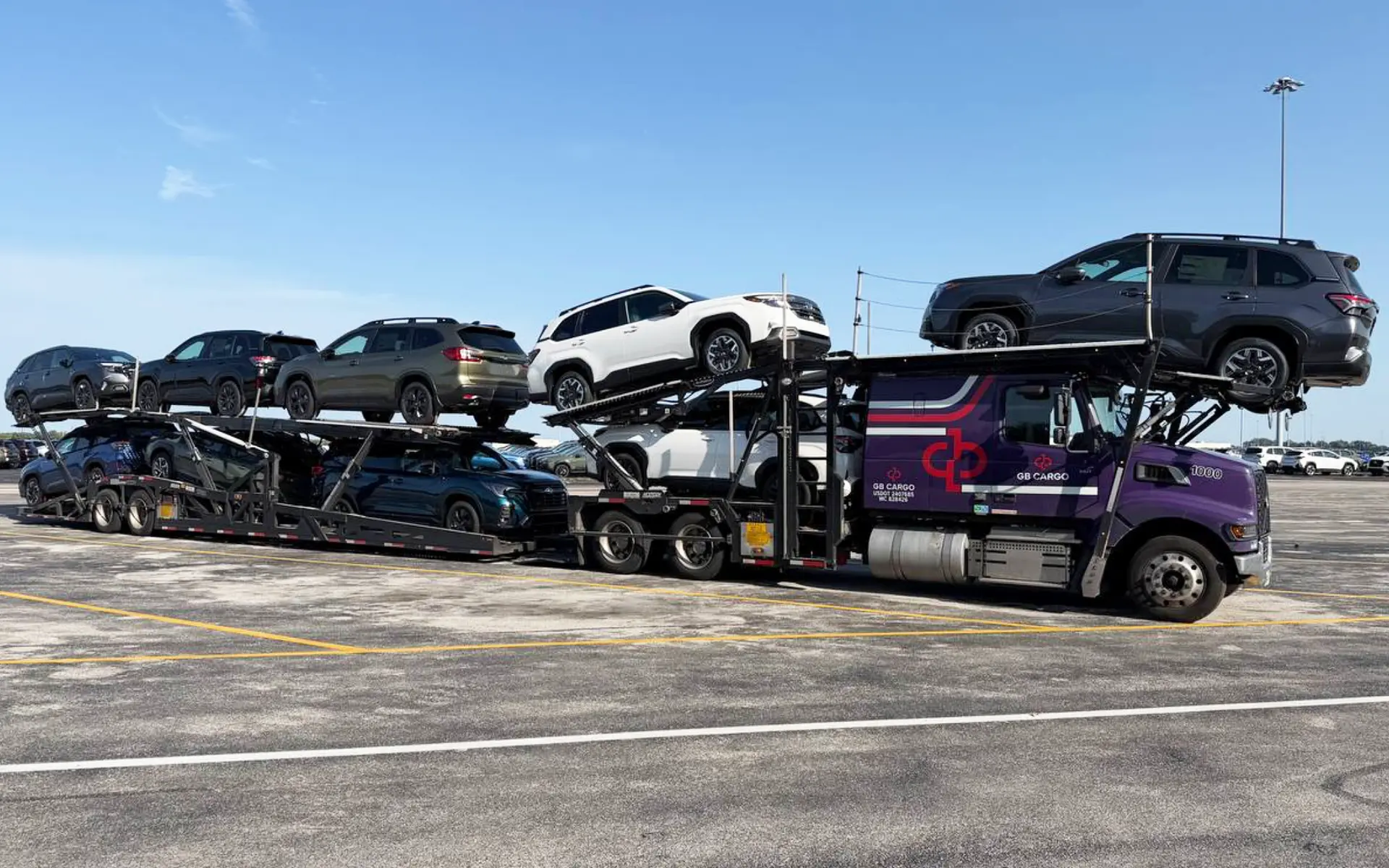
We run 40-plus nine-car haulers on OEM plant-to-dealer inbound, auction, and fleet moves, including multi-year dedicated contracts. Every account has a named point of contact rather than a rotating dispatch queue, and clients track shipment location and status from pickup through delivery.
We do not currently haul Land Rover Defender volume, and nothing in this article should be read as a claim about JLR’s network. The operational observations here come from the lanes we actually run.
Has JLR committed to building Defenders in the United States?
No. As of August 28, 2026, the public record consists of a non-binding memorandum signed in May 2026 and management commentary from an August earnings call. No binding manufacturing agreement, plant allocation, production volume, platform, or start-of-production date has been announced by either company.
When will we know?
JLR’s CFO said a specific manufacturing agreement was targeted around the end of 2026. That is a target rather than a commitment, and targets in this industry move. Even if an agreement is signed on schedule, it would not by itself fix a plant, a volume, or a production date — those typically follow in separate announcements.
Would U.S. production end Defender imports from Slovakia?
Nothing in the current record suggests it would. Molyneux explicitly said localizing the existing Defender range does not make sense at current volume and described the U.S. opportunity as new vehicles in new segments. Under that framing the two flows would run in parallel rather than one replacing the other. The BMW, Mercedes-Benz, and Volvo cases all show imports continuing for years or decades after domestic production started.
Which U.S. ports currently handle Land Rover vehicles?
Specialist logistics reporting identifies three main entry points: Brunswick, Georgia; Baltimore, Maryland; and Port Hueneme, California. Brunswick is the best-documented node, with a JLR processing facility operated by Wallenius Wilhelmsen Solutions. The volume split across the three is not publicly disclosed.
The documented record between May and August 2026 supports addition, not subtraction. A localization decision changes the origin node first, and in every comparable case the existing ports kept their volume and picked up a second direction. The planning error is treating a conditional, non-binding announcement as a deletion — and then discovering at year-end that the flow got bigger instead of smaller.
Carry the contingent U.S. origin as a separate node in your network model rather than substituting it for the Nitra lane, and hold both until a definitive agreement names a plant and a market allocation. Doing that before year-end costs almost nothing and saves a rebuild afterward. If you want to work through what a specific lane looks like under either scenario, our team can walk through it with you, and a dedicated account manager stays with the program from planning through delivery with visibility from pickup to drop.
Sources
DB Cargo, on the Nitra–Belgium finished-vehicle rail partnership: dbcargo.com. Georgia Ports Authority, on Brunswick auto and heavy-equipment throughput: gaports.com.
Stay informed on the latest news and insights from GB Cargo.