Illinois’ Biometric Law and the New Wave of Secure Vehicle Release Tools
New secure vehicle release tools verify drivers, not authority. What OEM planners should know about Carpass, Cox SVT, Carmack liability, and Illinois BIPA.
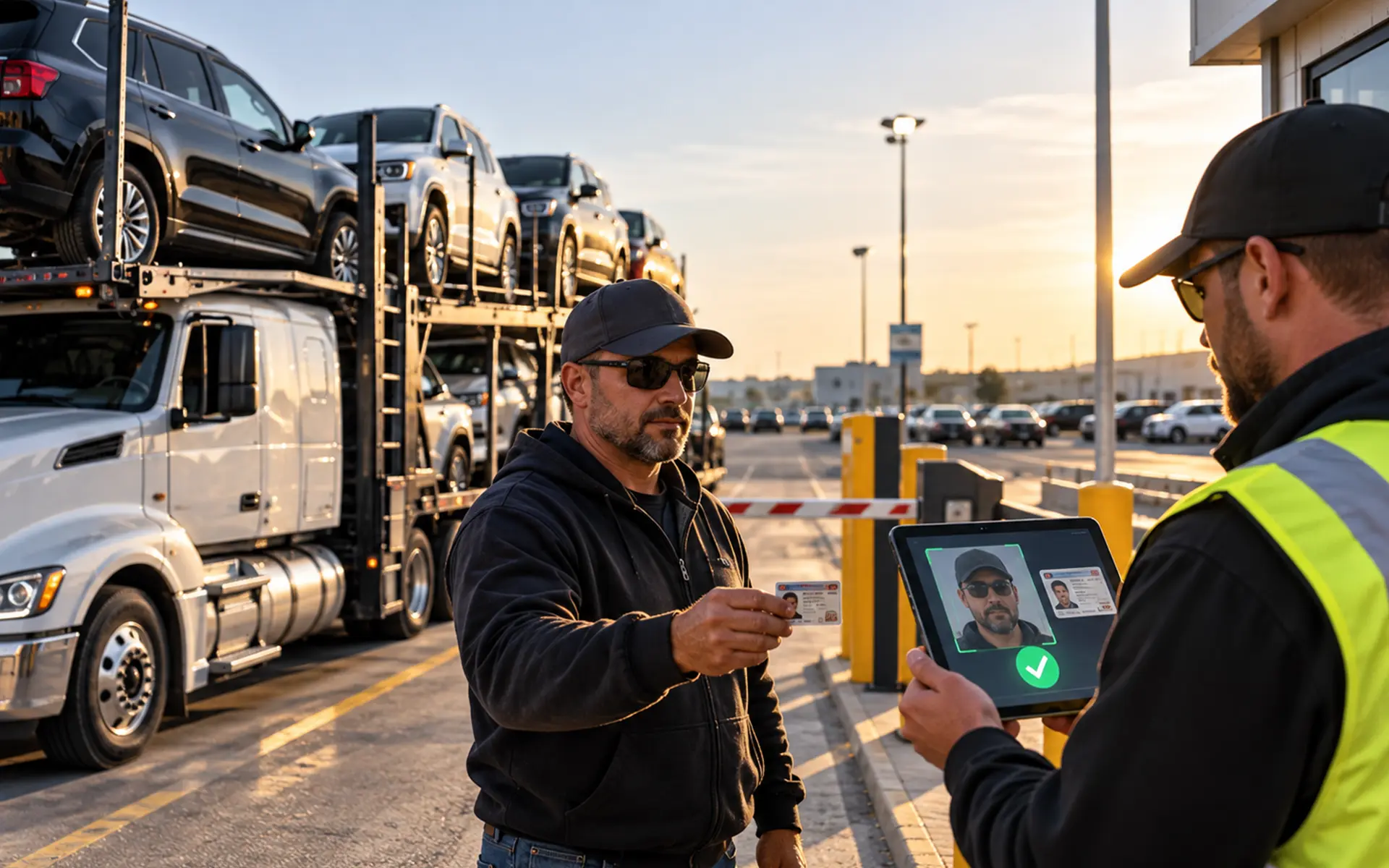
A verified driver can still be the wrong driver. New release tools confirm who is standing at the pickup gate, but fraudulent pickups usually succeed on a different question: was that person ever authorized to take this VIN today? And in Illinois, the face scan that answers the first question creates legal duties of its own.
That matters to OEM (Original Equipment Manufacturer — the vehicle maker) logistics planners because a wrong release doesn’t end with a missing unit. It opens a custody dispute about who had the vehicle, who approved the handoff, and whose contract absorbs the loss.
This year brought three notable responses. Cox Automotive piloted Secure Vehicle Transfer in August, ACV tightened its seller release procedures, and on October 20, Carpool Logistics announced Carpass, a broker-run release system built on biometric driver verification. Each one strengthens part of the pickup, but none of them, on their published terms, settles who pays when the check approves the wrong transaction.
Below, we break down what these tools prove, what they leave open, and what planners should require no matter which system shows up at their gates.
A release is secure only when four distinct questions get four independent answers. Most release fraud works by letting one answer stand in for another.
The substitution problem is where losses start. A genuine DOT number (the U.S. Department of Transportation registration number that identifies a motor carrier) on a truck door proves the carrier exists, not that this driver works for it. A printed gate pass proves someone obtained the document, not who they are. A verified face proves identity, not authority.
This framework is useful because it’s vendor-neutral. Before evaluating any release tool, a planner can ask which questions it answers directly, which it infers from something else, and which it leaves to the person at the release desk.
Documented release fraud rarely defeats a strong check head-on. It finds the place where a convincing document, name, or account substitutes for one of the four answers.
Automotive reporting in 2026 described several recurring schemes. Criminals impersonate legitimate transport companies and arrive with convincing paperwork. Some monitor transport listings, identify the pickup location, and collect the vehicle before the real carrier arrives. Others use stolen credentials or cloned websites to get inside logistics platforms, then divert vehicles by altering dispatch details.
Each scheme maps to a skipped question. Impersonation exploits question two, and arriving first exploits question four. A hijacked platform account is the hardest case because it corrupts question three — the assignment itself — so every downstream check confirms the wrong transaction correctly.
The true scale is unknown, and planners should be skeptical of anyone quoting a single number. No reliable national data series counts finished-vehicle release fraud. The NICB (National Insurance Crime Bureau — an insurance-industry nonprofit that tracks vehicle crime) reported 268,415 vehicle thefts in the first half of 2026, 21% below the same period in 2025, but that figure covers all motor vehicle theft and doesn’t isolate fraudulent transport releases.
The directional signals still point to high stakes per incident. Forbes, citing observations from the Super Dispatch platform, reported a median vehicle value of roughly $80,000 in transport theft cases and a rising number of vehicles taken per incident. Those are platform observations rather than national statistics, but they explain why the release point is getting serious attention.
QR release checks, single-use codes, location conditions, and identity checks already existed in U.S. vehicle logistics before 2026. What’s new is how the latest tools package those controls and how widely they might be deployed.
Carpass, as Carpool describes it, starts with a one-time verification in Carpool’s driver app. The driver photographs a government ID, which is checked against carrier records, and takes a live selfie that biometric face matching compares to the ID photo. Once the verified driver is inside the pickup geofence (a virtual boundary around the pickup location), the app generates a time-limited, encrypted QR code.
Releasing staff scan that code with a standard phone camera, with no app or login required. They see the driver’s name, photo, company, DOT number, and assigned vehicles, and compare them to the person and truck in front of them.
Carpool says a pilot stopped attempted fraud, that the system adds no per-shipment cost, and that full rollout is targeted for year-end 2026. The announcement doesn’t include incident counts, independent testing, or details on the verification vendor, data storage, or what happens when verification fails. Since the announcement is only days old, that’s a gap in public documentation, not evidence the product doesn’t work.
Cox’s tool is the closest comparison. Secure Vehicle Transfer already binds its credential to a specific VIN, carrier, and location and revokes it when authorization changes, which addresses question three more directly than a driver-centered credential does. Carpass’s distinguishing features are the driver photo at release, an explicit expiration, and no app for releasing staff — a real advantage at dealerships and small pickup points where installing anything is a hurdle, though not yet tested publicly.
Facility access is a separate layer. BNSF made electronic entry and exit requests mandatory for its automotive facilities as of May 1, 2026, and port terminals require federal credentials to enter. Permission to enter a ramp or terminal is not permission to collect a specific vehicle, and no OEM, auction, or port requirement we reviewed makes biometric release an industry-wide standard yet.
Identity verification is being marketed as release security, but in our view most of the remaining risk sits upstream in the assignment record and downstream after the handoff. A face match answers question one well. It does much less for questions two through four.
None of this makes verification useless. Checking a person, an assignment, a location, and a current credential together is clearly stronger than accepting a forwardable paper pass. The risk is false confidence, where a green screen at the desk becomes permission to skip the VIN count.
We hold ourselves to the same standard. No carrier, including us, can make every driver trustworthy or rule out account compromise. What a carrier can do is make assignment changes traceable and keep its own record of who picked up which VIN, and when.
Verification determines what staff check, while contracts and transportation law determine who carries the loss. Those are separate systems, and the new tools only address the first one.
Under the Carmack Amendment (the federal law, 49 U.S.C. §14706, that governs a motor carrier’s liability for cargo loss and damage on interstate shipments), carrier liability generally turns on whether the carrier received the property. Federal law also separates brokers, who arrange transportation, from carriers, who perform it. That’s why impersonation disputes often hinge on a single fact: did the real carrier ever have the vehicle?
Two court decisions illustrate that boundary. In PNS Jewelry v. Dunbar Armored, the court found Carmack didn’t apply because an impersonator took the goods before the actual carrier received them. In Industrial Risk Insurers v. UPS, the goods were already loaded into the carrier’s trailer with a signed bill of lading, and the court treated them as in the carrier’s possession when impersonators removed them.
Neither case involved vehicles, but both show that whose name appeared on the dispatch doesn’t answer the liability question. Receipt, control, and the agreed handoff arrangement do.
ACV’s terms show what a clear allocation looks like. As of June 2026, risk of loss stays with the seller while a vehicle sits at seller-controlled locations, and sellers must follow ACV’s current seller vehicle release procedures, keep release documentation for at least 120 days, and cover losses from noncompliance. Carriers running auction pickups with controlled release procedures already work inside this model, where the procedure and the liability rule are separate, explicit clauses.
For broker-run tools, including Carpass, the public materials don’t establish who pays after a false approval, whether carriers can export the release log, or what happens to a legitimate assignment when verification can’t be completed. Planners should get those answers in writing, and it’s worth asking every carrier — us included — how cargo coverage applies to your loads in a fictitious-pickup scenario.
In Illinois, a face scan is a regulated act, and the duties follow whoever collects, possesses, or discloses the data — not whoever owns the app. That makes the design of a release tool a compliance question for every party that touches it.
The Illinois Biometric Information Privacy Act (BIPA — the state law governing collection of fingerprints, face geometry, and similar identifiers) draws a sharp line. An ordinary photograph isn’t a biometric identifier, but a scan of face geometry is. A system that only displays a driver’s photo sits on one side of that line, while a system that measures a face to match a selfie against an ID sits on the other.
Once BIPA applies, its requirements are specific:
Violations carry $1,000 in damages if negligent and $5,000 if intentional or reckless, or actual damages if higher. A 2024 amendment limits repeated scans of the same person by the same method to one recovery, and on April 1, 2026, the Seventh Circuit held that amendment applies retroactively to pending cases. The court was explicit that BIPA’s underlying duties didn’t change.
Logistics sits squarely in this litigation zone. The consolidated cases behind that ruling involved railroad facility fingerprint access and trucking company time clocks. In 2024, BNSF agreed to a proposed $75 million settlement with roughly 46,500 truck drivers over fingerprint scans at its gates, without admitting liability.
Two points reach beyond simple employment. BIPA protects any person, not only employees, so owner-operator status doesn’t remove a driver from its scope. Colorado’s biometric rules, in effect since July 1, 2025, also expressly cover contractors and subcontractors.
Our position as an Illinois-based carrier is straightforward. Before enrolling our drivers in any broker’s or platform’s verification system, we’d want to know who captures the face data, who stores it and where, how long it’s kept, and who obtains consent. That isn’t opposition to verification — it’s the same diligence we’d expect a shipper to apply to us.
Planners managing finished-vehicle transport for OEMs don’t need to choose a winning tool. They need a release standard that any compliant system — broker, platform, or carrier-run — has to meet.
A standard also prevents a quieter problem: lock-in. When one broker’s credential becomes the only accepted proof of release, that broker controls assignment activation, revocation, and the official record of what happened at your dock. Owning the standard keeps that record yours.
We’re an asset-based carrier, so the trucks and drivers on our loads are dispatched by our own team rather than handed to third parties we can’t fully vet. We provide per-load tracking with VIN-level visibility, and our drivers capture timestamped photos at pickup and delivery that customers can see almost immediately.
Assignment changes flow from driver to dispatch to a named account manager who owns assignment changes, so there’s one accountable person who knows which truck should be at your gate.
What is secure vehicle release?
It’s a set of controls confirming that the right person, from the right carrier, collects the right VIN at the right place and time, with a record of the handoff. Identity verification is one part of it, not the whole.
Does biometric verification make the carrier liable for a theft?
Not automatically. Carmack liability generally depends on whether the carrier received the vehicle, and contracts allocate loss beyond that. A verification record can serve as evidence, but it doesn’t decide the question on its own.
Is Carpass the same as Cox’s Secure Vehicle Transfer?
No. Both use location-conditioned credentials, but Secure Vehicle Transfer binds its credential to a VIN, carrier, and location with automatic revocation. Carpass emphasizes biometric driver enrollment, a displayed photo, and no app for releasing staff.
The new release tools make it much harder to fake who is standing at the gate, and that’s real progress. But verified isn’t authorized: assignment integrity, loss allocation, and — in Illinois — biometric compliance still have to be designed on purpose. That design belongs to the planner, not the vendor.
Before evaluating any release tool, map each of your pickup points against the four questions and note which are answered by a document, which by a person, and which not at all. That map becomes your requirements list. If you’d like a second set of eyes, talk through your release requirements with our team.
This article is for general information and isn’t legal advice. How these laws apply depends on your contracts, insurance terms, data flows, and jurisdictions.
Stay informed on the latest news and insights from GB Cargo.