What the ACERTUS–Fisher Shipping Deal Tells Us About Auto Transport Consolidation
ACERTUS has made seven-plus acquisitions since 2016 without adding trucks. What auto transport consolidation actually changes for shippers and carriers.

Seven acquisitions. Zero new trucks.
When your transport provider is acquired, the announcement tells you nothing about the thing you actually depend on — whether the same equipment shows up on the same day at the same yard. Most operations teams find that out during the first disrupted week, not from the press release.
Here is the detail that explains what these deals are really for. When ACERTUS acquired Bluestar Auto Movers in March 2025, the transaction explicitly excluded Bluestar’s asset-based trucking division. The buyer wanted the customer relationships and left the trucks on the table.
ACERTUS announced the acquisition of Fisher Shipping Company on August 11, 2026. FreightWaves reported it independently the next day and confirmed the core facts: the deal closed, and financial terms were not disclosed. No source — company, wire, or trade press — has published a purchase price, valuation, or deal structure.
Fisher Shipping is based in Auburn, Massachusetts, and was founded in 2006 by Dave Fisher. Under the announced terms, Fisher continues operating under its own brand with its existing leadership team, and Dave Fisher receives an equity interest in ACERTUS along with a role managing customer and commercial relationships for the combined organization.
What Fisher is matters more here than what it cost. On its own website, the company describes itself as a national auto transport brokerage working through an extensive carrier network — partner trucking companies rather than owned trailers and drivers. That is a self-description, not a regulatory classification, and we treat it that way. No public source confirms Fisher’s operating authority, owned-asset count, or carrier network size.
Third-party estimates put Fisher under 25 employees and around $6.8 million in annual revenue. That figure comes from a data vendor’s proprietary estimation method, not from company disclosure, so it is useful only as a rough indication of size: a small, founder-led operation joining a much larger platform.
The pattern only becomes visible when you line the deals up in sequence. Under Tailwind Capital ownership since late 2016, the platform now called ACERTUS has assembled McNutt Automotive Logistics, Amerifleet, Metro Title Services, VehicHaul, RCG Logistics in 2023, Guardian Auto Transport in 2024, Bluestar Auto Movers in 2025, and now Fisher Shipping.
Every one of those deals added something real. Customer books. Adjacent service lines — salvage and repossession work, oversized and exotic vehicle handling, corporate relocation. Title and registration capability. A transportation management system. What the sequence has not added, at any point, is a meaningful block of trucks and drivers.
The Bluestar deal removes the guesswork. Bluestar had an asset-based trucking division, and that division was specifically carved out of the transaction. The buyer took the brokerage, the white-glove delivery relationships, and the relocation service line, and deliberately left the equipment behind.
This is where most readers of consolidation news go wrong. The instinct is to read an acquisition as capacity news — bigger platform, more trucks available in the weeks when everyone needs them. It is a reasonable assumption, and it is the wrong one.
Platform scale is coordination scale, not capacity scale. Trucks are slow to add and expensive to hold. They arrive with drivers to recruit, maintenance programs to run, insurance to place, and safety scores that follow the operating authority. Relationship businesses are faster to buy and far easier to integrate. So when a lane tightens in November, the same finite pool of equipment is still competing for the same freight, no matter how many logos have merged in the layer above it.
None of that is a criticism of ACERTUS. It is a disciplined playbook, executed consistently across a decade — acquire a relationship-driven business, keep the brand and the team, connect it to shared systems and back-office services. It just is not the playbook most people assume they are watching.
Size claims are the least useful data point in a carrier evaluation, and they are almost never verifiable from the outside.
Nearly every company in finished-vehicle logistics is privately held, which means none of them are required to publish revenue, headcount, or fleet counts. The third-party data vendors that fill that gap work from proprietary estimation methods, and their figures for the same company routinely disagree by more than an order of magnitude on revenue and by a factor of ten on headcount. That is a characteristic of the sector, not a mark against any particular firm.
We are in exactly the same position. We tell you we run more than 40 trucks. You have no way to audit that from a website.
So treat scale claims — ours included — as positioning rather than evidence, and evaluate against what is actually on the record. Operating authority, insurance filings, and safety history are public records maintained by the Federal Motor Carrier Safety Administration (FMCSA — the federal body that regulates commercial trucking). Those are the facts that hold up when a claim and an outcome disagree.
In the near term, almost nothing changes. That is the honest answer, and it is why these announcements generate so little urgency. Fisher’s dealership and fleet customers keep the same point of contact, the same brand on the invoice, and in most cases the same pricing through the current term.
The structural change is slower and quieter. If ACERTUS follows the pattern it has stated with prior acquisitions, Fisher accounts migrate onto the shared transportation management system (TMS — the software that tenders, tracks, and bills loads) and into the shared carrier network over time. Customers may eventually be interacting with a different set of systems, a different pricing methodology, and a different pool of hauling carriers while still dealing with a brand they recognize. No source confirms this has happened yet with Fisher. It is a documented pattern, not a prediction.
Most operations teams respond to acquisition news by monitoring the relationship. They watch whether their account manager still answers, whether service feels the same, whether anything obviously broke. That is the wrong instrument, because relationship quality is a lagging indicator. By the time it degrades noticeably, the underlying mechanism has usually already changed.
Monitor the mechanism instead. Who tenders the load, who dispatches the driver, and whose insurance responds first if something goes wrong are all specific, answerable questions — and the answers can change after an integration without anyone announcing it.
In our experience, dispatch handoff confusion is the single most common problem during carrier transitions. Not pricing. Not equipment availability. Dispatch. Somebody calls a driver directly to redirect a delivery, the driver does not know whether that person has authority to make the change, and a nine-car load sits while three parties reconcile it. Our own protocol exists specifically because of that failure mode: drivers accept routing changes only from dispatchers, and dispatchers verify destination addresses visually using mapping tools before a change goes through. Our dedicated account management structure functions as a verified channel for exactly this reason.
There is a broader effect worth naming plainly. Each acquisition removes one more independent intermediary from the market, which means dealership operations teams and fleet operators managing repositioning volume have marginally fewer distinct counterparties to negotiate with over time. How much that matters depends on how much total freight volume flows through any one platform, and that is not something public data can establish for a private company. We will not pretend to quantify it.
On the capacity side, the effect runs in the opposite direction: concentration on the buying end of freight.
Each acquisition adds another book of freight volume that flows through a single platform’s vetting, onboarding, and rate-setting apparatus, rather than being distributed across several independent brokers with different carrier relationships and different rate practices. For carriers who depend on brokerage-sourced freight, the practical consequences are fewer distinct counterparties, more standardized onboarding and technology requirements, and potentially less rate leverage if any one platform’s aggregate volume grows large enough to influence pricing in specific lanes.
Whether that threshold has been reached anywhere in this market is genuinely unknown, and for the reasons above, it is not knowable from outside the companies involved. It is a directional concern, not a demonstrated market effect.
We should be straightforward about our own position here, because it affects how you should read everything above. We own our equipment and we are not a broker — but we also run loads sourced from Super Dispatch and Central Dispatch to fill open spots and backhaul capacity. Brokered freight is part of how a carrier keeps trailers full on the return leg of a triangle route. Brokers do legitimate work, and we work with them. The argument in this article is about knowing which model you are buying, not about one model being illegitimate.
One gap deserves an explicit flag. We found no reporting anywhere — no carrier survey, no owner-operator association comment, no lane-level rate data — on how carriers who haul Fisher-sourced freight are actually affected by this deal. That is a real evidentiary hole, and we would rather name it than fill it with inference.
Four checks separate a capacity commitment from a coordination commitment. All four are answerable before you sign, and none of them depend on how a provider describes itself.
Motor carrier authority and broker authority are different registrations, both held in public FMCSA records, and a single lookup settles in one minute what marketing language will never tell you. Some companies hold both. That is legal and common — but it means the entity you are contracting with may be arranging your freight rather than hauling it, and you should know which is happening on which load.
This is the check almost nobody runs, and it matters most on exactly the day you need it. Contingent cargo coverage and primary cargo coverage are not the same instrument. Contingent coverage responds only after the hauling carrier’s own policy has been pursued and has failed to pay — it is backup protection for the arranging party, not front-line protection for your vehicle. Primary cargo coverage held by the carrier that physically moves the vehicle responds directly.
The practical question to ask is simple: if a vehicle is damaged in transit, which policy pays, and what has to happen first? We publish our own coverage structure on our premium insurance page, and we would encourage you to ask any provider for the same detail in writing.
Ask who is authorized to redirect a driver, how that authorization is verified, and what happens when a dealership calls a driver’s cell phone directly. If a provider cannot answer that clearly, it is usually a sign that dispatch authority sits somewhere other than the entity you are talking to.
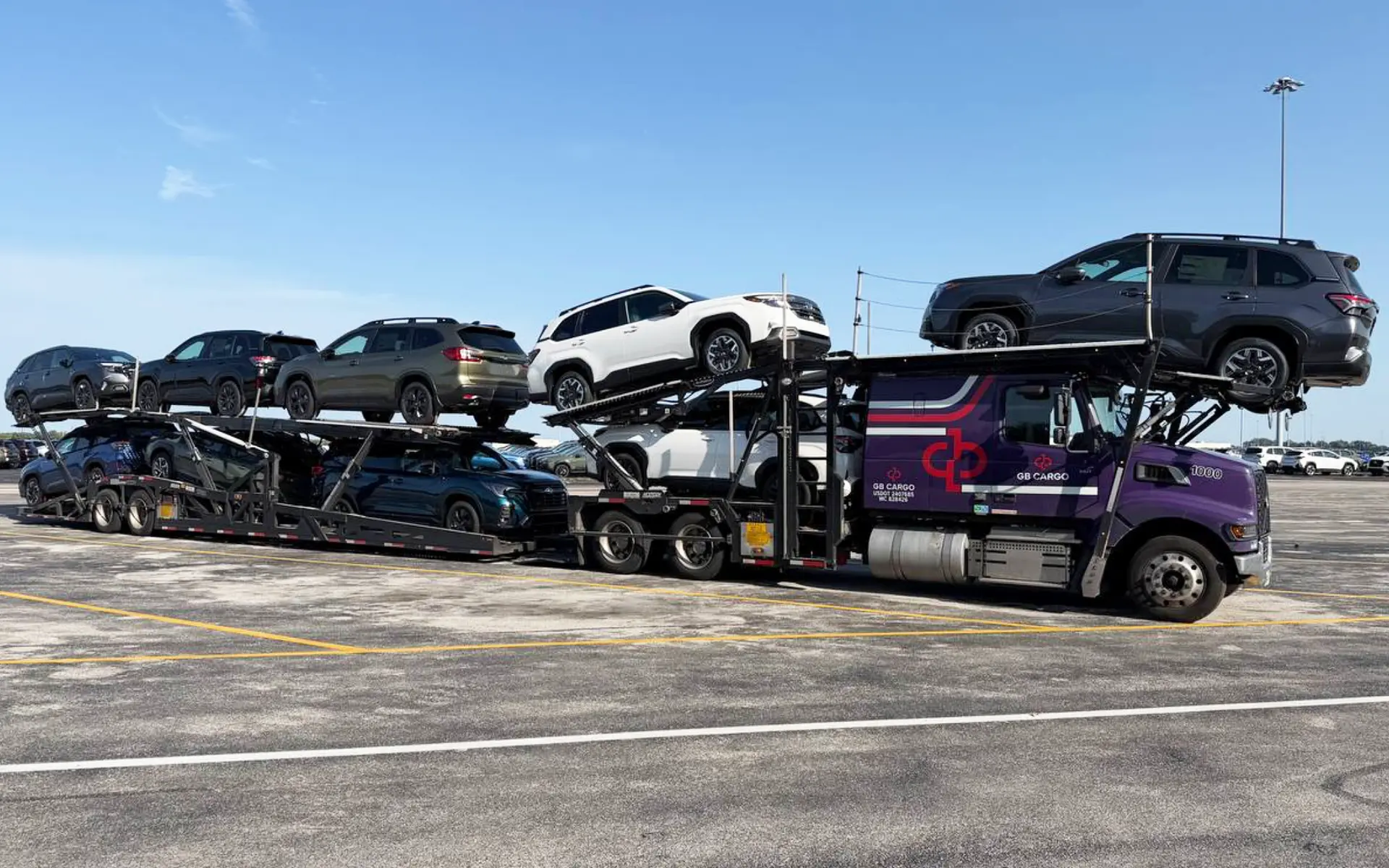
Capacity claims should be concrete enough to be wrong. Ours are: we run a fleet of more than 40 trucks, all nine-car haulers, moving 100-plus vehicles per week in one direction on our core corridors — Chicago to South Florida, Texas, California, and New York, using triangle routing to keep deadhead miles down. On the Illinois to South Florida corridor we work to a four-day transit benchmark and a three-hour pickup window target, and we maintain a damage-free delivery rate above 99 percent.
You cannot audit those numbers from a webpage — that is the point we made earlier, and it applies to us. What you can do is ask a provider for the equivalent specifics and see whether the answer arrives in that form at all. Vague answers to concrete equipment questions are informative.
We are an asset-based finished-vehicle carrier headquartered in West Lafayette, Indiana, with a Chicago terminal. We own and operate our own equipment — more than 40 trucks, all nine-car haulers — which means scheduling, condition standards, and compliance sit under our direct control rather than a partner network’s.
Every account has a named point of contact rather than a rotating dispatch queue. Our real-time tracking gives clients shipment status from pickup through delivery, and our system generates timestamped photo documentation at both ends, shared with every party on the load.
While researching this deal, we found a published article about it that misidentified Fisher Shipping as a marine transport provider, placed ACERTUS in the wrong state, and named executives who do not appear to exist at either company.
That is worth knowing as a practical matter. Consolidation news now propagates through auto-generated aggregators faster than trade press can verify it, which means the version of an acquisition you encounter first may be fabricated in whole or in part. Before you act on a report that your provider changed hands, confirm it against the company’s own announcement or a named trade publication.
Does an acquisition change my existing transport contract?
Typically not on its own. Contracts generally survive a change of ownership, and in deals structured like this one — brand retained, leadership retained — the terms you signed usually continue through the current period. What can change without a contract amendment is the operational mechanism behind the service: which systems handle your loads, and which carriers physically haul them.
How do I find out whether my provider owns trucks or brokers loads?
Check the operating authority in FMCSA records, then ask directly which entity will be the carrier of record on your loads. Companies that own equipment can usually tell you fleet size, trailer configuration, and terminal locations without hesitation, because those are facts about assets they hold.
Should I move my freight if my provider gets acquired?
Not reflexively. An acquisition is a prompt to re-verify, not a reason to switch. Run the four checks above at your next renewal and see whether the answers match what they were before the deal. If they do, you have lost nothing but an hour. If they have quietly changed, you found out on your schedule instead of during a disrupted week.
The question that survives every deal announcement
Consolidation in finished-vehicle logistics is reorganizing who coordinates freight. It is not changing who moves it. The ACERTUS–Fisher deal, like the six or more before it, transfers relationships, customer books, and service capability between companies while the trucks stay exactly where they were — owned by the same fragmented population of asset-based carriers as before.
That is why the operational question outlives the news cycle. Does the entity you are paying control the equipment, or does it control a relationship with whoever does? Both are legitimate businesses. They are not the same purchase, and the difference shows up on the days that matter most.
Before your next tender cycle, confirm in writing which entity holds the operating authority on your loads and whose cargo coverage responds first if a vehicle is damaged. One email, two answers — and you will know which kind of commitment you are actually holding.
If you want to compare that against what an asset-based carrier commits to, our team is happy to walk through the specifics for your lanes. You can reach us through our contact page.
Stay informed on the latest news and insights from GB Cargo.