Your dispatcher recognized the voice.
That used to be the check. Someone calls asking to change a delivery address, the voice sounds familiar, the caller ID matches what's on file, and the email that follows reads like every other email from that company. The load moves.
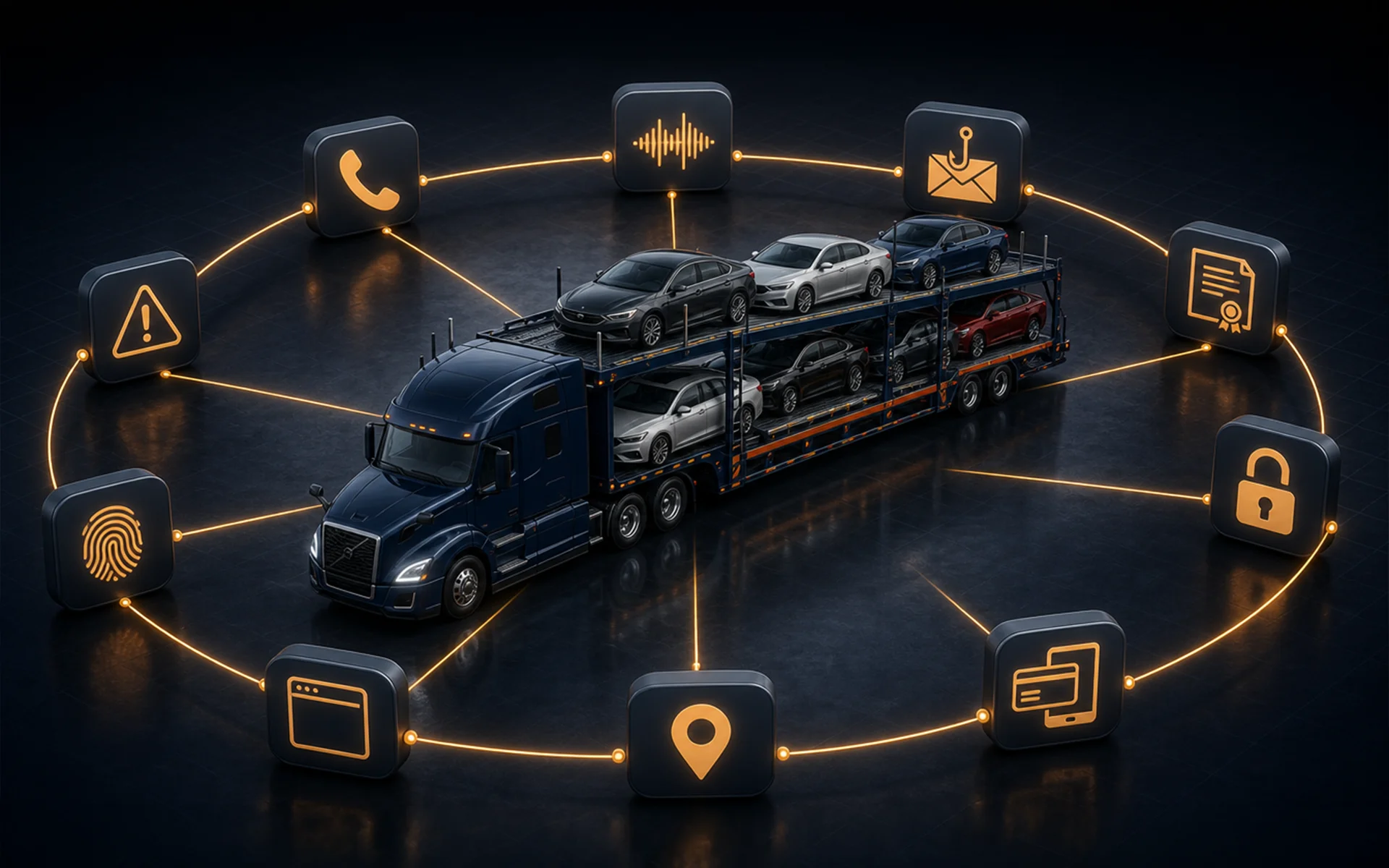
Three of the four signals your team uses to judge whether a request is real can now be manufactured for pocket change.
Here's what makes that strange. We went looking for a documented case of AI voice cloning being used to steal a freight load — a named victim, a dollar figure, an enforcement record. We searched trade press, security firm research, and federal enforcement filings. We couldn't find one.
The claims are everywhere. The cases aren't. That gap is worth understanding before you decide how to protect your inventory, because the real exposure sits somewhere other than where most of the coverage points.
AI Removed Three Detection Tells, and Never Had to Invent a New Scheme
Every fraud type currently marketed as “AI-enabled” in vehicle transport has a pre-AI equivalent sitting in the enforcement record. Impersonation, forged paperwork, phishing, and load diversion all predate generative tools by decades. What changed is the cost and the polish of the pretext — and the informal signals your staff used to catch it.
The unfamiliar voice
Phone-based diversion fraud has always worked the same way: someone claiming to be a known contact requests a change. The historical weak point for the fraudster was the voice.
Trade coverage from August 2025 describes fraudsters using AI-generated voice clones to impersonate carriers and shippers when targeting brokers. It reads as a trend report assembled from brokers' own accounts.
What it doesn't include is a case. The widely shared 2026 story about a broker's voice cloned from a few seconds of audio traces back to a video whose statistics closely track one vendor's marketing materials. No named victim. No court record. No independent reporting from the established trade outlets. We raise it because you have probably seen it, and because where a story comes from matters.
The bad grammar
Awkward phrasing and obvious typos were the informal filter your office staff applied to suspicious email. That filter is gone.
AI-generated correspondence reads as fluent professional English. Forged carrier authority documents, insurance certificates, and delivery paperwork now look the way real ones look.
The consequence gets less attention than it deserves: every fraud training program built around “watch for spelling mistakes” now teaches your team to trust a signal that stopped working.
The scale ceiling
Sending thousands of personalized approaches used to require proportional human labor. It doesn't anymore.
FMCSA (Federal Motor Carrier Safety Administration — the federal agency that regulates commercial trucking) publishes carrier names, MC and DOT numbers, and safety profiles through its public SAFER database. Legitimate parties use it to confirm who they're dealing with. It works equally well as a targeting list.
One caution worth carrying through the rest of this article: no primary source we reviewed attributes that scaling specifically to generative AI. It is consistent with automated tooling. It has not been demonstrated.
The Schemes AI Is Being Pointed At
Compromised email leading to load board hijacking
This is the dominant documented mechanism, and it starts nowhere near a truck.
The FBI's April 2026 public service announcement on cyber-enabled cargo theft describes threat actors impersonating and spoofing brokers by email, sending links disguised as a carrier-broker agreement or as a response to a service complaint. The link installs remote access software.
Security firm Proofpoint documented nearly two dozen such campaigns across two months in late 2025, with volumes ranging from under ten messages to more than a thousand. The tools installed were legitimate IT products — ScreenConnect, SimpleHelp, PDQ Connect, Fleetdeck, N-able, LogMeIn Resolve — followed by software that harvests saved browser credentials.
Once inside, the attacker posts loads under the compromised company's name. From your side, the posting looks exactly like the real thing, because it is coming from the real account.
Mid-transit reroute
A call reaches the driver or the dispatch office requesting a change to the drop location, sometimes with extra payment offered for the inconvenience. Central Dispatch's own fraud guidance names this as a primary vehicle-specific vector and tells carriers not to accept it.
What makes it work has less to do with the technology than with the moment it arrives in. The driver is alone, usually behind schedule, and the request sounds like the kind of routine change that happens on any given week. Saying no to a familiar voice costs something socially. Saying yes costs nothing until the vehicles are gone.
This is where voice cloning is claimed to matter most. It is also the scheme with the cleanest procedural fix, which we come back to further down.
Double brokering
A booked load gets re-tendered to a second carrier without the shipper's knowledge, often at a lower rate, with the spread pocketed. In the aggravated version, the delivery address is altered before the load is handed to an unwitting legitimate carrier.
AI has little to do with this one, and we would rather say so than stretch the point. The scheme never depended on document quality. Its most reliable detection signal is still physical: a driver arriving to collect vehicles identified only by year, make, and model rather than by full 17-digit VIN (Vehicle Identification Number — the unique code assigned to every vehicle). Legitimate dispatch paperwork carries the VIN. Re-tendered loads frequently don't.
Carrier identity hijacking
Someone gains control of a legitimate carrier's contact details on file with FMCSA, updates the phone number and email, and books loads as that carrier. The real carrier usually finds out when a broker or dealer calls about a shipment their company never booked.
The enforcement record includes an auto transport case directly. Michael Chaves, owner of a Rhode Island vehicle transport company, was sentenced in March 2021 to 30 months in federal prison for falsifying motor carrier safety records, and ordered to pay $631,868 in restitution. The Justice Department's announcement was headlined “Auto Transport Company Owner Sentenced for Falsifying Motor Carrier Safety Records.”
Why a Car Hauler Is an Easier Target Than a Dry Van
Vehicles are unusually well suited to theft by deception, for four reasons that have nothing to do with technology.
Per-unit value is high. Custody often includes the keys and, depending on the move, the title paperwork travels with or alongside the unit — which means a diverted load can arrive at a fraudulent destination with much of what a resale needs already attached to it. A stolen vehicle can then be retitled, exported, or parted out without the specialized fencing infrastructure that bulk commodities require.
And — the one that matters most — a car hauler doesn't need a dock. Palletized freight has to be diverted somewhere with dock-compatible equipment to unload it. A vehicle load can come off in any accessible parking area: a shopping plaza, a residential driveway, an empty lot. That structural difference is why a convincing phone call converts into a completed theft faster in this segment than in most others.
One thing worth knowing when someone quotes you a number: no source we could find publishes theft counts or average loss values specific to vehicle transport. The major cargo theft databases break losses out by commodity — footwear, electronics, apparel, food and beverage, pharmaceuticals — and vehicles are not a line item in any report we reviewed. Anyone citing an auto transport fraud statistic is borrowing one from a different commodity.
What the Cargo Theft Numbers Actually Show
Cargo theft is not becoming more frequent. It is becoming more selective and considerably more expensive.
In 2025, total supply chain crime events across the United States and Canada were essentially unchanged from the year before — 3,594 versus 3,607. Inside that flat total, confirmed cargo theft incidents rose 18%, from 2,243 to 2,646. Average theft value rose 36% to $273,990. Total estimated losses rose 60%, to roughly $725 million. The first quarter of 2026 repeated the pattern: overall incidents down 5.3%, confirmed thefts up.
Fewer events. More of them real. Each one worth substantially more.
For a dealership, that shift changes the arithmetic of how much attention this deserves. A rising count of low-value incidents is a nuisance you can absorb and price in. A falling count of increasingly deliberate, higher-value ones means the loads being targeted are the ones somebody researched first — and a nine-car load of late-model inventory is exactly the kind of target that math selects for.
Meanwhile the figures quoted for fraud attempts keep climbing. One verification vendor blocked 784,201 fraudulent inbound emails in the second quarter of 2026, up 48.5% from the first quarter.
Those two sets of numbers measure different things and cannot be drawn as a single trend line. Blocked-attempt counts move with attacker activity, with detection improvements, and with the vendor's own customer growth, all at once — and the companies publishing them sell carrier verification software. That same vendor also changed how it classifies fraud between 2025 and 2026, which means the year-over-year comparison isn't like for like.
One number to refuse outright: an industry report published in May 2026 places annual strategic theft losses somewhere between $3.5 billion and $10 billion. A $6.5 billion spread on an unsourced line is not a statistic. Treat any single figure about AI's contribution to freight fraud as unusable until someone attaches a stated method to it.
Now the part that settles the argument. In March 2019, FMCSA was already telling carriers to confirm identity by calling the phone number listed in SAFER rather than a number a counterparty supplied. Its current guidance on broker and carrier identity theft says the same thing. The FBI's 2026 advisory recommends independently verifying shipment requests through secondary methods, and states plainly that familiar names and email addresses alone do not confirm authenticity.
Seven years apart. Same fix. If the defense against AI-era fraud is identical to the defense that predates it, then this fraud has always succeeded on verification failure rather than on forgery quality. AI made a convincing pretext cheaper. It did not open a gap that wasn't already there.
The Layer Your Process Can't Reach
Some of this has moved past anything your team can evaluate, and we would rather say that than hand you a checklist that implies otherwise.
In early 2026, Proofpoint spent more than a month watching a cargo theft actor operate inside a monitored decoy environment. The attacker deployed six separate remote access tools redundantly, so that removing any single one would not evict them. Then they ran the installers through a third-party certificate-signing service, so all of it appeared to Windows as trusted, digitally signed software.
That is not a better-written phishing email. It defeats a technical control — the trust a computer places in signed software — rather than a human judgment call. Proofpoint's own recommendations are correspondingly technical: inventory your remote access tools, build network detection rules, monitor code-signing certificates.
The honest conclusion for a dealership is a narrow one. Verification discipline protects you against the schemes that come through you. It does nothing about a carrier whose systems were compromised three weeks before your load existed. That isn't something you can assess from your desk — it's a question to put to the carrier: how do you protect your email and dispatch systems, and who owns that responsibility internally?
Worth noting as well: Proofpoint is the most technically rigorous source in this space, documenting the most sophisticated campaigns on record — and never attributes any of it to AI.
How a Carrier's Breach Becomes a Dealership's Loss
The dealership usually absorbs the loss first and argues about it afterward.
Three things happen at once. The vehicle is gone. A custody dispute opens between insurers over who actually possessed the freight at the moment of diversion. And your operation takes the hit nobody puts in the fraud statistics — a hole in the delivery schedule, a sold unit you can't hand over, floor plan interest still running on a car that no longer exists. For dealerships moving retail and wholesale inventory on a tight turn cycle, that third cost often outruns the first.
The screen most dealers rely on is the one that fails here. Asking for a certificate of insurance and comparing rates feels like due diligence, and for years it was reasonable. But insurance certificates are among the exact documents harvested in fake carrier packet schemes, where a fraudulent “onboarding” request collects a real carrier's paperwork for reuse elsewhere. And a forged certificate now reads as professionally as a real one.
We should be straight about the limits of what we can tell you here. We looked for published guidance on how diversion losses actually get allocated between dealer, carrier, and insurer, and how long resolution typically takes. We didn't find it — not from the dealer associations, not from the insurance industry. Ask your own broker how your policy responds, and ask any carrier you work with about the coverage sitting behind every load they move, before you need either answer.
“Are You Insured?” Is the Wrong First Question
A certificate proves a document exists. It does not prove that the company that emailed it to you is the company whose truck shows up.
A better opening question: who physically touches this vehicle, and how do I confirm it's them through a channel I set up before today?
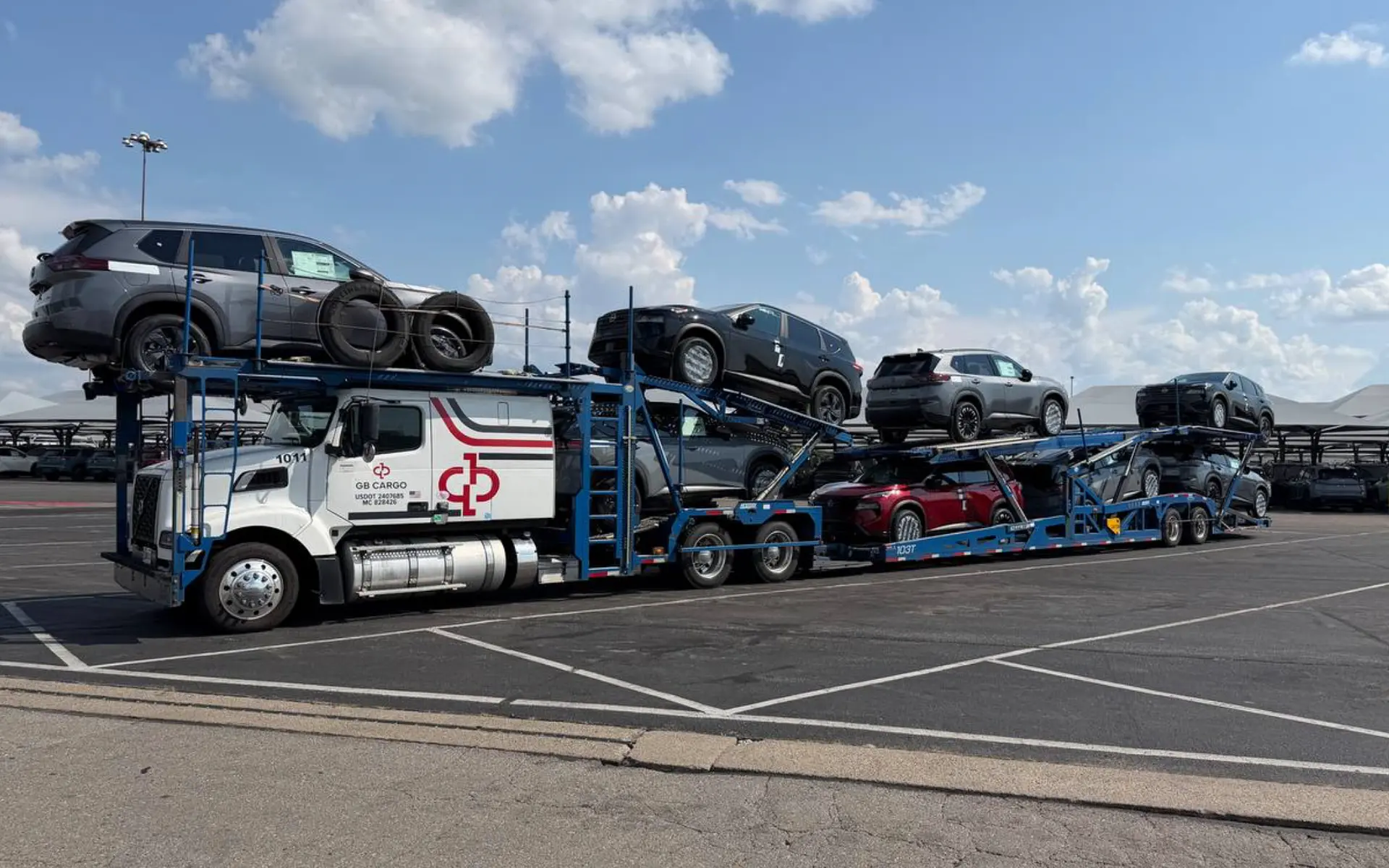
That question is uncomfortable for us to raise, because an honest answer includes our own limits. We own and operate our equipment, which removes a layer of exposure — we are not handing your vehicles to a carrier we found on a board an hour ago. It does not make us immune. Larger contracted fleets are attractive targets for email compromise precisely because centralized dispatch concentrates access, and one compromised account reaches more loads than one compromised owner-operator does.
We also use load boards. Super Dispatch and Central Dispatch, for open spots and for backhaul capacity coming off dedicated lanes, even though most of our volume comes direct. Any carrier telling you they never touch the spot market is either describing a smaller operation than they imply or not describing it accurately — and spot market avoidance isn't the protection people assume it is.
Controls That Work Whether or Not the Fake Is Convincing
None of these require anyone on your team to detect a forgery. That's the point of them.
1. Establish the contact channel at booking, before you need it. Callback verification only works against a number the fraudster didn't supply. Get a named person and a direct line when the relationship starts, and put it somewhere your team will actually find it under pressure.
2. Look up the carrier independently through FMCSA SAFER, not through the contact details in the email you received. One caveat, and it matters: a verification vendor's 2026 data suggests roughly half of theft incidents now involve carriers holding legitimate MC numbers and clean operating histories. That figure comes from a company selling verification software, using a category that didn't exist in its own 2025 reporting, so hold the number loosely. Hold the implication tightly — a clean SAFER record confirms the carrier is real. It doesn't confirm that the person emailing you is that carrier.
3. Confirm the full 17-digit VIN before pickup, not at delivery. A driver who can't produce it is a live signal, and it's one that no amount of polish smooths over.
4. Treat every address change as unverified until you confirm it through the pre-established channel. Never the number in the request. Never on the strength of a familiar voice.
5. Look at the destination address before anything moves. Our dispatchers pull up a requested delivery address on a map as a matter of routine. A supposed private residence that resolves to a warehouse, or a dealer address that turns out to be a strip mall parking lot, answers the question in about fifteen seconds. Satellite imagery has no opinion about how convincing the caller sounded.
6. Refuse peer-to-peer payment demands at delivery. A request for Zelle or Cash App at the drop is a documented fraud signal, not a payment preference.
7. Give your driver explicit authority to refuse and escalate. Our drivers accept routing changes only from our dispatchers, because dispatch has verification tools the cab doesn't. They're trained to escalate anything unusual rather than resolve it themselves under pressure.
8. Photograph everything. The FBI's advisory specifically recommends documenting drivers, licenses, vehicles, plates, cab and truck numbers, and DOT and MC numbers for every party to the move.
How We're Handling This
A carrier with a clean record is an attractive identity to steal, precisely because clean records draw less scrutiny when someone is booking under time pressure. We assume we're a target and work from that assumption.
Attempts reach us periodically. That is true of any carrier with a public FMCSA record, and a carrier who tells you otherwise isn't watching closely. What we try to do is stay ahead of it — when a new method shows up in enforcement reporting or industry channels, we work out our own control for it before it arrives rather than after.
Our named account contact rather than a rotating dispatch queue exists for reasons that mostly have nothing to do with fraud. But a contact who knows your history and your voice is, functionally, the independently established channel federal guidance has recommended since 2019. Tracking a shipment's location from pickup through delivery and timestamped photo documentation at both ends serve the same double purpose: visibility day to day, and an evidence record when something is disputed.
Why GB Cargo
— Asset-based. We own and operate our equipment rather than brokering your vehicles to carriers we haven't vetted.
— A named account contact, not a rotating dispatch queue.
— Real-time tracking from pickup through delivery.
— Timestamped photo documentation at both ends of every move.
— Routing changes accepted only from our dispatchers, never directly from an inbound call to a driver.
Frequently Asked Questions
Has AI voice cloning actually been used to steal a freight load?
Not in any case we could verify. Voice cloning as a freight fraud method is widely described across vendor material and trade coverage, but we found no instance with a named victim, a dollar figure, and independent confirmation — no enforcement action, no security firm incident report, no trade press investigation. The technology plainly exists and the mechanism is plausible. The documented cases are, so far, missing.
Are cargo thefts increasing, or just fraud attempts?
Both, but not in the same way. Total supply chain crime events were flat in 2025, while confirmed thefts rose 18% and total estimated losses rose 60%. Reported fraud attempts are climbing much faster than either — though attempt figures come from vendors with a commercial interest in the trend, and shouldn't be read as a measure of how much fraud succeeds.
What should my team do if someone asks to change a delivery address mid-transit?
Stop the change, then verify through the number you established at booking — not the number that contacted you. A legitimate request survives a five-minute callback. Give whoever answers the phone explicit authority to hold the load while they check.
Does using an asset-based carrier eliminate fraud risk?
No, and we won't claim it does. It removes the layer where your vehicles get handed to an unvetted third party. It doesn't address email compromise, which is the dominant documented mechanism and one that reaches carriers of every model.
Conclusion
The claims about AI-driven freight fraud currently run well ahead of the documented cases. What's verifiable is narrower and more useful than the headlines: thefts are consolidating into fewer, larger, more deliberately targeted events, and the informal tells your staff relied on to catch a fake have stopped working. The defense hasn't changed since FMCSA published it in 2019, because it never depended on spotting a fake — only on confirming an instruction through a channel you established first.
Next Steps
Before your next booking, write down the phone number and the named person your dealership would call to verify an unexpected change — and confirm that number came from somewhere other than an inbound message. If it isn't written down before you need it, it won't be there when you do. If it would help to talk through how we verify a load before it moves, we're glad to walk you through it.