Does Carvana’s Move Into New Cars Change Finished-Vehicle Transportation?
Carvana bought seven Stellantis dealerships — but does it change finished-vehicle transportation? A carrier's honest, lane-level read on what actually moves freight.
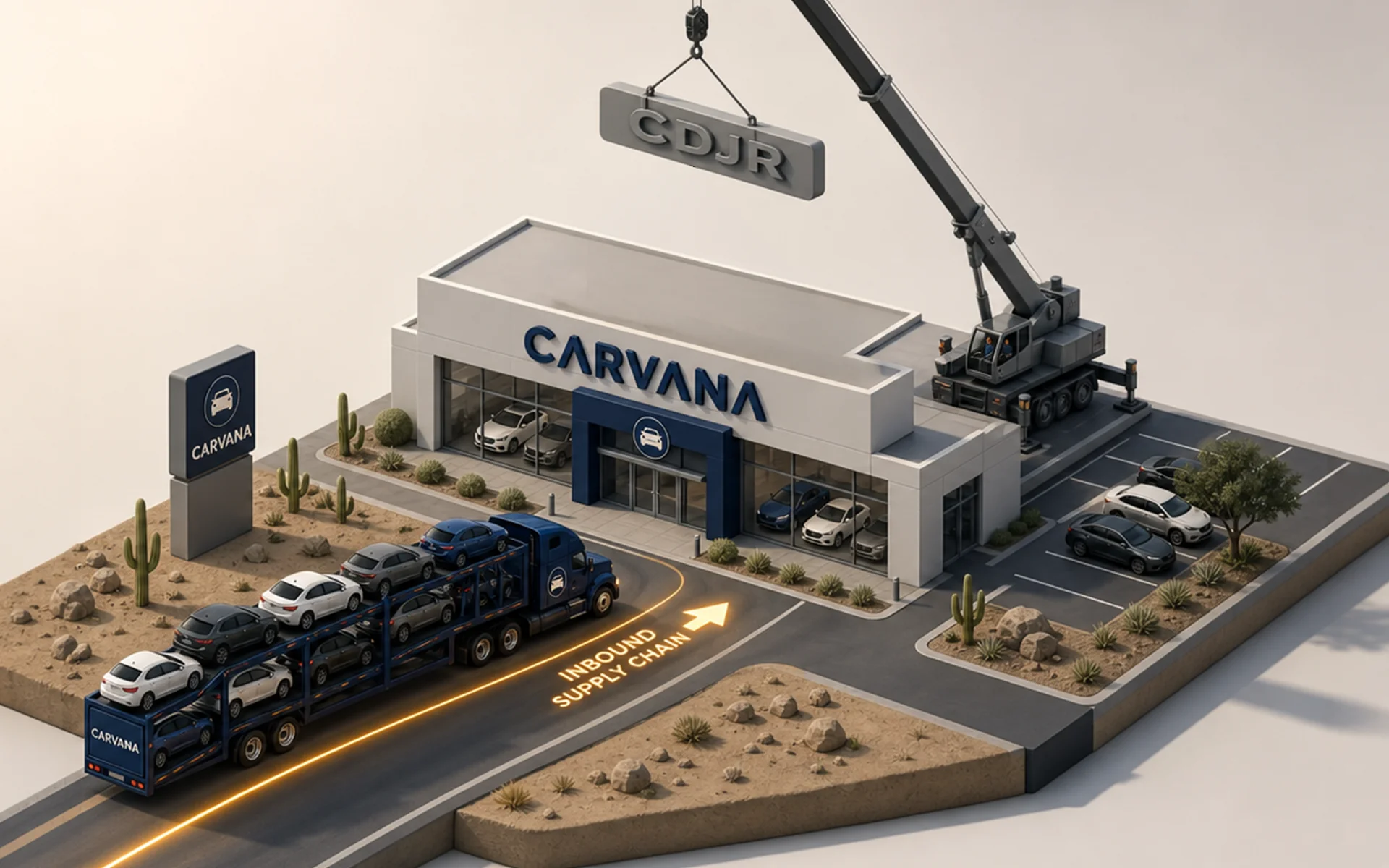
Seven dealerships don’t move a freight market.
If you run or quote finished-vehicle lanes, you’ve been getting a steady drip of Carvana headlines since the spring — the online used-car retailer buying up Stellantis stores, opening a self-guided “test drive” store in Dallas, posting a single location that sells more than 700 new vehicles a month. The coverage sounds like it should reshape your inbound lanes. What none of it tells you is whether to reprice, repower, or ignore it.
Here’s the part the disruption headlines skip. Carvana has bought seven Stellantis CDJR (Chrysler, Dodge, Jeep, Ram — the four Stellantis truck-and-SUV brands) franchised dealerships since early 2025, runs them on an all-online sales model, and turned one near-dormant Arizona store into the highest-volume Stellantis dealer in the country. That’s a genuine retail story. But the freight-relevant signal isn’t the seven stores at all. It’s one lane that jumped from roughly 40 to 700-plus units a month, and a quieter integration that’s been pulling third-party miles in-house since 2022. This piece separates the retail noise from the freight reality, lane by lane.
Carvana has acquired seven Stellantis CDJR franchised dealerships since early 2025, all rebranded under its own name. Six of the seven cost a reported $171 million combined, with the last deal closing in April 2026. The stores sit in Casa Grande, Arizona; Dallas, Texas; San Diego and Sacramento, California; Union City, Georgia; Hudson, Massachusetts; and Avon Lake, Ohio.
What makes them different from a conventional dealer is the sales model, not the inventory. Every transaction runs through Carvana.com, whether the customer walks in or not. There are no in-store finance offices and no commission salespeople. New CDJR vehicles get listed alongside Carvana’s used inventory, and the service departments stay open to meet franchise requirements.
For carriers, the instinct is to read “online retailer buys dealerships” as a threat to inbound freight. That instinct is wrong, and the reason is structural. A franchise change doesn’t reroute original-equipment-manufacturer (OEM — the vehicle maker) inbound shipments. Those lanes — plant or rail ramp to dealer lot — run through Stellantis’ contracted carrier program, dispatched at the OEM level. The carrier delivering a Ram from a Michigan plant to a CDJR store is hired by Stellantis’ logistics provider, not by whoever owns the storefront. Change the sign over the door, and the inbound chain behind it stays the same.
At current scale, seven stores are a rounding error in the finished-vehicle freight market. The arithmetic isn’t close.
The U.S. franchise dealer network runs about 16,990 stores. Seven of them is 0.04 percent of the rooftops. Even if you take Carvana’s best-performing store and pretend every location matches it — 700-plus units a month — seven stores generate roughly 58,800 new-vehicle inbound moves a year. Set that against a North American finished-vehicle logistics market estimated at $19.62 billion in 2026, and a U.S. new-vehicle selling rate of about 16.1 million units a year, and the incremental freight all but disappears.
This is where most coverage blurs two different things. Carvana’s franchise move is genuinely disruptive to auto retail — a national-reach digital storefront converting used-car shoppers into new-car buyers is a real competitive event, and dealers are right to watch it. But retail disruption and freight-market disruption are not the same outcome, and one does not automatically produce the other. A store can sell cars in a way that rattles the dealer down the street without changing a single thing about how those cars get hauled to the lot.
That distinction matters because it tells you where to spend attention. The finished-vehicle carrier market in mid-2026 is already shaped by forces an order of magnitude larger than seven dealerships: a projected 82,000-driver shortfall, spot rates up around 25 percent year-over-year in early 2026, and automotive truckload rates running 3 to 7 percent softer than 2025 on a flat production year. Against that backdrop, the question isn’t whether seven stores tip the market. They don’t. The question is whether anything inside this story moves freight at all — and the answer is yes, but only in two specific places.
A national rounding error can still be a real event on a single lane. That’s the first place this story actually touches freight.
Most carriers handle the Carvana news in one of two ways, and both miss. Some dismiss it entirely — seven stores, immaterial, done. Others over-read the disruption framing and brace for a structural shift that isn’t coming. The disciplined read sits between them, and it comes from looking at one number instead of the headline.
Casa Grande, Arizona, went from 30 to 50 new vehicles a month before Carvana to more than 700 a month after. That’s a 14- to 23-fold increase at a single destination. Nationally it’s noise. At the lane level, it’s a different operation entirely.
A store moving 40 units a month generates almost no recurring inbound delivery activity — a carrier might touch that lane occasionally and never think about it. A store moving 700 units a month at steady cadence needs regular, high-frequency inbound delivery from plant and ramp to lot. The lane didn’t get a little busier. It went from dormant to high-cadence essentially overnight, and whoever holds the OEM inbound contract on that corridor absorbed the entire jump.
This is the part of the Carvana story that carriers running these lanes should actually price. Not because seven stores matter in aggregate, but because volume concentration at a single destination changes how you plan equipment and scheduling for that destination. A lane that suddenly demands consistent weekly cadence is a different commitment than one you serve opportunistically. It rewards dedicated capacity — equipment and a schedule committed to the lane — over spot coverage that may or may not be there when the next batch releases. It also rewards live visibility: at 700 units a month, real-time tracking on inbound moves is the difference between a predictable lot and a backed-up one.
We don’t run the Casa Grande lane, so this isn’t our volume to claim. But the pattern is one every finished-vehicle carrier should recognize, because it isn’t unique to Carvana. Any time a single destination’s throughput jumps by an order of magnitude — a new distribution center, a consolidated regional hub, a high-volume store — the carrier holding that lane faces the same planning problem. The Carvana case is just an unusually clean example of it, with public numbers attached.
The takeaway for peers: when you hear “700 units a month,” don’t think market share. Think cadence, equipment commitment, and whether the lane is now a dedicated-capacity problem rather than a spot one.
The intuitive read is that a retailer with its own 840-truck fleet will eventually pull inbound freight in-house. The equipment says otherwise, and this is the most important operational point in the whole story.
Here’s the assumption worth dismantling. Carvana operates an in-house hauling arm with about 840 power units and 871 trailers, all leased. On paper, that’s a large fleet. So the logic goes: why would a company with 840 trucks keep paying third parties to move new cars to its stores?
Because those 840 trucks can’t do the job. Carvana’s fleet is built for last-mile delivery — single- and two-car haulers, branded, dropping vehicles at customers’ homes inside a roughly 100-to-300-mile radius of a hub. That’s a fundamentally different machine than the 9- to 11-car open rack rigs that move new vehicles from plant to dealer over long distances. The two aren’t substitutes. They’re different businesses that happen to share the word “hauling.”
The economics are where it becomes obvious. Nothing beats a 9-car stinger on distances longer than 500 miles. A stinger — the rack configuration that carries nine vehicles on a single tractor-trailer — spreads the cost of the driver, the tractor, the fuel, and the regulated hours across nine units at once. Run that same 500-plus-mile lane with a two-car last-mile hauler and you’re paying for a driver and a truck to move two vehicles instead of nine. The per-unit cost isn’t a little worse. It’s multiples worse, and it gets worse with every mile.
That’s the structural reason OEM inbound stays with contracted rack carriers regardless of who owns the dealership. Long-haul, multi-car finished-vehicle movement is a rack-equipment, lane-density, cost-per-mile business. A last-mile fleet optimized for local single-unit delivery can’t touch those economics, and no amount of leased two-car trucks changes the math. Carvana’s own investor materials frame its fleet as a lower-cost option for local delivery — which is exactly the point. It’s optimized for the last 100 to 300 miles, not the first thousand.
So when you assess what Carvana’s franchise move does to inbound freight, the fleet size is a red herring. The relevant number isn’t 840 trucks. It’s the per-unit cost of moving a car 800 miles on a two-car hauler versus a nine-car rack — and that comparison closes the question. Inbound rack lanes are safe from self-haul not because Carvana hasn’t gotten to them yet, but because the equipment to take them economically isn’t the equipment Carvana runs. It’s the kind of distinction that’s easy to miss from the outside and obvious from inside the cab.
The franchise headlines are the loud story. The consequential one is quieter, older, and has almost nothing to do with the dealerships.
Carvana has spent years building something that does threaten third-party finished-vehicle miles: the integration of ADESA’s auction sites into its own reconditioning and delivery network. Carvana bought ADESA’s U.S. physical auction business in 2022, bringing 56 sites into its footprint. Since then, it’s been converting those sites into Inspection and Reconditioning Centers (IRCs — facilities where used vehicles are inspected, reconditioned, and staged for sale), with 18 sites operational or in process as of mid-2026 and three more announced between April and June 2026 alone.
Each converted site does something specific to freight. It becomes a hub from which Carvana’s own fleet can recondition and deliver vehicles within a 150-to-300-mile radius — without a third-party carrier touching the move. Carvana has already reported cutting wholesale inbound miles by more than 60 percent since early 2022 by routing its own volume directly to ADESA instead of through outside lanes. Every new IRC extends that self-served radius further into territory that used to require a brokered carrier.
This is the real encroachment, and it predates the dealerships. The franchise acquisitions feed vehicles into this infrastructure — trade-ins from new-car buyers, wholesale units sourced through dealer-only auctions — but they don’t define it. The IRC build-out would be eating third-party middle-mile miles whether Carvana ever bought a single Stellantis store. The franchises accelerate it only at the margin.
So the threat map for a finished-vehicle carrier looks nothing like the headlines suggest. OEM inbound — the lanes the disruption coverage implies are at risk — are the safest part of the picture, protected by both the contracted-carrier structure and the equipment economics. The exposed miles are middle-mile and regional long-haul: the trade-in moving from a store to an IRC, the wholesale unit moving from an auction to reconditioning. Those are precisely the distances Carvana’s self-haul radius keeps expanding to cover.
The honest read for peers is uncomfortable but useful. If you want to know what Carvana costs the third-party carrier market over the next five years, don’t count dealerships. Count IRC sites, and map their delivery radius against the lanes you run. A new IRC in a metro where you haul middle-mile is a more meaningful event than a new dealership in a metro where you don’t.
None of this is a reason to panic. Carvana’s network still has significant slack — its reconditioning capacity sits well above its actual volume — and the self-haul radius has hard limits past which rack economics still rule. But it does mean the carriers reading this story correctly are watching a different number than the one in the headlines.
The store-by-store footprint matters more than the store count, because the freight effect is entirely local. Three patterns are worth a carrier’s attention.
Stellantis’ Midwest production network — the plants and transmission corridors that feed Jeep, Ram, and Dodge volume — pushes finished vehicles south and southeast toward markets like the Union City, Georgia store in the Atlanta metro. This is operating territory we know. Our core lanes run from the Midwest into the Southeast, and Midwest-origin OEM volume moving toward Southeastern destinations is the kind of corridor where consistent, asset-based capacity earns its keep. A franchise change at the destination doesn’t reroute that freight, but a volume change at the destination can reshape the cadence it demands.
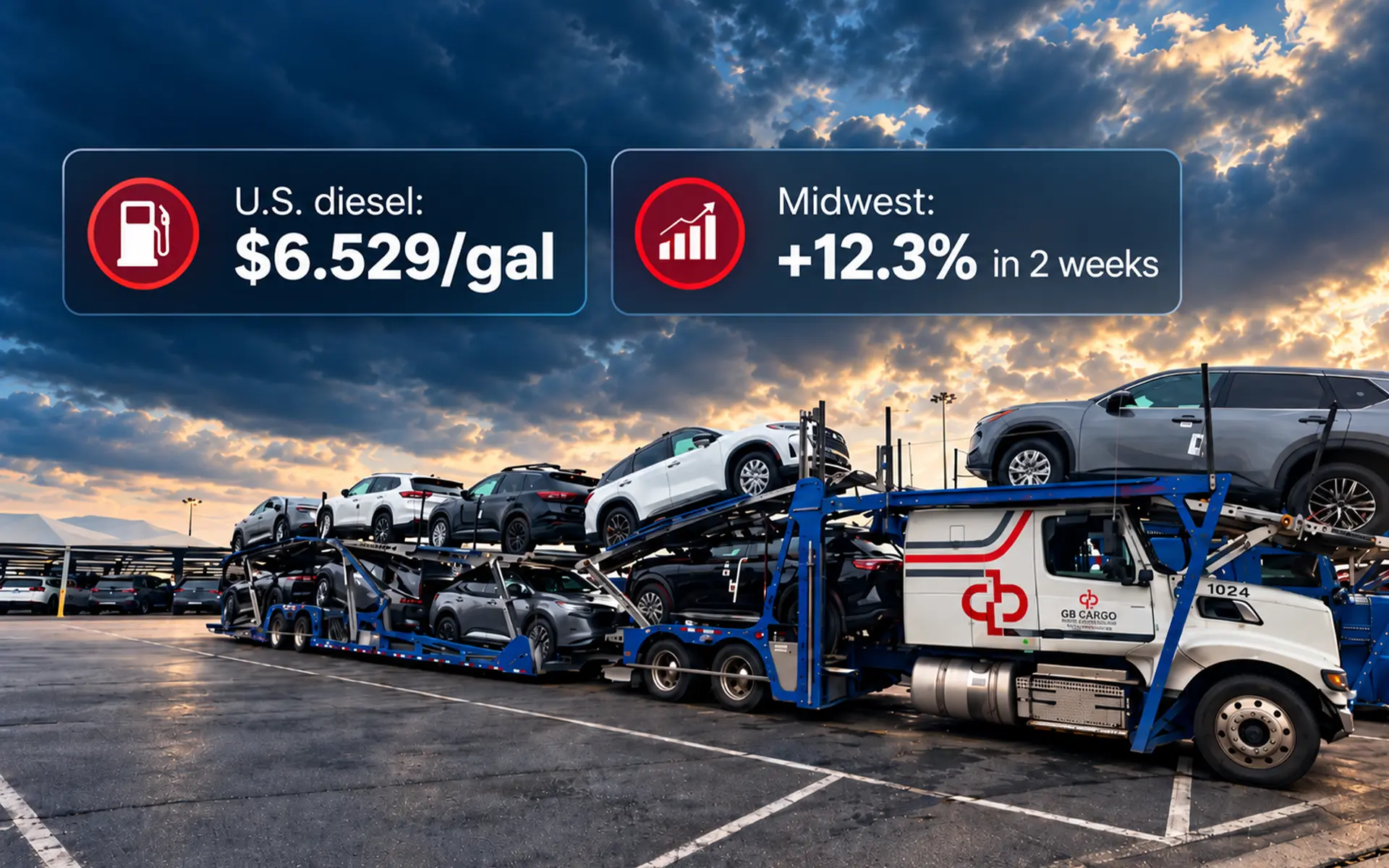
Three of the seven stores sit in California — San Diego and Sacramento among them — and California carries a structural diesel premium that changes the math on every move touching the state. As of mid-2026, West Coast diesel ran well above the national average, with California typically the most expensive market in the country, per the U.S. Energy Information Administration (EIA — the federal agency that tracks energy prices). Any OEM inbound to a California store, and any third-party move on a California origin or destination lane, carries higher fuel-surcharge exposure than the national average. For carriers quoting California lanes, the franchise volume is a smaller variable than the fuel base it rides on.
The Avon Lake, Ohio store sits in one of the densest automotive logistics corridors in the country — the I-70, I-71, and I-75 lanes that carry heavy finished-vehicle rail and truck volume through the Midwest. That density cuts both ways. There’s ample carrier capacity already serving the corridor, which means any incremental inbound volume from the store gets absorbed easily. But it also means the lane is more contested and more established than a comparable lane into the Southwest. A new high-volume destination in Ohio competes for capacity already spoken for; the same destination in a thinner corridor would stand out more.
The through-line across all three: the franchise story’s freight effect isn’t national and isn’t uniform. It’s a set of local lane questions — origin production, destination cadence, regional fuel base, corridor density — that each carrier has to answer against its own book.
The structural points in this article aren’t abstract to us. We’re an asset-based carrier — we own and operate our equipment rather than brokering loads to third parties we can’t fully control. Our fleet runs modern 9-car haulers built for exactly the long-haul, multi-car rack economics that make OEM inbound a different business from last-mile delivery. Every client works with a named, dedicated account contact rather than a rotating dispatch queue, and monitors shipments in real time from pickup to delivery. When a lane’s cadence changes, that combination — owned equipment, dedicated management, live visibility — is what keeps it predictable.
Strip away the headlines and the practical picture is straightforward. The Carvana franchise move creates modest additive opportunity in two places and a near-term threat in none.
The additive opportunity is in the middle-mile and long-haul flows the franchises feed. Trade-ins captured at the new stores have to move from the store to an IRC for reconditioning, and where that IRC sits outside Carvana’s self-haul radius, a third-party carrier moves the unit. Wholesale vehicles sourced through Carvana’s new dealer-only auction access generate long-haul moves into the network. And on any store that approaches Casa Grande’s volume, the OEM inbound lane sees higher cadence that the contracted carrier program absorbs. These are real but small, and they accrue mostly to carriers already positioned in those flows.
The near-term threat is essentially nil. Seven stores don’t move rates or capacity on any lane. OEM inbound is protected by both contract structure and equipment economics. And Carvana’s self-haul fleet, however large, can’t take long-haul rack work it isn’t built for.
The longer-run watch item isn’t the franchises at all — it’s the IRC network. As Carvana converts more ADESA sites into reconditioning hubs, the radius it can serve without third parties grows, and that’s where middle-mile miles quietly leave the third-party market. That trend deserves a place on every finished-vehicle carrier’s planning horizon, with or without the dealership news. The right response to seven stores is no response. The right response to the IRC trend is to know exactly which of your lanes fall inside an expanding self-haul radius, and to compete on the service and reliability a leased last-mile fleet can’t match where rack economics still win.
Does Carvana haul its own new-car inbound freight?
No. New vehicles moving from a Stellantis plant or rail ramp to a Carvana CDJR store travel on Stellantis’ contracted carrier program, dispatched at the OEM level — the same way they’d move to any other franchised dealer. Carvana’s own fleet is built for last-mile customer delivery in single- and two-car haulers, not the long-haul rack transport that inbound freight requires. The equipment economics make self-hauling that segment uneconomical regardless of fleet size.
Are the seven dealerships big enough to move finished-vehicle rates?
No, not at current scale. Seven stores are 0.04 percent of the U.S. franchise dealer network. Even at Casa Grande’s exceptional volume, the aggregate freight they generate is immaterial against a $19.62 billion finished-vehicle logistics market. The one real effect is local cadence concentration on individual high-volume lanes — not market-wide rate or capacity movement.
What’s the real long-term risk to third-party carriers here?
The Carvana/ADESA IRC integration, not the franchises. As Carvana converts auction sites into reconditioning hubs, it expands the radius within which its own fleet handles middle-mile delivery, steadily pulling those miles away from third parties. That build-out predates the dealership acquisitions and would continue without them. Carriers concerned about Carvana’s effect on their book should track IRC locations against their own lanes, not store count.
Carvana’s move into new cars is a real retail story and, for now, mostly a freight non-event. Seven dealerships don’t move a finished-vehicle market measured in the tens of billions, and the OEM inbound lanes the disruption coverage implies are at risk are in fact the safest part of the picture — protected by contracted-carrier structure and by rack economics a last-mile fleet can’t beat. The freight signal worth tracking lives elsewhere: in the single lanes where one destination’s volume jumps an order of magnitude, and in the IRC network that’s been quietly absorbing middle-mile miles since 2022. The carriers reading this story correctly aren’t counting dealerships. They’re watching cadence and reconditioning radius — the two numbers that actually move their lanes.
If you run finished-vehicle lanes, the useful move isn’t to react to the franchise headlines — it’s to audit your own book against the flows that actually shift. Map the IRC and self-haul radius around the lanes you run today, and flag any that fall inside an expanding reconditioning hub’s reach. That single exercise will tell you more about Carvana’s effect on your freight than any disruption headline will. The dealership count is noise; the reconditioning radius is the signal worth your time.
Stay informed on the latest news and insights from GB Cargo.