Is Amazon Autos Going to Change the Car Hauling Industry?
Amazon Autos sells cars but doesn't haul them. Here's why one design rule keeps it out of car hauling — and the single change that would flip that answer.

Amazon sells cars now. It doesn’t haul them.
If you run dealership operations, someone above you has probably already asked whether Amazon Autos is about to reshape how vehicles reach your lot — and what it does to your delivery costs. The trade coverage hasn’t helped. It splits between “Amazon is coming for everything” and “it’s just a lead generator,” which leaves you with no way to plan capacity around it. Neither headline tells you what to actually do differently on Monday morning.
Here is the part almost no one explains clearly: the reason Amazon Autos doesn’t touch car hauling isn’t restraint. It’s a single design rule buried in how the platform works. Change that one rule, and the answer to this question flips completely. That’s the real story, and it’s the one worth planning around — because it turns a vague worry into a specific thing you can watch for.
Amazon Autos is a marketplace, not a delivery service. It runs on a buy-online, pick-up-in-store model — BOPIS (buy online, pick up in store — the customer completes the purchase digitally, then collects the item in person). You browse and buy the car on Amazon; you pick it up at the dealership. The platform has expanded quickly since its late-2024 launch — more brands, more than a hundred metro markets, plus used and certified pre-owned inventory — but every one of those additions runs through licensed franchised dealers. Growth in the storefront hasn’t changed the fundamental design: the dealer sells and delivers, and Amazon hosts the listing.
The dealer stays at the center of the transaction. Under the current model, the franchised dealer remains the legal seller of record and the party that hands over the vehicle. Amazon doesn’t take a cut of the sale price at all — its revenue model is built on dealer advertising and sponsored listings, not a share of front-end gross. It’s closer to a storefront than a store, and that framing isn’t marketing spin. It’s a structural choice with real consequences for who moves the car.
The flow is worth understanding because it shows how little of it is Amazon’s. A buyer browses inventory filtered to their area, selects a vehicle, chooses whether to finance, lease, or pay cash, and places a deposit — all on Amazon. The dealer then sends electronic contracts, the buyer schedules a pickup usually within a few days, and the relationship for service and warranty stays with the dealer afterward. Amazon is the interface at the front and absent from everything physical.
So when people picture an Amazon van dropping a new car in the driveway, that’s not what happens. The customer drives to the dealership to inspect the vehicle, sign anything that needs a wet signature, and take delivery. There is no Amazon Prime delivery for cars. That single fact shapes everything else in this article. It also means the state franchise laws that require a licensed dealer to conduct the physical sale aren’t an obstacle Amazon is working around — they’re the reason the model looks the way it does.
The vehicle is already on the dealer’s lot before Amazon’s platform is involved at all. Everything that got it there — the entire finished-vehicle logistics chain — happens first, and Amazon Autos has no role in it.
Finished-vehicle logistics, or FVL (the specialized supply chain that moves assembled vehicles from the plant through to dealer delivery), is a long sequence before a buyer ever sees the listing. A new car travels from the manufacturing plant to a rail ramp or regional compound, then to the dealer lot, using a mix of rail and over-the-road auto haulers. That movement runs entirely inside the manufacturer’s contracted carrier network.
The scale of that network is easy to underestimate. Every new vehicle sold in the country — more than sixteen million units in a strong year — moves through some portion of this system. It runs on roughly 75 automotive rail compounds, dedicated railcar fleets operated by the major Class I railroads, and a specialized over-the-road carrier network that handles the road segments rail can’t reach efficiently. The long-haul leg often moves by rail; the final leg to the dealer lot moves by truck. None of it is improvised, and none of it responds to which website eventually posts the listing.
This matters because it’s the overwhelming majority of the physical miles a vehicle covers before it’s sold. Amazon Autos enters only after all of it is finished. The platform’s inventory rule confirms this — it shows buyers cars that are already sitting at nearby dealers. In practical terms, your inbound delivery chain from OEMs (Original Equipment Manufacturers — the vehicle makers) to your lot is structurally unaffected by whether a given car eventually sells through Amazon, your website, or a walk-in.
If you were bracing for Amazon Autos to change how vehicles arrive at your dealership, it doesn’t. Not the carriers, not the lanes, not the schedule. That entire layer sits upstream of anything Amazon does.
This is the part worth carrying into a planning conversation. Your inbound delivery relationships — the ones that get vehicles onto your lot reliably and in good condition — are the same relationships you needed before Amazon Autos existed and will need regardless of how the platform grows. Amazon changes where a buyer clicks. It doesn’t change the truck that brought the car. Treating those as the same problem is the mistake that makes the whole question feel more threatening than it is.
The obvious worry is that Amazon, of all companies, could turn its enormous delivery machine toward cars whenever it wanted. Amazon does move freight at massive scale — tens of thousands of trailers, intermodal containers, aircraft. On paper it looks like the one company positioned to absorb vehicle hauling overnight.
That assumption is where most predictions go wrong. Finished vehicles are not parcels, and the gap between the two isn’t a matter of scaling up — it’s a different discipline. A vehicle is non-stackable, high-value cargo. It requires purpose-built multi-level trailers and drivers trained in loading sequence and tie-down technique, because how and where each unit rides on the trailer is a safety and damage question, not a packing convenience. A parcel can go in any bin that fits. A vehicle has a specific place it belongs on a specific trailer, and getting that wrong shows up as a scratched bumper or a dinged panel on someone’s brand-new car.
The control layer is different too. Damage in this industry is tracked at the VIN (Vehicle Identification Number — the unique code for each vehicle) level under standardized damage codes — a framework with no equivalent in general freight. Rail movement depends on contracted relationships with the major railroads under automotive-specific agreements, not spot-market booking. Route and load planning has to account for vehicle dimensions, dealer load patterns, and trailer clearance. None of that transfers from moving boxes.
Add it up and the barrier becomes clear. Amazon’s enormous trailer fleet is oriented toward standard freight, and standard freight and finished vehicles are different problems. Moving cars at scale requires purpose-built equipment, specialized carrier relationships, and regulatory and damage-tracking infrastructure that a parcel network doesn’t possess simply because it’s large. Size is an advantage in freight, but it doesn’t substitute for the specific capability that finished-vehicle hauling demands.
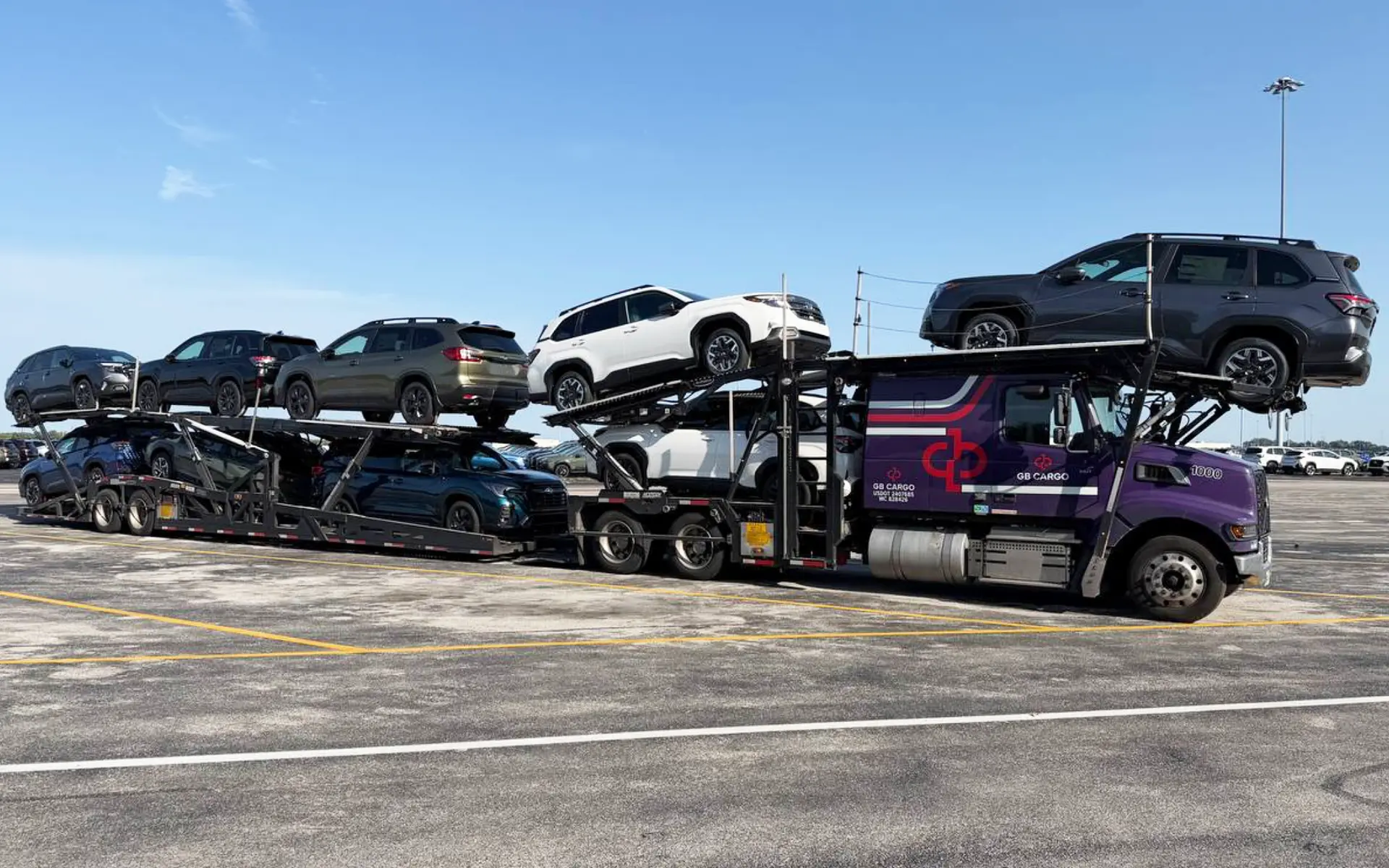
This is the work we do every day, and it’s why the asset-based model matters here. Because we own and operate our own carriers, we control the variables that actually determine whether a vehicle arrives in the condition it left in — how a load is sequenced on our nine-car haulers, how each unit is documented at pickup and delivery, and how equipment is maintained. We invest in modern carriers for exactly that reason. When you own the trailer and employ the driver, the chain of accountability for a vehicle’s condition doesn’t pass through a third party you’ve never met.
There’s a useful parallel in the Amazon Autos model itself. Amazon owns the transaction interface but not the physical layer underneath it — the actual moving of the car stays with people who specialize in it. It’s the same distinction that separates an asset-based carrier from a broker. A broker owns the booking; it arranges the move through third-party carriers it can’t fully vet or control. Brokers serve a real purpose, especially for shippers with unpredictable, scattered demand across lanes no single carrier covers well. But when a shipper runs consistent lanes and cares about the condition of every unit, owning the physical layer is what gives you direct control over quality, scheduling, and compliance.
The reason this matters for the Amazon question is that it explains what a scale player would actually have to build. Amazon didn’t become the largest online marketplace by owning every warehouse and truck from day one — but in parcel delivery, over years, it did build a purpose-built physical network because the standard one couldn’t give it the control it wanted. Finished-vehicle hauling would demand the same kind of purpose-built investment, not a repurposing of what already exists. That’s a long, capital-heavy road, which is one more reason the near-term answer to the disruption question is “not yet.” For dealerships weighing carrier partners today, the same logic applies at a smaller scale: a partner that has already built the asset base and account structure is offering control that a booking layer can’t.
Here is the design rule that explains everything. Amazon Autos only shows a buyer vehicles within roughly 75 miles of their location. You can’t browse a car three states away and have it shipped to you. Every listing you see is already close by.
That single constraint is why Amazon Autos generates almost no hauling demand. When every purchase is a local pickup, there’s nothing to ship — the buyer just drives over. The rule quietly keeps Amazon out of the most logistics-intensive form of vehicle retail: matching a buyer in one region with the exact vehicle they want sitting in another.
It’s worth sitting with why long-distance matching is the hard part. The reason a national inventory is logistically heavy isn’t just distance — it’s that it unlocks demand that would otherwise never happen. A buyer in one state who wants a specific trim, color, or configuration that only exists two states away can only complete that purchase if something moves the car to them. Local-only browsing never surfaces that demand in the first place, so it never generates the freight. The 75-mile rule doesn’t just cap Amazon’s shipping volume; it prevents the demand that would require shipping from ever forming.
This is the sharp line between Amazon’s model and Carvana’s. Carvana lets a buyer anywhere purchase a vehicle located anywhere, which is precisely why Carvana requires a car-hauling operation to function — vehicles have to physically travel to reach buyers. Amazon Autos, by design, avoids that entirely. The disruption question isn’t really about Amazon’s ambition or its logistics muscle. It’s about one geographic setting. As long as that 75-mile limit stands, the hauling industry barely feels Amazon Autos at all.
There is one place where online car buying already produces hauling demand, and it’s worth understanding because it’s the shape of what a broader shift would look like. When a buyer purchases from a dealer far away rather than a local one, that vehicle has to physically travel to them. This is the last mile of digital retail — not a niche add-on, but the logistics that appear the moment a sale crosses geographic lines.
This is exactly the demand Amazon’s 75-mile rule keeps suppressed and Carvana’s national model creates. It’s not hypothetical for carriers; it already exists wherever a buyer completes a long-distance purchase. We handle these moves regularly, and they’re a useful preview of what scaled long-distance online buying would look like multiplied — the same operation, just far more of it.
In our experience, that move typically looks like this: the vehicle is dispatched to us by the dealer or a broker, and it travels on one of our existing corridor runs alongside other vehicles headed the same direction, when we have room on the trailer. It’s usually a single unit riding a mixed load rather than a dedicated trip. That’s the efficient way to do it — the buyer gets their car without paying for an entire trailer, and the vehicle is documented and tracked the same way every unit on that load is. Clients follow it in real time from pickup to delivery.
This is the operational reality that gets lost in the disruption debate. Long-distance online purchases don’t require some new form of logistics to be invented. The capability already exists, and carriers already run it. What limits it today isn’t infrastructure — it’s that the largest online marketplace deliberately keeps its transactions local. The demand is latent, sitting behind a geographic rule.
For an operations director, the practical read is that the fulfillment side of long-distance online buying is a known quantity, not a mystery. If your dealership sells to a buyer several states away — through your own site, a national marketplace, or any other channel — the vehicle rides an established corridor with a carrier that documents and tracks it. The cost and the timeline are predictable when the lane is one a carrier already runs. What’s unpredictable is volume, and volume is set by whichever platform decides how far a buyer is allowed to shop.
So, will Amazon Autos change the car hauling industry? In its current form, no — and now the reason is concrete rather than a guess. It’s a marketplace and advertising layer sitting on top of a physical logistics chain it doesn’t touch, held local by a 75-mile rule. The volume is still a small share of sales at the dealers reporting it, and the model leaves inbound delivery, carriers, and lanes exactly as they were.
The disruption that Amazon Autos does threaten is real, but it’s aimed elsewhere. Analysts watching the space point to the lead-generation marketplaces — the sites dealers pay to forward buyer contacts — as the layer most exposed, because Amazon converts a shopper into a completed transaction rather than just handing over a lead. That’s a meaningful shift in who captures value at the start of a car purchase. It is not a shift in who moves the car. Those are two different industries, and conflating them is how the hauling question gets answered wrong.
But the honest answer includes a condition, and this is where we’d point operations leaders to watch. The signal that matters isn’t Amazon adding more brands or pulling traffic from the lead-generation sites. It’s whether Amazon drops the geographic limit and moves toward what Carvana does — letting a buyer anywhere purchase a vehicle located anywhere.
In our view, if Amazon decides at some point to remove that constraint and apply its scale and infrastructure to long-distance vehicle fulfillment, it could significantly reshape the auto transportation business. That’s a genuinely different scenario from today’s BOPIS marketplace, and it’s the one carriers and dealers should actually be tracking.
Two developments are worth keeping in the corner of your eye, with the caveat that neither is a hauling program today. The first is that Amazon has opened its broader logistics network to enterprise clients and named automotive as a target sector. That effort is currently aimed at parts and supply-chain goods, not finished vehicles, so any application to vehicle hauling is speculative — but it shows Amazon building optionality in automotive logistics beyond the consumer transaction. The second is that the pressure for long-distance home delivery is building on its own, independent of Amazon, driven by what digital retail has trained buyers to expect. Some carriers already see smaller-unit home delivery as central to where the business is heading.
Put those together and the picture is a set of pieces that don’t currently connect but could. A national online marketplace, an enterprise logistics arm targeting automotive, and rising buyer expectations for delivery are three separate things today. The disruption scenario is the one where they connect. That’s not a prediction — it’s a checklist. If you see the geographic limit drop and a vehicle-hauling capability announced, that’s the moment the answer to this article’s question changes from “no” to “yes.”
The takeaway isn’t alarm. It’s that the thing to watch is specific and knowable. Not the marketplace — the map.
Asset-based carrier. We own and operate our equipment, which gives us direct control over quality, scheduling, and compliance rather than depending on third-party carriers we cannot fully vet.
New equipment. We invest in modern car carriers, which affects safety, reliability, and the condition a vehicle arrives in.
Dedicated account management. Every client has a named point of contact, not a call center or a rotating dispatch queue.
Real-time tracking. Clients monitor shipment location and status from pickup to delivery, which supports proactive communication and accurate ETAs.
Does Amazon deliver cars to your door?
No. Under the current Amazon Autos model, the customer buys the vehicle online and then picks it up at the dealership. The dealer handles the handover. There is no Amazon delivery van for cars.
Does Amazon Autos change how vehicles reach a dealer’s lot?
No. The finished-vehicle logistics chain that moves a car from the plant to the dealer lot runs before Amazon’s platform is ever involved. Whether a car later sells through Amazon or any other channel has no effect on how it arrived.
If I buy from a distant dealer online, how does the car get to me?
That vehicle has to be transported. Typically it’s dispatched to a carrier by the dealer or a broker and travels on an existing corridor run alongside other vehicles headed the same way, rather than on a dedicated trip — which keeps the cost reasonable for a single unit. The buyer can track it from pickup to delivery, and it’s documented at both ends the same way every other vehicle on that load is.
Why can’t Amazon just use its delivery network to haul cars?
Because finished vehicles aren’t parcels. They’re non-stackable, high-value cargo that needs purpose-built multi-level trailers, drivers trained in load sequencing and tie-down, VIN-level damage tracking, and contracted rail relationships. A large parcel fleet doesn’t convert into that capability without significant purpose-built investment, which is a major reason vehicle hauling hasn’t been absorbed by general logistics players.
Amazon Autos leaves car hauling untouched today, but not because Amazon lacks the reach to change it. It leaves hauling untouched because one design rule keeps every sale local, and a local sale needs no carrier. That same rule is the only thing standing between the current model and a genuinely disruptive one. The question worth carrying forward isn’t whether Amazon could reshape auto transport — it’s whether it drops the 75-mile limit. Everything hinges there.
The useful move right now, while this is still hypothetical, is to pressure-test your delivery chain against a long-distance-fulfillment scenario. If online buying went national tomorrow, you’d want to already know which lanes and which carrier relationships you’d lean on — before the market forces the question. A carrier relationship built around consistent corridors, documented condition at both ends, and a named contact is easier to establish in a quiet moment than in a scramble. If it would help to think through how that fits your delivery picture, our team is glad to talk it through.
Stay informed on the latest news and insights from GB Cargo.