From Inventory Drift to Planned Repositioning: The Car Hauler's Role in One-Way Rental Logistics
One-way rentals create predictable fleet imbalances. Learn how car hauling companies help rental operators reposition vehicles efficiently — and what to look for in a hauling partner.
A customer picks up a sedan in Chicago on a Friday afternoon and drops it off at a Miami location the following week. From the customer's perspective, the transaction is complete. From the rental company's perspective, that vehicle just left a market where it may be needed and arrived in one where it may already be oversupplied. Multiply that by thousands of daily transactions across a national network, and the logistics problem becomes structural.
This is the operational reality behind one-way car rentals. The customer experience is simple. The fleet management behind it is not.
This article covers how one-way rentals create fleet imbalances, why seasonality makes those imbalances predictable and recurring, and how car hauling companies function as the repositioning mechanism that keeps the model viable at scale. For rental fleet managers and operations directors evaluating hauling partnerships, it also outlines the criteria that separate a reliable contracted partner from a spot-market gamble.
Watch The Video Overview
How One-Way Rentals Redistribute Your Fleet Without Asking
Rental companies don't treat every city-pair as equally "open." Route eligibility and pricing are managed precisely because a one-way reservation is simultaneously a revenue transaction and an inventory redistribution event — one that can help or harm fleet availability elsewhere in the network.
Drop fees, one-way rate premiums, and unauthorized return penalties are not arbitrary charges. They are demand-shaping tools. Enterprise discloses that some one-way rentals carry a drop charge or mileage charge, and that the one-way rate may exceed a same-location return. Avis notes that a drop-off charge may apply on certain rates. Budget is explicit about the consequence of improvising: returning a vehicle to an unauthorized location triggers a minimum $45 unauthorized return fee, potentially higher by distance. Hertz frames the one-way fee as partially covering the cost of returning the vehicle to its origin location. Taken together, the major rental operators are telling the same story — one-way flexibility has a logistics cost, and that cost is passed on, at least in part, to the customer.
Research in rental fleet operations describes the underlying problem plainly: one-way rentals alter fleet distribution across locations, causing shortages at some stations and surpluses at others, forcing operators to relocate vehicles to restore a target distribution. Those relocation costs are not only the direct expense of moving vehicles — they include the utilization cost of vehicles temporarily removed from rentable inventory while in transit. For an operator like Avis Budget Group, which reported an average Q3 fleet of 735,841 vehicles at 72.1% utilization, even a modest displacement of inventory across markets translates into meaningful revenue impact.
The operational response is what fleet managers refer to as "empty transfers" — moving vehicles without a paying customer in them, purely to rebalance supply. At the scale of a national rental network, this is a continuous, multi-node planning problem. Pricing and physical logistics have to work in parallel.
Why Fleet Imbalance Is a Calendar Problem
The imbalance created by one-way rentals doesn't arrive randomly. It follows the calendar — which makes it foreseeable, if not always easy to manage.
Summer Peaks and Holiday Surges
U.S. travel demand spikes sharply around major holidays, and rental fleets feel it directly. AAA projected 45.1 million Americans would travel over Memorial Day 2025, with 39.4 million traveling by car. The Independence Day period was projected to draw 72.2 million travelers — 61.6 million of them by car. June 2024 set an all-time high for seasonally adjusted airline passenger enplanements, at 82.9 million.
For rental operators, these surges mean rapid, location-specific inventory drawdowns at airport markets, resort metros, and drive-to destinations. Fleet that was balanced in May can be badly skewed by early July if pre-positioning hasn't happened. The window between "we see it coming" and "we need vehicles now" is short, and the cost of moving fleet on an expedited basis during peak demand is higher than the cost of planning ahead.
The Snowbird Pattern and Sun Belt Lanes
Winter introduces a different but equally predictable flow. Auto transport data shows a 15% winter surge in Florida-bound vehicle moves, alongside 12% and 9% winter declines in New York and Illinois, respectively. The underlying driver is well-documented: Florida has historically drawn more than 800,000 elderly temporary in-migrants at peak times — the classic "snowbird" pattern — which shapes mobility and rental demand in Sun Belt markets well beyond what permanent population figures would suggest.
The New York–to–Miami corridor is the highest-order-volume route in auto transport lane data, which reflects this directional demand. For rental fleet planners, it means vehicles follow travelers south through the winter and need to be pulled back north when the season ends. That return run — often compressed into a short spring window — is where the cost and timing pressure tends to be highest.
The Post-Season Rebalancing Problem
Seasonal imbalance doesn't resolve itself. When the Florida winter season winds down, rental companies face the reverse problem: Sun Belt markets are oversupplied, northern markets are undersupplied, and the timeline for correction is compressed because summer demand is already building.
When advance planning has kept pace with the seasonal cycle, these transitions are manageable. When it hasn't — or when demand shocks exceed the forecast — operators are left sourcing capacity on a spot market at precisely the moment when everyone else needs it too. Auto transport lane data puts a number on what that timing costs: June is the most expensive month for vehicle moves, averaging $1.20 per mile and $580.71 per move, compared to November's $1.15 and $517.75. The cost of reacting rather than planning is real and quantifiable.
What Multi-Vehicle Hauling Actually Contributes
Car hauling is the mechanism that makes large-scale fleet repositioning economically viable. The core advantage is bulk efficiency: multi-vehicle open transport reduces cost per vehicle-in-network (VIN) moved compared to single-vehicle alternatives, and that gap widens meaningfully as loads increase. Industry data shows six-vehicle shipments are materially cheaper per mile than single-vehicle moves — a difference that compounds quickly across hundreds of repositioning runs in a peak-season cycle.
The operational workflow for a fleet repositioning move follows a consistent pattern. A distribution gap is identified — typically through reservation signals, utilization differentials, and station inventory targets. A relocation order is created specifying origin, destination, timing windows, and the vehicles to be moved. The carrier is dispatched, vehicle condition is documented at pickup, status is tracked in transit, and delivery is confirmed with an electronic proof of delivery (POD). At each stage, documentation matters — both for condition accountability and for the invoicing and reporting that follows.
Drive-away alternatives, where vehicles are moved by a driver rather than loaded onto a carrier, add mileage and wear to rental inventory. For a vehicle that will be returned to the rental cycle immediately on arrival, that wear has direct asset-management implications. Open transport eliminates both the mileage and the wear, delivering the vehicle in the same condition it left.
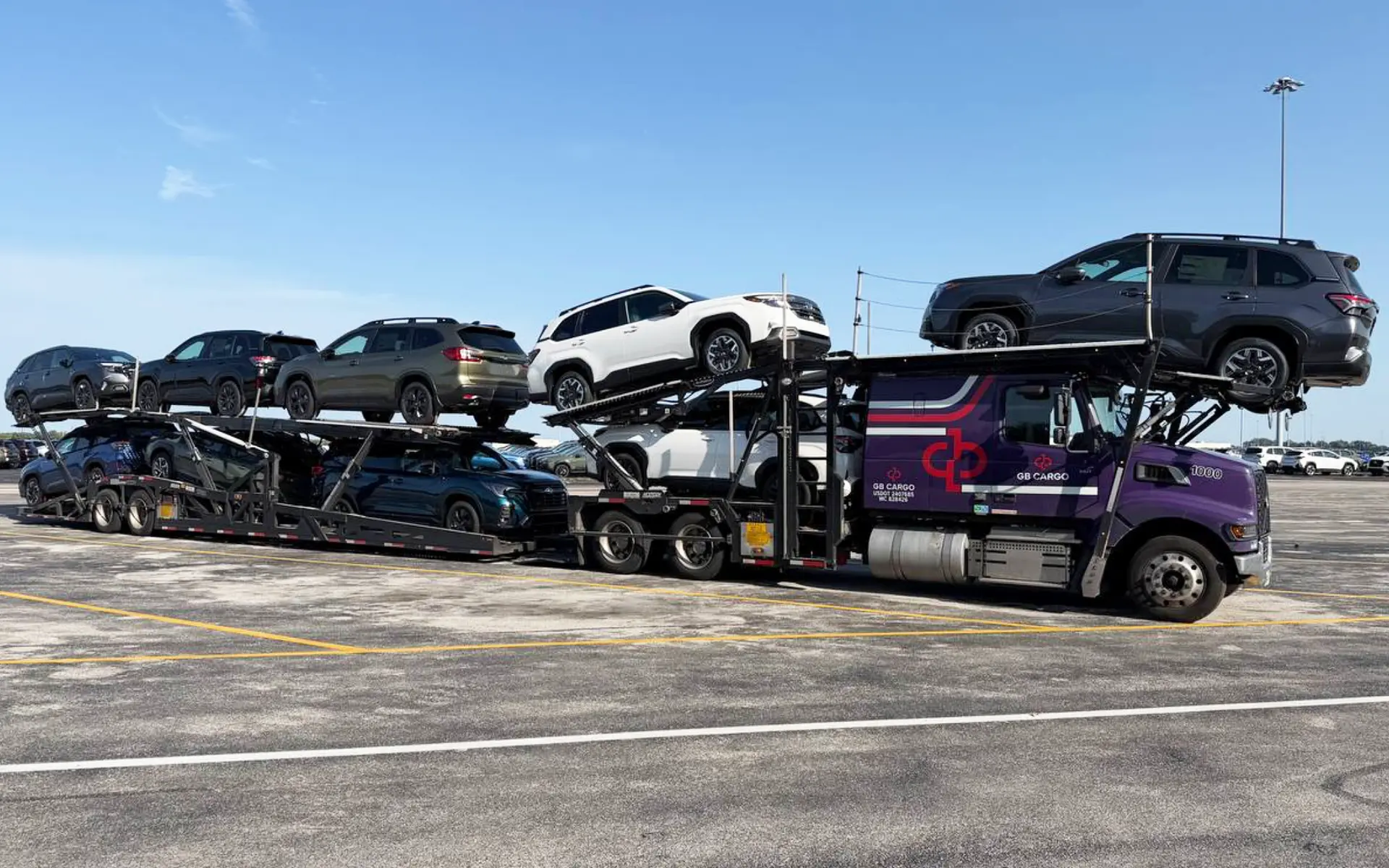
Our fleet includes configurations up to 10-car stingers, which means meaningful load consolidation on longer repositioning runs. The math is straightforward: moving 10 vehicles per truck over a 1,200-mile lane is a fundamentally different cost structure than moving them individually or in smaller groups. For rental companies that can batch their relocation runs — aligning pickup windows and routes to maximize load — the savings compound across a full season.
Seasonal Peaks Are When Your Hauling Partner Either Proves Itself or Doesn't
The research framing of car haulers as the "pressure relief valve" during peak season is accurate, but it carries an assumption: that the hauler has capacity available when it's needed. That assumption is not guaranteed in a spot-market relationship.
The most reliable answer to peak-season capacity is advance scheduling. When rental fleet planners share their seasonal repositioning calendar — pre-peak pre-positioning runs in late spring, post-season return runs in late winter — those moves can be planned end-to-end rather than sourced as spot exceptions. The difference in reliability and cost is significant. A carrier who knows your Q2 and Q4 volume can reserve capacity against it. A carrier receiving a same-week request during the busiest month in auto transport cannot make the same commitment.
Peak season is also when compliance risk is highest. Spot-market capacity expands as volume increases, and unfamiliar carriers enter the market. FMCSA (Federal Motor Carrier Safety Administration — the federal body that regulates commercial trucking) provides the SAFER system for verifying a carrier's safety rating, inspection history, and crash data. That verification process is straightforward and the data is public — but it matters more when you're working with carriers you haven't used before. Rental companies that rely heavily on spot-market sourcing during peak season are, in effect, accepting more compliance uncertainty at the moment when their volume and visibility are highest.
Auto transport lane economics also explain why contracted relationships outperform spot over a full season. Carriers build profitable routes using anchor loads — consistent, reliable volume on defined lanes — and use that foundation to optimize capacity utilization. Shippers who can supply that consistent volume earn more reliable service and better rate predictability. Overflow and irregular lanes remain spot-driven, but the core of a seasonal repositioning program doesn't have to be.
What Rental Fleet Managers Should Look for in a Hauling Partner
Compliance You Can Verify Without Asking
Car hauling is regulated commercial trucking. FMCSA's cargo securement rules require that cargo be firmly immobilized using adequate structures and tiedowns — standards that apply to every load, on every run. A hauling partner's compliance record should be verifiable on platforms you already use: FMCSA SAFER, Carrier411, and the carrier's own published information.
Our credentials are publicly verifiable on all of these. We don't ask clients to take our word for our safety record — we point them to the same sources they'd use to vet any carrier. That transparency is more useful than a self-reported claim, and it's the baseline we'd recommend applying to any hauling partner under evaluation.
Visibility Between Pickup and Delivery
A vehicle in transit is temporarily not rentable. For a rental fleet manager tracking utilization KPIs across dozens of stations, "we'll call you when it arrives" is not useful information. The question is where the vehicle is right now, and when it will be available.
Our real-time tracking portal lets clients locate any vehicle by order ID or VIN at any point between pickup and delivery. That visibility enables accurate ETA communication to receiving stations, which directly affects how those stations plan for incoming inventory. It's a small operational capability that has an outsized effect on how smoothly a multi-location repositioning program runs.
A Named Contact Who Knows Your Program
Repositioning programs have moving parts: timing windows, multi-stop runs, condition documentation requirements, and the kind of lane-specific knowledge that only comes from running the same routes repeatedly. Routing those questions through a call center adds friction. Our dedicated account management model means clients have a named contact who knows their lanes, their seasonal schedule, and their documentation expectations — not a queue that resets with every call.
This matters most at exactly the moments when it's hardest: peak season, when timing is tight and there's no margin for coordination delays.
A Relationship Structure That Matches How Fleet Repositioning Actually Works
Spot-market sourcing will always exist, and there are situations where it's appropriate — irregular lanes, one-off moves, overflow volume. But the core of a seasonal repositioning program is not a one-off situation. It's a recurring, predictable workload that benefits from a contracted partner who can plan around it.
We work with car rental companies on a long-term contracted basis because that structure creates mutual planning visibility. You share your seasonal calendar; we reserve capacity against it. You get rate predictability and a compliance profile you've already verified. We get the lane consistency that lets us optimize load and scheduling on your behalf. The spot market remains an option — but it works best as a supplement to a contracted program, not the foundation of one.
Why GB Cargo
What we offer rental fleet clients:
Asset-based operation: We own and operate our equipment — including open carriers up to 10-car stinger configurations. We are not a broker. The carriers that move your fleet are ours.
Customer tracking portal: Any vehicle can be located by order ID or VIN from pickup to delivery, giving your team accurate ETA data at any point in transit.
Dedicated account management: One named contact per client — not a call center. Your account manager knows your lanes, your seasonal schedule, and your documentation requirements.
Verifiable compliance: Our credentials are publicly available on FMCSA SAFER and Carrier411. We also publish relevant information on our website.
Lane coverage: We run high-volume corridors including Sun Belt lanes and the NY–Miami route, and can adjust scheduling to meet seasonal repositioning needs.
Long-term contracted relationships: We prefer contracted partnerships over spot sourcing — because planning ahead produces better outcomes for both sides.
How does GB Cargo handle seasonal volume increases for rental fleet clients?
The most reliable approach is advance scheduling. When clients share their seasonal repositioning calendar — pre-peak pre-positioning runs, post-season return moves — we can plan the full program alongside them rather than responding to requests as they arrive. That planning process is where capacity gets reserved, lanes get optimized, and timing windows get aligned with your station inventory targets. Last-minute volume is harder for any carrier to absorb during peak months; planned volume is not.
What carrier configurations are available for fleet repositioning runs?
We run open carriers in multiple configurations, up to 10-car stingers. The right configuration for a given repositioning run depends on the volume available for a given lane and pickup window. Our account team works with clients to structure loads that balance cost-per-VIN against timing requirements — which is particularly important for rental fleets that want to maximize load consolidation across a seasonal cycle.
How do rental fleet managers track shipments in transit?
Through our customer portal, accessible at any point between pickup and delivery. Vehicles can be located by order ID or VIN, giving operations teams accurate location and ETA data without requiring a phone call. That visibility is especially useful when receiving stations need to plan for incoming inventory or communicate ETAs to local operations.
Conclusion
One-way rentals are a structural feature of the rental car business, not an edge case — and the fleet imbalances they create are predictable, seasonal, and recurring. Multi-vehicle car hauling is the most cost-efficient mechanism available to address those imbalances at scale, but its value depends entirely on the planning infrastructure behind it. Carriers who know your seasonal calendar can plan around it. Carriers sourced on a spot basis when you need them most cannot offer the same reliability. The rental operators who treat fleet repositioning as a contracted, planned program — rather than a reactive procurement problem — are the ones who enter peak season with inventory in the right places.
Related Insights
66,000 Hybrids, 40,000 Units of Headroom. The Math Behind Hyundai's Alabama Tucson Plan