Why Does Bait and Switch Still Happen in B2B Auto Transportation?
Bait-and-switch persists in B2B auto transport because it exploits urgency and limited visibility—especially 24–48 hours before pickup.
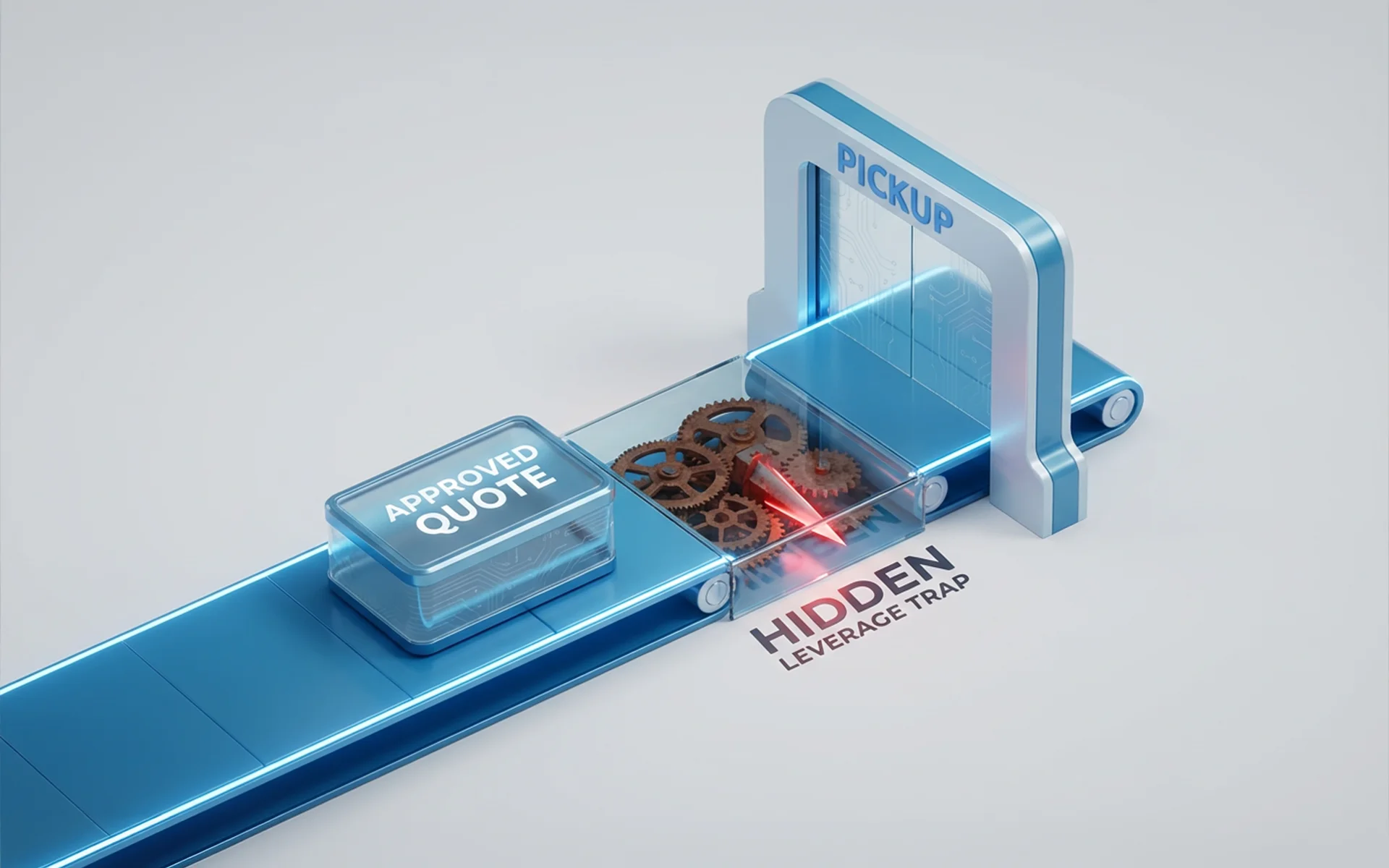
In B2B auto transport, bait-and-switch usually doesn’t look like an obvious scam. It often starts with a quote that seems workable, gets approved quickly, and then quietly drifts toward a last-minute problem.
That’s why this practice survives in B2B environments with experienced logistics teams. It’s not built on tricking beginners. It’s built on time pressure, limited visibility, and handoff complexity — especially in the 24–48 hours before pickup, when changing course feels expensive.
In this article, we’ll explain how bait-and-switch plays out in B2B, why the “market shift” excuse is so common, and what procurement and operations teams can do to reduce exposure without making every shipment painful.
Watch The Video Overview
In consumer shipping, the tactic often looks like: low quote → higher price → customer panic.
In B2B, it’s usually more subtle:
Those phrases matter because they make a decision sound like a neutral event. Instead of “we quoted too low,” it becomes “the market moved.”
And in B2B, the “cost” isn’t just the rate. The real cost is the disruption:
At that point, bad actors are counting on one reality: you may pay more simply to avoid restarting the entire chain reaction.
The easiest way to understand this is as a timeline — not a single moment.
It starts with a quote that looks attractive enough to get approved. In some organizations, the lowest price gets the fastest “yes,” especially if the process is optimized for speed.
Common early warning signs include:
At this stage, nothing feels wrong — because execution hasn’t been tested yet.
After you commit, the update cadence often stays high-level:
But the key detail is missing: Who is assigned, and when are they actually arriving?
In B2B, this is the pressure-building stage. The clock keeps moving, and your ability to pivot gets worse by the hour.
You told us something important: in B2B, the “switch” can happen at any stage — but the highest-pressure moment is usually 24–48 hours before pickup.
That window is the sweet spot for bad actors because:
That’s when the familiar language shows up:
Sometimes a real market change exists. But bait-and-switch uses the idea of the market to create a decision you have to make fast.
Not every situation turns into a hostage scenario — but enough do that it’s worth naming.
In B2B, hostage dynamics usually look like one of these:
Even the soft version creates major internal damage, because now you’re not negotiating a rate — you’re protecting a delivery promise and a chain of custody.
This problem persists because it fits B2B systems too well.
Some buying processes unintentionally reward the fastest “approved” quote. If feasibility checks aren’t built in, a low quote can win without proving it can be executed.
Most shippers can’t easily see:
That’s not a shipper mistake — it’s the nature of the market. But bait-and-switch uses that visibility gap.
Here’s the simple mechanic:
That’s why the “market shift” line tends to show up right before pickup. It’s not just a timing coincidence — it’s leverage timing.
If you only address bait-and-switch when it happens, you’re already late. The most effective prevention is a small set of guardrails.
A B2B-friendly pre-qualification checklist should include:
If your team needs a standard place to start, FMCSA’s SAFER Company Snapshot is a useful verification step for authority lookups (USDOT/MC).
(We won’t link it directly here if you prefer, but it’s easy to find.)
Most switches are possible because the quote was vague.
What we recommend requiring in writing:
This isn’t about being rigid. It’s about preventing a vague quote from becoming an emergency negotiation.
Even with strong procurement controls, you’ll still face switch attempts occasionally. When you do, the priority is simple: restore clarity quickly.
When you hear “market shift,” ask for:
If they can’t answer those questions, you likely don’t have a real plan — you have a placeholder.
Legitimate reasons for change do exist, such as:
The difference is usually documentation + clarity, not emotion. A legitimate change has a clear new scope item. A bait-and-switch change often leans on urgency and generalities.
As an asset-based carrier, our internal focus is to avoid putting shippers into these situations at all. That means confirming feasibility early, keeping documentation tight, and escalating issues fast — because “surprises” near pickup aren’t just frustrating, they’re operationally expensive.
Bait-and-switch risk often overlaps with double brokering (Double Brokering — when a shipment is re-assigned without the shipper’s knowledge).
This matters in B2B because the question “who is hauling?” impacts:
That’s why vendor verification isn’t just a compliance step. It’s a continuity step.
There are compliance requirements for brokers and carriers, but regulation alone doesn’t prevent bad behavior.
Practically, your best protection is documentation:
Even when you don’t pursue formal complaints, that record improves internal accountability and makes future sourcing decisions stronger.
Callout: The 60-second B2B checklist
Is bait-and-switch illegal in B2B auto transport?
It depends on the facts and the specific conduct. In practice, the bigger issue is that vague scope and last-minute changes are hard to challenge without clean documentation and defined change control.
How can we tell the difference between a real scope change and a bait-and-switch?
A real scope change comes with clear specifics and usually written proof. A bait-and-switch change often arrives late, with urgency-heavy language (“market shift”) and limited operational detail.
Why does “market shift” show up right before pickup?
Because that’s when your alternatives are weakest. The closer you get to pickup, the more expensive it feels to restart — and that’s exactly what leverage-based repricing depends on.
How does double brokering relate to bait-and-switch risk?
Both rely on visibility gaps. When you can’t clearly verify who is hauling and when they’re actually assigned, you’re more exposed to last-minute repricing and unauthorized handoffs.
Bait-and-switch still happens in B2B auto transportation because it exploits predictable conditions: urgency, limited visibility, and complex handoffs.
The most reliable defense is balanced:
When you treat the 24–48 hour pre-pickup window as a known risk period — and standardize how changes are requested and approved — you reduce the space where bait-and-switch can work.
Stay informed on the latest news and insights from GB Cargo.