Which Equipment Type Should OEMs Require From Finished-Vehicle Carriers?
Learn which carrier equipment specs OEMs should require—securement, air-ride, fleet age, capacity fit, tracking, and service recovery.

OEM (Original Equipment Manufacturer — the vehicle maker) logistics teams are expected to protect three things at once: damage-free delivery, reliable ETAs, and cost-efficient capacity. When a load is delayed or a new unit arrives with transport-related damage, the impact shows up immediately—at plants, ports, rail ramps, and dealerships.
That’s why “equipment type” can’t be treated as a carrier-side detail. The equipment a finished-vehicle carrier runs—securement system, ride quality, trailer configuration, and visibility tools—directly influences risk, reliability, and day-to-day execution. Equipment age matters too, because it affects mechanical downtime risk and how consistently a carrier can deliver against tight schedules.
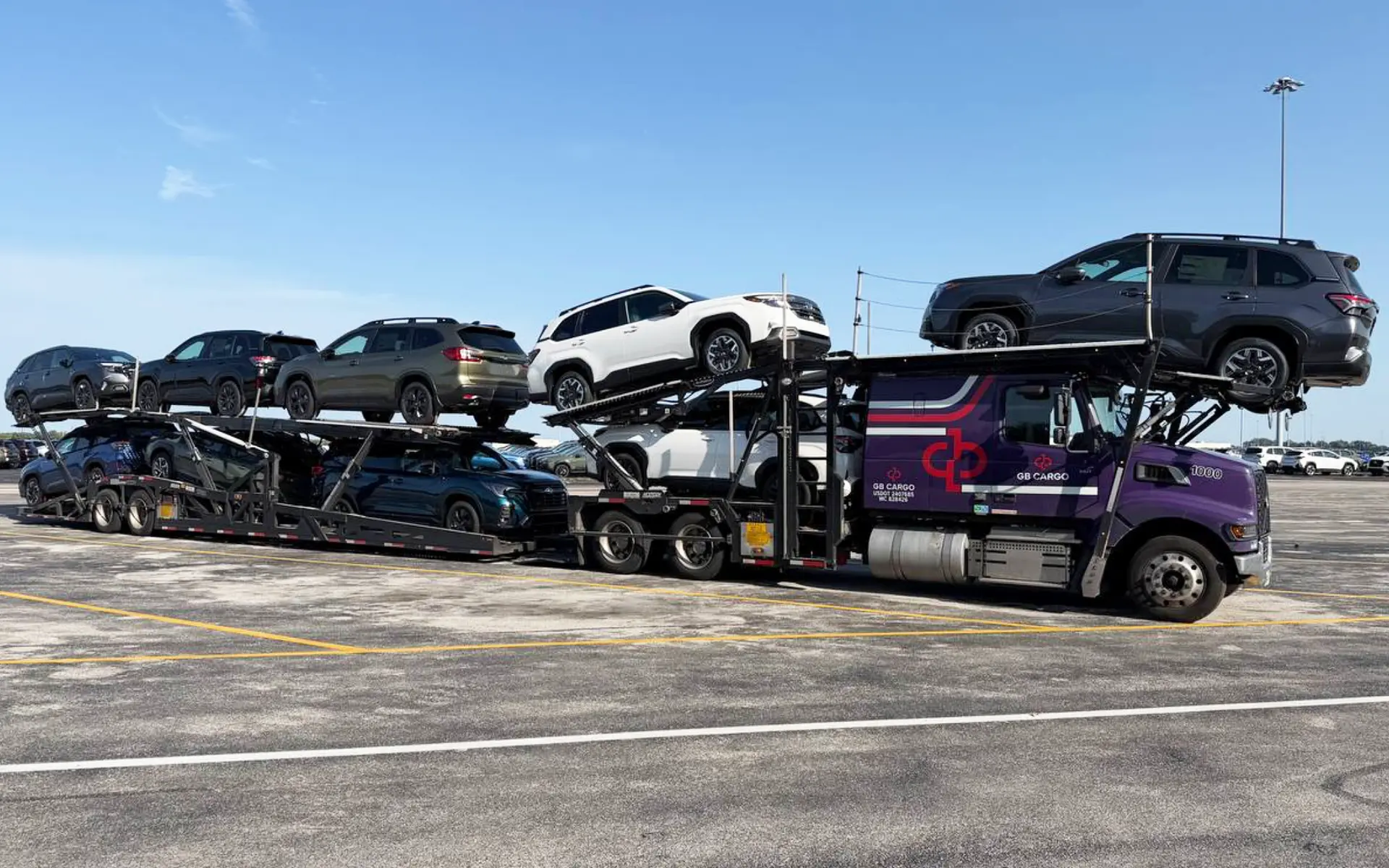
Below, we break down the equipment requirements OEMs should define in RFQs and carrier scorecards, and we share how we operate for OEM moves: our equipment ranges from brand new to 4 years old (oldest), we use soft-tie securement for OEM vehicles, all of our equipment is air-ride, we typically run 7–9 cars per load depending on vehicle size and weight, we do not offer enclosed, our damage-free performance is 99.9%, and we proactively manage exceptions (including mechanical issues) with clear customer updates.
Many OEM teams think of equipment type as “open vs. enclosed.” In finished-vehicle logistics, it’s broader than that. Equipment type is the full system that drives outcomes across four practical areas:
When these elements are defined and enforced, performance becomes more predictable across lanes, seasons, and volume swings.
The wrong equipment spec doesn’t only create damage risk. It creates operational friction:
Over time, those issues become real costs—rework, claims administration, manual follow-ups, and missed dealer or distribution commitments.
In finished-vehicle logistics, equipment age is often a proxy for reliability. As power units and trailers get older, mechanical breakdown risk and unplanned downtime typically increase. And in OEM networks, downtime isn’t just “a carrier problem.” It disrupts Just-in-Time (JIT) logistics (a scheduling approach where inventory arrives when needed, not early) and can quickly cascade into missed appointments and dealer promise issues.
When a truck breaks down mid-route, the common consequences include:
Our equipment ranges from brand new to 4 years old (oldest). In our experience, keeping fleet age tight helps reduce preventable service failures because it supports more consistent uptime and faster maintenance cycles.
Even with newer equipment, OEMs should evaluate the service recovery plan, not just the spec sheet. Our approach is straightforward:
When OEMs qualify carriers, we recommend asking:
Clear, specific answers here usually correlate with fewer surprises during peak volume.
For most OEM volume moves, open transport is the standard approach. That means protection doesn’t come from a hard shell around the vehicle. It comes from securement, ride quality, handling discipline, and consistent execution.
We operate in that same reality:
Callout: Our OEM baseline spec (facts only)
Securement is one of the most direct drivers of damage exposure in finished-vehicle logistics. For new units—where cosmetic condition matters—OEM programs often prefer securement methods designed to reduce contact risk and improve repeatability across drivers.
For OEM moves, we use soft-tie securement. Chains are used only for heavier equipment moves, which typically isn’t the use case for new OEM cars.
Soft-tie securement systems aim to reduce damage risk in a few practical ways:
No securement method replaces careful loading and driving. But standardization reduces variability—and variability is often where claims originate.
Here’s what we recommend OEM teams include in RFQs and carrier qualification:
If a carrier can’t answer clearly, it’s hard to enforce consistency later.
Ride quality is easy to overlook until there’s a problem. Road vibration and shock can contribute to cosmetic issues, component stress, and “mystery damage” disputes—especially across long lanes or rough seasonal routes.
We run air-ride across our equipment. Air-ride (air suspension) is designed to reduce vibration and road shock compared to harsher systems, which supports more consistent handling across a nationwide network.
For OEMs, ride quality should be treated as part of the protection system—not a comfort feature.
Capacity is often discussed like a single number: “How many cars can you haul?” In real OEM networks, the better question is: “How reliably can you haul the right mix—safely, legally, and consistently?”
Trailer configuration and flexibility influence:
For us, the realistic operating range is typically 7–9 cars per load, depending on the type and weight of the vehicles. That range reflects what can be done consistently on real lanes and real mixes—not a best-case maximum.
OEM mixes change. SUVs and crossovers consume more deck space. EV (electric vehicle — battery-powered) models can be heavier, which can reduce legal capacity depending on configuration and weight distribution.
If a carrier is pressured to “hit max capacity” regardless of mix, risk can rise:
We generally see better outcomes when OEMs align capacity expectations to the actual vehicle profile and allow for a realistic average per load.
When evaluating equipment type for OEMs, we recommend focusing on how the trailer handles variety:
Strong carriers explain how they plan loads—not only the maximum they’ve ever carried.
OEM teams increasingly expect structured visibility, reliable status updates, and digital documentation. The biggest operational gap we see in the industry isn’t usually the absence of a tool—it’s inconsistent execution.
We provide:
Depending on an OEM’s systems and requirements, carriers may also be asked about EDI (Electronic Data Interchange — structured system-to-system data exchange) or API (Application Programming Interface — software connection for data sharing). Whether or not deep integration is needed, the baseline expectation should be consistent status communication and clean documentation.
In our experience, OEM escalation risk drops when updates are standardized. A practical baseline includes:
OEMs can (and should) define these expectations as part of carrier qualification.
To make equipment decisions consistent across lanes and vendors, we recommend a scorecard approach. Below is a practical rubric OEMs can adopt and tune.
You can adjust weights based on lane volatility, seasonal risk, and vehicle profile.
Minimum requirements (typical OEM baseline):
Nice-to-haves (program dependent):
These are common warning signs we recommend OEMs screen for:
If these show up during qualification, they tend to show up again under pressure.
What equipment type should OEMs require for finished-vehicle moves?
We recommend OEMs define equipment type as a package: soft-tie securement, air-ride equipment, trailer configuration that fits the OEM’s vehicle mix, and consistent visibility with ePOD (electronic proof of delivery — digital delivery confirmation). When those elements are standardized, damage exposure and service variability typically drop.
Is open transport safe enough for new OEM vehicles?
Open transport is the common standard for OEM volume moves, but safety depends on the controls around it. Soft-tie securement, air-ride equipment, disciplined loading practices, and clear exception management are what make open transport dependable for new units.
Why do soft-ties matter more than “being careful”?
Driver care is essential, but OEM programs need repeatability across many drivers, lanes, and volumes. Soft-tie securement provides a standardized method that can be trained, audited, and executed consistently—reducing the chances that small handling differences become damage events.
How does fleet age affect on-time delivery for OEM lanes?
Older equipment tends to carry higher breakdown and out-of-service risk, which can disrupt appointment windows and dealer delivery promises. Newer fleets paired with a clear repair/repower plan reduce downtime exposure and make service recovery faster when exceptions happen.
For OEM finished-vehicle logistics, equipment type isn’t a technical footnote—it’s a practical predictor of outcomes. Securement standards, ride quality, capacity fit for real vehicle mixes, and consistent visibility all influence damage exposure and on-time reliability. Equipment age matters because it affects downtime risk and how quickly a carrier can recover when something goes wrong.
When OEMs define equipment requirements clearly—and evaluate carriers against those requirements—performance becomes more predictable across lanes, seasons, and volume changes.
Stay informed on the latest news and insights from GB Cargo.