Is a Direct Carrier Relationship Worth It for Your Dealership?
Brokers or direct carriers — the right answer depends on your lanes. Here’s how dealership ops directors should think through the decision.
The answer depends on one thing most dealerships never stop to map.
Most operations teams default to brokers for every shipment because the workflow is simple: one call, one invoice, no carrier vetting. That works. But at some point, it's worth calculating what that convenience layer costs on the same two or three lanes your dealership runs every single month.
The broker-vs-carrier debate is usually framed as a binary choice. It isn't. The dealerships that get the most value from their transport spend treat it as a routing question: which lanes are consistent enough to warrant a direct carrier relationship, and which ones genuinely benefit from a broker’s network reach? That’s the frame this article works from — not a blanket argument against one model or the other.
The term gets used loosely. Before evaluating whether a direct carrier relationship makes sense for your operation, it’s worth being precise about what it actually means.
A direct carrier is the entity that owns the trucks, employs the drivers, and physically moves the vehicles. When you book with a carrier directly, the contract is with the company executing the haul. A broker, by contrast, does not own equipment or employ drivers. A broker’s job is to connect shippers with carriers — they are logistics coordinators, not transportation providers.
This distinction matters operationally. With a direct carrier, communication is unfiltered. If there’s a delay — weather, a weigh station backup, traffic through a congested freight corridor — the information comes straight from the source. There’s no intermediary relaying a message from a driver to a dispatcher to a broker to your team, with accuracy degrading at each step.
The distinction also carries legal weight. Under federal transportation regulations enforced by the FMCSA (Federal Motor Carrier Safety Administration — the federal body that regulates commercial trucking), the physical carrier holds cargo liability during transit. That liability chain is short and traceable when you’re working directly with the entity hauling your vehicles.
Before establishing any direct relationship, verify the carrier’s credentials on the FMCSA’s SAFER system. You’re looking for active operating authority listed under “Carrier,” not “Broker.” Pull the MC number (Motor Carrier number — the federal operating license issued by the FMCSA) and confirm it’s current. Review the safety rating, the out-of-service history, and the limits of the Motor Truck Cargo Insurance. A policy with a $100,000 limit isn’t adequate coverage if the carrier is moving four high-value units on a single haul.
If everything checks out, you establish the relationship once. That’s where most of the operational work lives — upfront, before the first load moves.
Broker margins are not a secret. Industry data indicates they typically run between 20% and 30% of the total transportation cost. In practice: a broker quotes your dealership $1,125 to move a vehicle. Behind the scenes, they post the load at $800. The carrier hauls the vehicle. The broker keeps $325.
That margin isn’t inherently unreasonable. If you needed that broker’s network to find a carrier on a route you’d never run before, they earned it. The question is whether they’re still earning it on a lane you ship every week.
There’s a second cost that rarely shows up in the transport invoice. Dealers finance inventory through floor plan arrangements, and interest begins accruing the moment a vehicle is purchased at auction. A truck financed at $90,000 at a 7.3% annual rate costs roughly $18 per day in carrying cost before it reaches your lot. A five-day delay caused by a broker posting a load below market rate — waiting for a carrier willing to accept the spread — adds approximately $100 to the acquisition cost of that vehicle, invisibly.
Auction storage compounds this. Most wholesale and salvage auction facilities enforce strict pickup windows. Once the grace period expires, daily storage fees begin, often ranging from $10 to over $50 per day. The vehicle waiting for a carrier acceptance is accruing two separate holding costs simultaneously.
This isn’t a blanket argument against the broker model. Reputable brokers provide real value. For dealerships sourcing inventory opportunistically from digital auction platforms across irregular national routes — a purchase in rural Texas one week, a unit in Seattle the next — a broker’s national carrier network is genuinely worth the margin. They solve a sourcing problem the dealership can’t easily solve internally, and good brokers bring compliance rigor, damage claim advocacy, and redundancy coverage if a carrier falls through.
The issue is using a broker on consistent lanes where a direct carrier relationship is available and the network flexibility simply isn’t being used. On those lanes, the margin is overhead without a corresponding service benefit. Recognizing that distinction is what the decision actually comes down to.
Lane consistency is a more useful decision variable than monthly volume alone.
A dealership moving 15 vehicles a month on the same corridor — reliably, month over month — is often a better candidate for a direct carrier relationship than one moving 40 vehicles to 30 different destinations. The first dealership has a predictable, repeatable pattern that carriers can build into their routing. The second needs network flexibility that brokers are better positioned to provide.
The high-fit scenario looks like this: a Midwest-based dealership running consistent outbound volume on major corridors — Chicago to Miami, Chicago to Los Angeles, Chicago to New York. These are high-frequency lanes with established carrier presence. A carrier operating out of a Chicago terminal has trucks moving these routes regularly. When your loads align with that existing routing, scheduling is predictable, pricing is stable, and you’re not paying for network access you don’t need.
The lower-fit scenario is a dealership that has expanded into national digital wholesale purchasing — buying specific units from auctions across dozens of states based on inventory opportunity rather than lane pattern. The geographic spread is too wide and too irregular for a single carrier to cover efficiently. Broker network scale genuinely serves those moves, and attempting to manage a sprawling patchwork of direct carrier relationships would create more administrative overhead than it saves in margin.
Most dealerships fall somewhere between these two scenarios. The practical question is: what percentage of your monthly vehicle purchases originate from the same two or three corridors? If the answer is high, you have enough lane concentration to make a direct carrier relationship worth evaluating — at least for those specific routes, even while maintaining broker access for the rest.
On the lanes where volume and consistency align, capacity doesn’t have to be a constraint. Carriers operating at scale on established corridors can absorb consistent monthly volume without requiring the dealership to manage multiple carrier relationships or navigate the open spot market on every move.
The most common objection to going direct is operational burden. The literature on this topic makes it sound significant: carrier vetting, FMCSA verification, insurance confirmation, rate negotiation, dispatch coordination, payment management. That’s a real list — if you’re building a direct network from scratch by sourcing carriers cold off a load board.
Working with an established carrier that has structured its dealership onboarding looks different. The compliance documentation exists and is verifiable. The account setup is handled once. The agreement is signed. After that, a dealership shipping on consistent lanes submits the load — and the carrier handles the logistics from there.
In practice: your team isn’t re-vetting a carrier before every shipment, renegotiating rates for each move, or chasing down proof of insurance every month. That work is front-loaded into the account setup and doesn’t recur. For dealerships running consistent lanes, the ongoing experience is close to what brokers provide in terms of day-to-day simplicity — without the intermediary layer.
Dedicated account management matters here. A named contact who knows your lanes, your typical load volumes, and your delivery requirements handles your loads. That’s a different experience than a rotating dispatch queue or a call center that picks up when you have a question about an ETA. You can read more about how we structure dedicated account management for our dealership clients.
The information gap that typically pushes dealerships toward brokers — “I can’t tell where my vehicle is” — is solved by real-time tracking. A client portal that shows shipment location and status from pickup to delivery removes the need to call anyone for an update. Your team — and your customers, if needed — can check progress without working through an intermediary.
The setup burden is real but finite. The operational experience after it is designed to be straightforward.
Equipment configuration is worth understanding before you commit to a carrier relationship, because it affects what loads the carrier can accommodate as your volume shifts.
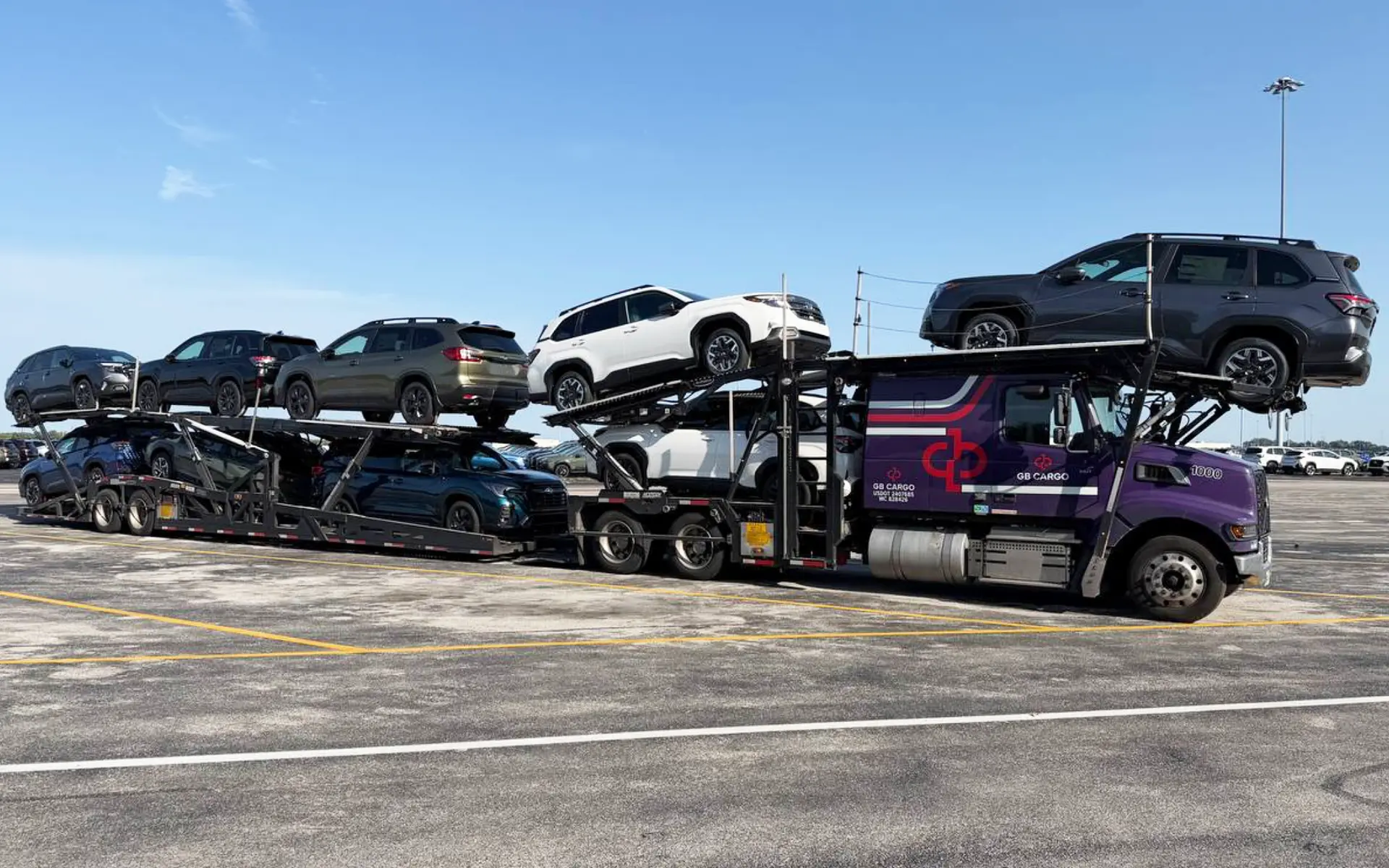
Standard multi-car rigs in the 7, 8, and 9-car range cover the spectrum of typical dealership volume — from single-vehicle dealer trades to consolidated multi-unit loads moving on the same lane. Carriers operating this equipment can accommodate volume fluctuation without the dealership needing to source a different provider based on load size. New equipment with well-maintained loading systems reduces transit damage risk, which matters not just for vehicle condition but for keeping the claims process out of your operations workflow. You can see more about our specialized equipment configurations and how we match them to load requirements.
On compliance, the verification steps are straightforward. Pull the carrier’s USDOT and MC numbers from the FMCSA SAFER system. Confirm operating authority is active. Review the safety rating and out-of-service history — high out-of-service rates signal operational problems that will eventually affect your loads. Confirm cargo insurance limits are adequate for the value of vehicles you’re moving. A standard $100,000 limit may not be sufficient if you’re moving multiple high-value units.
One specific risk worth naming: double brokering. This is a fraud in which a bad actor poses as a carrier, accepts your load, and then illegally re-brokers it to an actual carrier without your knowledge. The entity physically moving your vehicle was never vetted by you, may lack proper cargo coverage, and — when the fraud unravels — may hold your vehicle until they’re compensated, effectively forcing you to pay twice. The protection isn’t avoiding direct carrier relationships. It’s working with a carrier whose FMCSA authority and compliance record are verifiable and whose relationship with your dealership is established, not sourced cold from a public load board.
Verify once, document it, and revisit periodically. That’s the appropriate level of ongoing diligence for a carrier relationship that’s functioning as intended.
Why GB Cargo
What’s the difference between an auto transport carrier and a broker?
A carrier owns trucks, employs drivers, and physically moves vehicles. A broker coordinates — they connect shippers with carriers but do not haul vehicles themselves. You can confirm which you’re dealing with by checking the entity’s authority type on the FMCSA SAFER system. Active “Carrier” authority means they operate equipment. “Broker” authority means they arrange transportation. Some companies hold both, which is worth clarifying before you book.
How do I know if my dealership ships enough volume to justify a direct carrier relationship?
Volume alone isn’t the right variable — lane consistency matters more. A dealership moving 15 vehicles a month on two or three reliable corridors is often a stronger candidate for a direct relationship than one moving more vehicles across many irregular destinations. Map your last 90 days of wholesale purchases by origin corridor. If a significant portion concentrates in two or three lanes, that’s the signal worth acting on.
What happens if a vehicle is damaged during transport — who’s responsible?
Under federal transportation regulations, the physical carrier holds liability for cargo while it’s in transit. The BOL (Bill of Lading — the document recording vehicle condition at pickup and delivery) governs the claim. Damage documented at delivery that wasn’t present at pickup is a claim against the carrier’s Motor Truck Cargo Insurance. Working directly with a carrier gives you a short, clear liability chain — the entity that moved the vehicle is the entity responsible for the claim, without an intermediary layer to navigate.
Direct carrier relationships aren’t the right answer for every shipment. For one-off moves across unfamiliar routes, for rapid national sourcing across dozens of auction locations, broker network reach is a genuine advantage that has real operational value.
But for dealerships that have developed consistent purchasing patterns on established corridors, the calculus changes. The broker layer that was useful early — when routes were unpredictable and volume was low — can become a recurring cost that no longer corresponds to a service the dealership actually needs. The margin markup, the floor plan interest on delayed pickups, and the communication lag through an intermediary all represent real money. They just don’t show up as line items.
The decision is worth revisiting periodically. Not as a wholesale replacement of one model for another, but as a routing exercise: which lanes are consistent enough that a direct carrier relationship reduces cost and complexity without adding operational burden.
Map your last 90 days of wholesale vehicle purchases by origin corridor. If two or three lanes account for the majority of your volume, you have enough lane concentration to make this evaluation worthwhile. That’s the conversation to start — not “broker vs. carrier” in the abstract, but whether specific, established lanes in your operation warrant a direct relationship.
We work with car dealerships on major corridors out of our Chicago terminal. If your purchasing patterns run Chicago to Miami, Chicago to Los Angeles, or Chicago to New York, we’re worth a conversation. Get in touch with our team and we can walk through what a direct carrier setup looks like for your specific lanes.
Stay informed on the latest news and insights from GB Cargo.